Pharmacology 3 - Unit 3
Syllabus
3. Chemotherapy
- Antitubercular agents
- Antileprotic agents
- Antifungal agents
- Antiviral drugs
- Anthelmintics
- Antimalarial drugs
- Antiamoebic agents
Scroll to Download
UNIT-IL
* CHEMOTHERAPY *
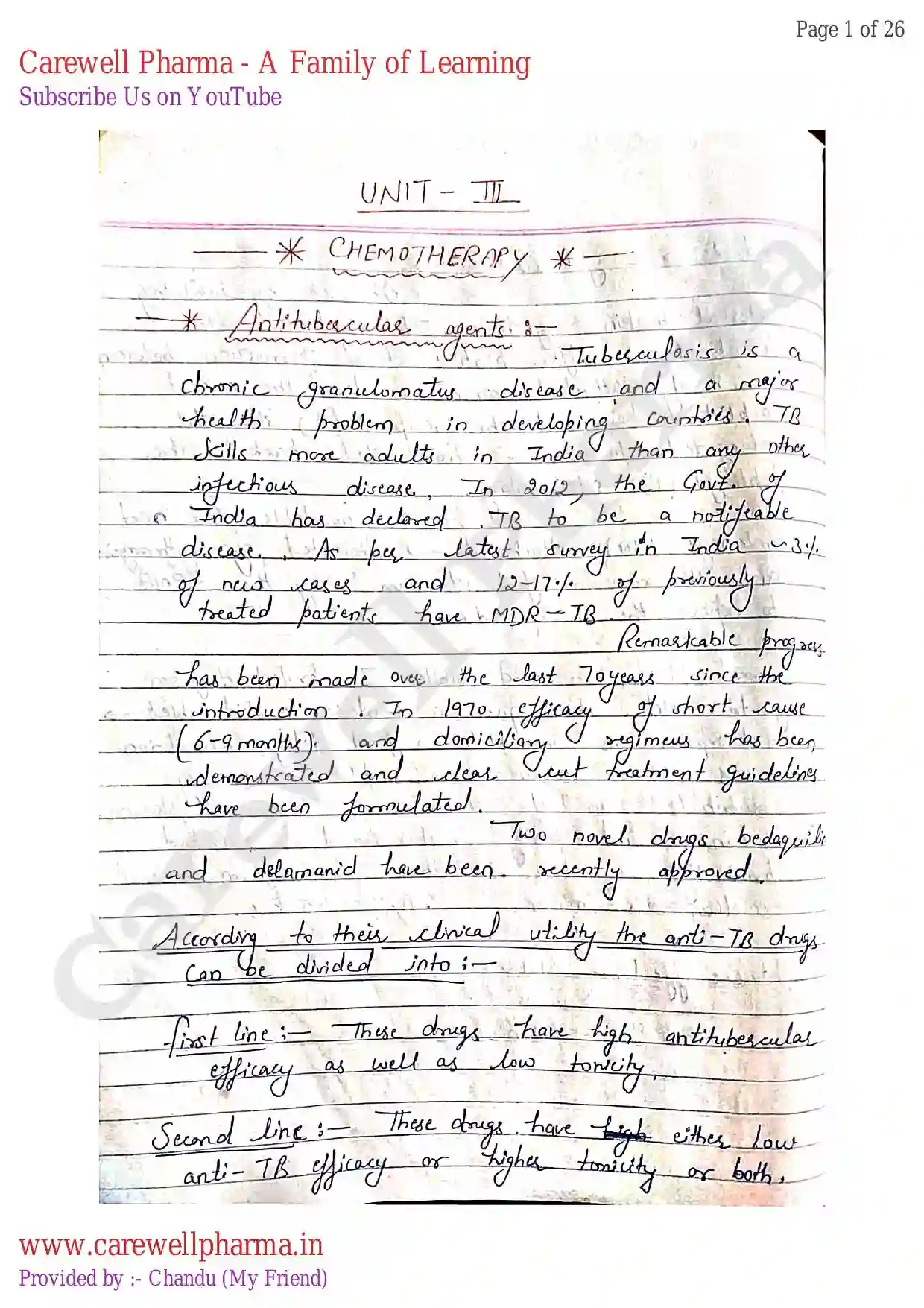
Antitubercular Agents
Tuberculosis is a chronic granulomatus disease and a major infectious health problem in developing Countries. TB kills more adults in India than any other disease. In 2012, the Govt. of India has declared TB to be a notifeable disease. As per latest survey in India ~3% of new cases and 12-17% of previously treated patients have MDR-TB.
Remarkable progres has been made over the last years since the introduction. In 1970. of short cause (6-9 months). Two novel domiciliary regimeus demonstrated and clear cut freatment guidelines have been formulated. and delaman'd have been recently
According to their clinical utility the anti-TB dngs Can be divided into -
- First Line: These drugs have high antitubercular efficacy as well as low tonicity.
- Second Line: These drugs have high either low anti-TB efficacy or higher tonicity or both,L
Classification of Anti-TB Drugs
| First Line Drugs | Second Line Drugs |
|---|---|
| Isoniazid | Fluoroquinolones |
| Rifampin | Ofloxacin |
| Pyrazinamide | Levofloxacin |
| Ethambutol | Moxifloxacin |
| Streptomycin | Ciprofloxacin |
M.O.A
Isoniazid → It is an excellent antitubercular ding, and an essential component of all antitubercular regimens unless the patient is not able to tolerate it or bacilli are resistant. It is primarily tuberculocidal. fast multiplying organisms are rapidly killed, but quiescent ones are only inhibited.
- The primary mechanism of action of INH is inhibition of synthesis of mycolic acids which are unique fatty acid components of mycobacteria cell wall.
- The lipid content of mycobacteria exposed to INH is enters a Catalase peroxidase enzyme into metabolite reduced. In mycobacteria which consist it adduct with NADP metabolite forme as well which inhibits mycobackrial DHFRase resulting in interruption of DNA synthesis.
Pharmacokinetics → Completely absorbed orally, perstr all body tissues, placenta, menings. Extensively metabolized in liver. Excreted in mine.
Interactions → Aluminium hydroxide inhibits INH absorption.
Adverse Effects → Well tolerated by mast patients. Mental disturbances, numbness, mental disturbons are the most important dare dependent toxic effects. Hepatitis, a major adverse effect of INH is rare in children but more comman in older people and in alcoholics.
Rifampicin → Semisynthetic derivative of rifampicin. obtained from streptomyces mediterranei. Against TB bacilli it is as Efficacious as INH and better than all other drugs.
M.O.A → Rifampicin inhibits DNA dependent RNA synthesis, Mycobacteria and other organisens develop resistance to rifampin rather rapidly.
It interrupts RNA binding to subunit of myobacterial DNA dependent RNA polymerase and act blocking its polymerizing function.
Pharmacokinetics → Well absorbed orally, widely distributed in the body, penetrates cavities, placenta and Excreted mainly in bile, some in urine also. Metabolized in liver, The is 2-5. has
Adverse Effect → Hepatitis, a major adverse effect occur in patients with preexisting liver disease Nausea, vomiting, abdominal cramps. breathlessness, haemolysis, Shock and renal failure,
Anti-Leprotic Drugs
Leprosy caused by Mycobacterium leprae. A chronic curable infectious disease mainly causing skin lesions and nerve damage mainly affects the skin, eyes, and peripheral nerves.
Classification of Antileprotic Drug
- Sulfone: Dapsone
- Phenazine derivatives: Clofazimine
- Anti TB drugs: Rifampin, Ethionamide
- Other Antibiotics: Ofloxacin, Moxifloxacin, Minocycline, Clarithromycin
Dapsone → It is diamino diphenylsulfone and most commonly used member of is Class.
Mechanism of Action → It is chemically related to sulfonamides and has same mechanism of action. Inhibition of PABA incorporation into folic acid by folate synthase. The antibacterial action is antagonised by PABA. It is leprostatic at very low concentration while arrested a bacterial growth at high concentration.
Dapsone is active against certain protozoa as well. combined with pyrimethamine for P. falciparum & Toxoplasma gondii infection. Anti-inflammatory property has been detected.
Pharmacokinetic → Dapsone is completely absorbed from intestine after oral administration and is widely distributed in the body peneration in Csf is poor. It is 70% bound to plasma protein. Metabolites are excreted in bile and reabsorbed excretion occurs mostly in urine Plasma is variable 24 hrs. or longer.
Adverse Effects → It is well tolerated at dase 100mg/day or less. Mild hemolytic anemia is common This is dose related Gastric intolerance - nausea and anorexia, headache, dry fever
Rifampin → Important tuberculocidal drug is also the important & most potent cidal drug for M. leprae upto 99.99% M. leprae are killed in 3-7 days by 600mg/day dose.
Moreover, it is not satisfactory if used alone. Rifampin has been included in the MDT of leprosy where by it shortens the duration of treatment, and prevents development of resistance.
Treatment of Lebrary → Leprosy is a chronic granulomatous injection caused by M. leprae primarily affecting skin and mucous membranes. In India, the National Leprosy Control Programme was launched in 1955, changed to National Leprosy Eradication Programme in 1982.
The operational simplicity WHO divided leprosy into:
1. Paucibacillary Leprosy (PBL) → Patient has less bacilli and is non infectious. It relexting tuberculoid tuberculoid and borderline
2. Multibacillary Leprosy (MBL) → Patient has large bacillary la fondatous and is Infectious. It borderline tuberculoid & borderline types.
MDT (Multidrug Therapy) of leprosy :-
- Rifampin 600mg once a month supervised
- Dapsone 100mg administered
- Clofazimine 300mg once a month supervised + 50mg administered 2 Months
Duration
- 2 months
- 6 months
Child Dose
- Rifampin : 10mg / kg once monthly.
- Clofazimine : 1mg daily 60mg dese once monthly
- Dapsone : 1-2mg kg daily.
Antifungal Drugs
These drugs are used for superficial and deep fungal infections. fungal infections are mostly associated with the use of broad spectrum antibiotics corticosteroids, anticancer drugs.
Many topical antifungal have been available Since the antiseptic era.
Two important antibiotics with systemic timyc amphotericin B-deal and grisefulvin lack on dermatophytes were introduced around 1960. to supplement
Classification of Antifungal Drugs
- Antibiotics
- Polyenes: Amphotericin B, Nystatin
- Heterocyclic Benzofuran: Griesofulvin
- Antimetabolites
- Azoles.
- Imidazoles (Topical): Clotrimazole, Econazole, Miconazole, Oxiconazole
- Imidazoles (Systemic): Ketoconazole
- Triazoles: Fluconazole, Itraconazole, Voriconazole, Posaconazole
- Allylamine
- Terbinafine
- Echinocandins
- Caspofungin
- Micafungin
- Anidulafungin
- Topical agents
- Tolnaftate
- Benzoic acid
- Butenafine
- Undecylenic acid
Polyene Antibiotics → The name derived from their highly double bonded Structure.
Amphotericin B → It is obtained from Streptomyces nodosus.
Mechanism of Action → Polyene antibiotics have high affinity for ergosterol present in fungal cell membrane. They combine with it, get inserted into the membrane and several polyene molecules to form micropore, The micropore is stabilized by membrane sterols which fill up the spaces b/w the AMB molecules. the lipophilic side constituting outer surface of the pore. Cell permeability is increased. Cholesterol present in host cell membranes
Pharmacokinetic → AMB is hot absorbed orally, but con given orally for intestinal. Administer i.v. as a suspension made with the help of deoxycholate (DOC), it gets widely distributed in body, but penetration in Csf is poor. It binds to sterols in tissues and to lipoproteins in plasma. It is slowly metabolized in liver. Excretion mostly in urine & bile both but urinary drug Concentration of active drug is low. is 15 days. About 60%
Adverse Effects → It consists of chills, fever, aches & pain, vomiting.
- Nephrotoxicity is the most important when use is for long term. Anemia, CNS toxicity.
Antiviral Drugs
Viruses are the ultimate-expression of obligate intracellular parasitism. They not only take nutrition from the host cell but also direct its metabolic machinery to synthesize new virus particles.
Drugs have been developed which target virus specific steps like cell penetration uncoating reverse transcription, virus assembly maturation and release from host cell.
Classifications of Antiviral Drugs
- Anti-herpes Virus Drugs: Idoxuridine, Trifluridine, Acyclovir, Valacyclovir, Famicyclovir, Ganciclovir, Foscarnet
- Anti-influenza Virus Drugs: Amantadine, Rimantadine, Oseltamivir, Zanamivir, Peramivir
- Anti-hepatitis Virus Drugs:
- For Hepatitis B: Lamivudine, Entecavir, Tenofovir, Telbivudine
- For Hepatitis C: Ribavirin, Interferon , Daclatasvir, Ledipasvir
- Anti-Herpes Virus Drugs → These are the drugs active against the herpes group of DNA viruses which include herpes simplex virus-1, Herpes simplex virus-2, Varicella-zoster virus, Epstein Barr virus.
i) Idoxuridine → It is 5-iodo-deoxyuridine, which acts as a thymidine analogue. It is the first pyrimidine antimetabolite to be used as antiviral drug. It completes with thymidine gets incorporated into viral DNA so that faulty DNA is formed which breaks down easily. Idoxuridine Effective only against DNA viruses and clinical utility is limited to topical treatment of herpes simplex keratitis.
ii) Acyclovir → This deoxyguanosine analogue requires a virus specific enzyme for conversion. to the active metabolite that inhibit DNA Synthesis & viral replication.
Acyclovir [herpes virus specific thymidine kinase] Acyclovir Mono-phosphate [Cellular kinase] Acyclovir triphosphate [inhibit herpes virus DNA polymerase]
Acyclovir triphosphate Competitively inhibit herpes virus DNA polymerase. Gets incorporated in viral DNA and stops lengthening of DNA strand. The terminated DNA inhibits DNA-polymerase irreversibly.
P'cokinetics → Only about 20% of an oral dose of acyclovir is absorbed. It is widely distributed attaining Csf conc. that is 50% of plasma conc. It is little plasma protein bound and is excreted unchanged in urine. Plasma is 2-3 hours.
Adverse Effect → Topical: stinging & burning sensation after each application.
Oral: The drug is well tolerated headache nausea and some CNS effects
Intravenous: Rashes, sweating, emesis and fall in BP occur.
Hallucinations, tremors etc. have been described to higher doses.
Uses
- Genital Herpes simplex
- Mucocutaneous H. simplex: remains localised to lips and gums
- H. simplex keratitis; used in superficial dendritic de corneal ulcer, and better for deep stromal infections because of good corneal penetration.
- Chickenpox
iii) Ribavirin → This purine nucleoside analogue that has broad spectrum antiviral activity against RNA & DNA virus including HCV, influenza A & B. mono & triphosphate derivatives generated intracellularly by host kinases inhibit GTP synthesis and viral RNA synthesis. Viral resistance to ribavirin is rare. Oral bioavailability of ribavirin is ~ 50%. It is partly metabolized & eliminated mainly by kidneys. is ~10 days.
Antiretrovirus Drugs
| Nucleoside Reverse Transcriptase inhibitors | Non-Nucleoside Reverse transcriptase inhibitors | Protease inhibitors |
|---|---|---|
| Zidovudine | Nevirapine | Ritonavir |
| Lamivudine | Efavirenz | Atazanavir |
| Stavudine | Delavirdine | Indinavir |
| Abacavir | Etravirine | Nelfinavir |
| Didanosine | Lopinavir | |
| Tenofovir | Darunavir |
- Entry inhibitor: Enfuvirtide
- CCR-5 Receptor inhibitor: Maraviroc
- Integrase inhibitor: Raltegravir, Dolutegravir.
- These are drugs active against human immuno deficiency virus (HIV) which is retrovirus. first anti-retrovius drug was made available for use in 1987.
Zidovudine → It is thymidine analogue the first prototype. After phosphorylation in the host cell - zidovudine triphosphate. Selectively inhibits Viral reverse transcriptase in reference to cellular DNA polymerase.
Single stranded viral RNA virus directed reverse transcriptase (inhibited by zidovudine triphosphate) Double stranded proviral DNA.
P'cokinetics → The oral bioavailability is ~65%. ~1hr). 15-20% of the unchanged drug along with metabolite excreted in urine. by hepatic glucuronidation. Crosses placenta & found in milk,
Adverse Effect → Anaemia. Neutropenia imp. dose related adverse effects Nausea, anorexia, abdominal pain, headache, insomnia.
Uses → It is used in HIV infected patients combination with atleast 2 other ARV drugs.
Anthelmintics drugs
Anthelmintics are drugs that either kill (vermicide) or expel (vermifuge) infecting helminths.
Helminthiasis is prevalent globally, but is more common in developing countries with poorer personal and environmental hygiene. In the human body, git is the abode of many helminths but some worm also live in tissues, or their larvae migrate into tissues.
Classifications
| for Round worm, hook worm, Pinworm | for whip worm | for tape worms |
|---|---|---|
| Albendazole | Albendazole | Praziquantel |
| Mebendazole | Mebendazole | Niclosamide |
| Piperazine | Albendazole | |
| Levamisole |
- for threadworm: Ivermectin, Albendazole
- for filariasis: Diethylcarbamazine, Ivermectin, Albendazole
- for hydatid disease: Albendazole, Mebendazole
i) Mebendazole → This benzimidazole introduced in 1972. It is congener of thiabendazole became very popular because it retained the broad spectrum anthelmintic activity but not the toxicity of its predecessor. Mebendazole has produced 100% cure rate / reduction in egg count in round worm. 75% cure has been reported in hook worm. About tapeworms, H. nana is relatively insensitive. It expels Trichinella spiralis from intestines, but efficacy in killing larvae that have migrated to muscles is uncertain.
The major site of action of mebendazole appears to be the microtubular protein '$\beta$-tubulin' of the parasite.
Mebendazole inhibiting microtubule synthesis. bind with \beta$-tubulin & inhibits polymerization $\rightarrow blocks glucose uptake in parasite. depletes glycogen stores.
It inhibits mitochondrial enzymes & depletes its glycogen stores. Hatching of nematode eggs and their larvae are also inhibited.
P'cokinetics → Absorption from intestine is minimal. 75-90% of an oral dose is passed in the faeces. The fraction absorbed is excreted mainly as inactive metabolites in urine / faeces.
Adverse Effects → It is well tolerated. Diarrhoea nausea and abdominal pain.. Expulsion of Ascaris from mouth or nose have occured probably due to starvation of the parasite and their slow death.
ii) Albendazole → It is subsequent introduced congener of mebendazole. Retains the broad spectrum activity. One dose treatment has produced which is comparable to 3 days treatment with mebendazole. A 3 days course has achieved nearly 50% cure and a second course repeated after 3 weeks cured practically all patients. 3 day treatment has been found necessary for tapeworms.
P'cokinetics → Absorption of albendazole after oral administration is significant but inconsistant. Absorption is enhanced when the drug is taken in with fatty meal. It is widely distributed in the body, enters brain and excreted in urine. is 8.5 hours. Thus, albendazole is able to exert antihelmintic activity in tissues as well.
Side Effects → Well tolerated. Only grist. side effects have been noted. few patients have felt dizziness, headache, fever, jaundice & neutropenia.
Uses → For intestinal worms it should be given on empty stomach
1. Ascaris hookworm : a single dose of 400mg is sufficient
2. Tapeworms & strongyloides: 400mg twice daily for 3 consecutive days.
3. Trichinosis
4.Cutaneous larvae migrans
Antimalarial Drugs
These are drugs used for prophylaxis, treatment and prevention of relapse of malaria.
Malaria caused by 4 species of the protozoal parasite. It is endemic in most parts of India and other tropical countries. It continues to be a major public health problem, mainly due to P. falciparum infection and its complications.
Classification of Antimalarial Drugs
- 4-aminoquinolines: Chloroquine, Amodiaquine, Piperaquine
- Quinoline methanol: Mefloquine
- Cinchona alkaloids: Quinine, Quinidine
- Diaminopyrimidines: Pyrimethamine
- Sulfonamides & Sulfones: Sulfadoxine, Sulfamethopyrazine, Dapsone
- Biguanides: Proguanil
- 8-aminoquinolines: Primaquine, Tafenoquine
- Antibiotics: Doxycycline, Clindamycin
- Sesquiterpene lactones: Artesunate, Artemether, Arteether, Arterolane
- Aminoalcohols: Halofantrine, Lumefantrine
- Napthoquine
- Napthyridine: Pyronaridine
- Atovaquone
Mechanism of Action → Chloroquine, Quinine, Mefloquine: It is rapidly acting erythrocytic Schizontocide against all species of plasmodia. Controls most clinical attacks in 1-2 days with disappearance of parasites from peripheral blood in 1-3 days.
Hemoglobin Globin utilized by malarial parasite.
Heme (Highly toxic for malarial parasite) [Heme Polymerase] Hemozoin (Non toxic to plasmodium)
(Chloroquine, Quinine, Mefloquine inhibit Heme Polymerase)
The parasite digests the host cells hemoglobin to obtain essential amino acids. Large amount of heme which is toxic to the parasite. To protect itself the parasite polymerizes heme to nontoxic hemozoin, which is sequestered in the parasite's food vacuole. Chloroquine prevents the polymerization to hemozoin. The accumulation of heme results in lysis of both the parasite and the RBC.
P'cokinetics → Oral absorption is excellent. About 50% gets bound in the plasma. Selective accumulation in retina is responsible for the ocular toxicity seen with prolonged use. Partly metabolized by liver and slowly excreted in urine, The early plasma varies from 3-10 days.
Adverse Effects → Nausea, vomiting, anorexia, itching, epigastric pain, headache. uncontrollable Can be used for treatment of malaria during pregnancy. No teratogenic or abortifacient effects have been reported.
Uses
- Extraintestinal amoebiasis
- Rheumatoid arthritis
- Lepra reaction.
Pyrimethamine + Sulfonamides → Sulfonamide & dapsone are not particularly effective antimalarial drugs in their own right have some inhibitory influence on the erythrocytic phase, especially of P. falciparum. They form supra-additive synergistic combination with pyrimethamine due to sequential block. Though both components are slow acting, the combination acts faster. So, it can be employed as clinical curative for P. falciparum.
As Clinical Curative → Sulfadoxine 1500mg + pyrimethamine 75mg (3 tab) single dose.
The major importance of sulfa-pyrimethamine combination is due to its efficacy against chloroquine-resistant P. falciparum. Sulfadoxine and Sulfamethopyrazine are ultra long acting sulfonamides.
Antiamoebic Drugs
These drugs are useful in infections caused by the anaerobic protozoa Entamoeba histolytica. Amoebiasis has a world wide distribution. It is endemic in most parts of the India. Amoebic cysts reaching the intestine transform into trophozoites which either live on the mucosa as commensals and form cysts that pass into the stools and serve to propagate the disease or invads the mucosa - form amoebic ulcers and cause acute dysentery.
Classification of Antiamoebic Drugs.
- Tissue amoebicides
- for intestinal + extraintestinal amoebiasis
- Nitroimidazole: Metronidazole, Tinidazole, Ornidazole
- Alkaloids: Emetine, Dehydroemetine
- for extra-intestinal amoebiasis only
- Chloroquine
- for intestinal + extraintestinal amoebiasis
- Luminal amoebicides
- Amides: Diloxanide furoate, Nitazoxanide
- 8-hydroxy-quinoline: Quiniodochlor, Diiodohydroxyquin
- Antibiotics: Tetracycline, Paromomycin
Metronidazole → It is the prototype nitroimidazole introduced in 1959 for trichomoniasis and later found to be a highly active amoebicide. It has broad spectrum cidal activity against anaerobic protozoa. Metronidazole is selectively toxic to anaerobic and microaerophilic microorganism.
Mechanism of Action
Pharmacokinetics → It is almost completely absorbed from the small intestine. little unabsorbed drug reaches the colon. It is widely distributed in the body. Metabolism occurs in liver by oxidation and glucuronide conjugation followed by renal excretion. Plasma is 8 hours.
Adverse Effects → Anorexia, nausea, metallic taste, dryness of mouth, itching, flushing, heat. peripherally neuropathy.
Uses
1. Amoebiasis Metronidazole is a first line drug for all forms of amoebic infection.
2. Giardiasis
3. Trichomonas vaginitis
4. Anaerobic infections