Pharmacology 3 - Unit 2
Syllabus
3. Chemotherapy
- General principles of chemotherapy.
- Sulfonamides and cotrimoxazole.
- Antibiotics- Penicillins, cephalosporins, chloramphenicol, macrolides, quinolones and fluoroquinolins, tetracycline and aminoglycosides
Scroll to Download
PHARMACOLOGY 3RD UNIT 2
CHEMOTHERAPY
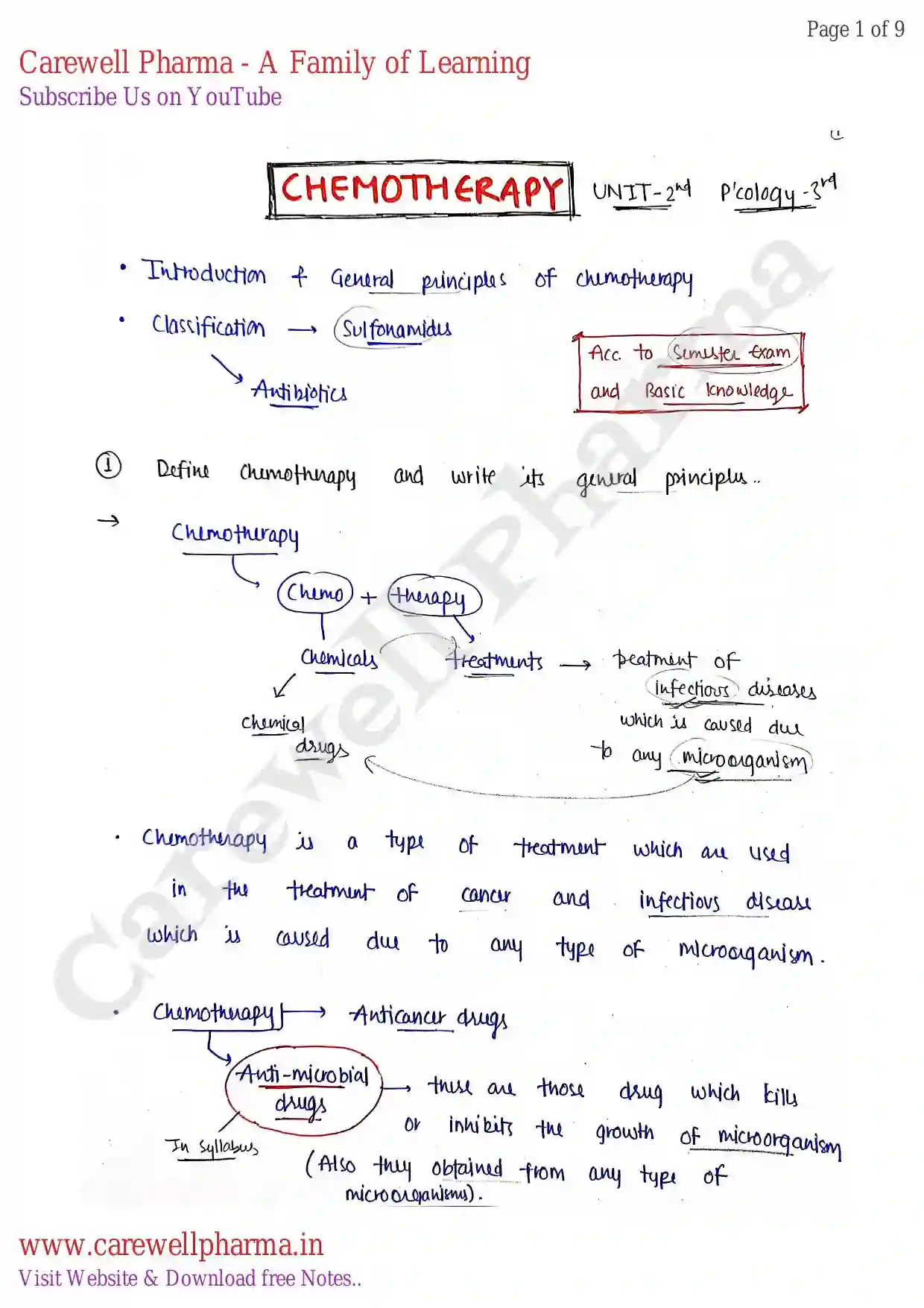
- Introduction & General principles of chemotherapy
- Classification - Sulfonamides Antibiotics
Acc. to Semester Exam and Basic knowledge
1. Define Chemotherapy and write its general principles
Chemotherapy - (Chemo) + therapy Chemicals or drugs + treatments beatment of infectious diseases which is caused due to any microorganism
Chemotherapy is a type of treatment which are used in the treatment of cancer and any type of infectious disease which is caused due to microorganism.
Chemotherapy → Anticancer drugs
Anti-microbial drugs - These are those drug which kills or inhibits the growth of microorganism (Also they obtained from any type of microorganisms).
Princple → Treatment of infectious disease by destroying microorganism with minimum affect/damage to host cells/patients.
History →
- The term "chemotherapy" was first coined byPaul Ehrlich.
- He known as the father of chemotherapy.
- He developed Arsenicals for sleeping sickness neoarsphenamine in 1906 for syphilis.
Classification of Antimicrobial Drugs / Chemotherapeutic Agents
- Sulfonamides and related drugs
- Antibiotics
Chemical Structure
- Acc to
- Sulfonamides eq. Sulfadiazine
- Quinolones eq. Norfloxacin, Ciprofloxacin
- \beta$-lactam antibiotica $\rightarrow eq. Penicillin, Cephalosporins
- Tetracyclines Oxyteracyclines, Doxycycline
- Aminoglycosides Sheptomycin, Neomycin
- Macrolides Erythromycin, Azithromycin
Type of organisms against which primarily active
- Antibacterial Penicillin, Aminoglycosides
- Antifungal Griseofulvin, Amphotericin B
- Antiviral Acyclovir, Zidovudine
- Antiprotozoal Chloroquine, Metronidazole
- Anthelmintic Mebendazole, Diethyl carbamazine
Spectrum of activity
- Narrow spectrum Penicillin, streptomycin, Erythromycin
- Broad spectrum Tetracyclines, chloramphini col
Type of Action
- Bacteriostatic Sulfonamides, Tetracyclines, chloramphenicols, Erythromycin, Clindamycin
- Bactericidal Penicillins, Aminoglycosides, Polypeptides, Rifampin, Isoniazid, Cephalosporins, floroquinolons, Metronidazole, Cotrimoxazole
Common Adverse Effects of Antimicrobial Agents
- Toxicity → Severe local & systemic toxicity
- Hypersensitivity → Skin rashis & allergic rxns.
- Drug Resistance → Unresponsive towards drugs
- Supra-infection → Appearance of new infection
- can cause Nausea, Vomiting, Headache ete..
2. Write a note on Sulfonamides and Cotrimoxazole.
Sulfonamide → It is first antimicrobial agents which is effective against pyrogenic bacterial infections. producing a produced by fever.
- In 1935, Gerhard Domagk discovered the first Sulfonamide Prontosil rubrum.
- Sulfonamides may be considered derivatives of sulfanilamide (p-aminobenzene sulfonamide). [Image description: Chemical structure of sulfanilamide, showing a benzene ring with an amino group ($-NH_2$) at the para position and a sulfonamide group ($-SO_2NH_2$) attached.]
- Sulfonamides are primarily bacteriostatic against many gram-positive and gram-negative bacteria. (broad)
Classification
Sulfonamides
- Short acting
- Sulfadiazine
- Intermediate acting
- Sulfamethoxazole
- Long acting
- Sulfadoxine
- Sulfamethopyrazine
- Special purpose
- Sulfacetamide sod.
- Sulfasalazin.
Mechanism (MOA)
They are basically bacteriostatic in nature (alone) which gives their action by inhibiting folic acid synthesis which is responsible for the synthesis of DNA & RNA and helps in the growth of bacteria.
PABA + Glutamate + Pteridine [Sulfonamide inhibits] folate synthase Dihydrofolic acid (DHF) [Cotrimoxazole inhibits] Dihydrofolate reductase Tetrahydrofolic acid (THF) $\downarrow$ DNA & RNA synthesis $\downarrow$ Growth of bacteria...
P'cokinetics
- Rapidly and nearly completely absorbed from git.
- Distribution (widely also in csf & placenta).
- Metabolism in liver. by non-microsomal enzymes
- Excretion by kidney / 10 hrs.
Adverse Reactions
- Nausea, vomiting and epigashic pain.
- Hypersensitivity rxns occurs in 2-5% patients.
- Rashes
Uses
- Meningitis (sulfadiazine)
- UTI (sulfamoxazou)
- Malaria
- Burns
- Ocular Infection.
Cotrimoxazole → It is the fixed dose combination of trimethoprim and Sulfamethoxazole.
- Trimethoprim is a bacterial antimalarial drug which inhibits dihydrofolate reductase (DHFRase).
- Individually, both sulfonamide and trimethoprim are bacteriostatic, but in combination it gives bactericidal action.
MOA
[Image description: Detailed pathway of Cotrimoxazole's MOA. PABA + Glutamate + Pteridine are converted by folate synthase into Dihydrofolic acid (DHF). Sulfamethoxazole inhibits ($\Theta$) folate synthase. DHF is normally converted by Dihydrofolate reductase into Tetrahydrofolic acid (THF). Trimethoprim inhibits ($\Theta$) Dihydrofolate reductase. THF normally leads to DNA & RNA synthesis. Cotrimoxazole (the combination of both) produces a bactericidal effect by blocking two sequential steps.]
ratio → Sulphamethoxazole : Trimethoprim → 5 : 1
(e.g., 400 mg : 80 mg = 480mg)
P'cokinetics
- It is mou rapidly absorbed than sulfamethoxazole.
- Trimethoprim (40%) + Sulfamethoxazole (65%) plasma protein bound..
- Partly metabolized in Liver
- Excreted in Urine
- 10hrs
Adverse Effects
- Nausea, vomiting, stomatitis, headache & rashish
- Folate deficiency (megaloblastic anemia).
- Should not be given during pregnancy.
Uses
- Bacterial diarrhoea
- UTIS (Urinary tract- infections)
- Typhoid
- GIT
- Respiratory bact infections.
3. Write a detailed not on Antibiotics.
(details Penicillins, Cephalosporins, Aminoglycosides, Quinolones, Macrolides, Tebacyclines, chloramphenicols)
Antibiotics → Thise are those agents which are used to kills or inhibits the growth of bacteria and they also Obtained from any type of microorganism.
eg. Penicillin (obtained from fungus) kills the Staphylococcus bacteria..
History → In 1928, Sir Alexander fleming accidently discovered the first antibiotic "Penicillin" by disboying the Staphylococcus in Culture plate
- Father of Chemotherapy Paul Ehrlich
- Speptomycin by selmon waksman 1943
- Cloramphenicol 1947
- Chlortetracycline 1948
- Neomycin 1949
- Erythromycin 1952
Classifications
Acc. to their action
- Bacteriostatic → Inhibits the growth of bacteria. eg. Tetracyclins
- Bactericidal → Kills the bacteria eq. Penicillin.
Acc to their spectrum
- Broad Spectrum → Wide range of actions eq. Tetracyclins.-
- Narrow Spectrum → Shat range of actions -