Physical Pharmaceutics 2 - Unit 4
Syllabus
Micromeretics: Particle size and distribution, mean particle size, number and weight distribution, particle number, methods for determining particle size by different methods, counting and separation method, particle shape, specific surface, methods for determining surface area, permeability, adsorption, derived properties of powders, porosity, packing arrangement, densities, bulkiness & flow properties.
Scroll to Download
PHYSICAL PHARMACEUTICS-2 UNIT 4TH
MICROMERETICS
Micromeretics
MOST IMPORTANT QUESTIONS
micro + Meretics Small particles like powders + to measure
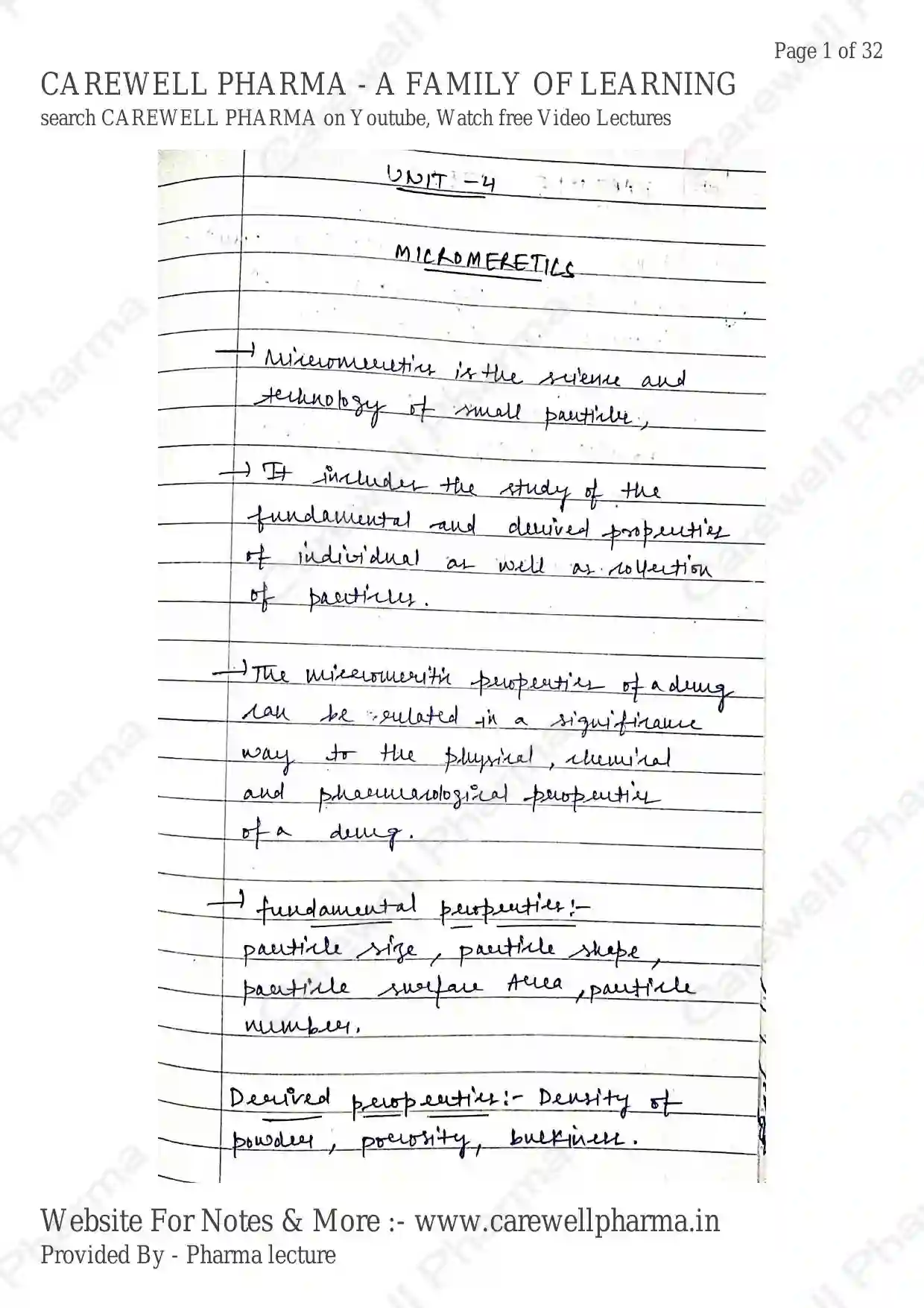
It is the study of the properties of small particles. Such as powders: It includes
- Particle size and distribution
- Shape and morphology
- Surface area and porosity
- Density and packing properties
- Flow and rheological properties.
It also involves in the analysis of these particles because these properties (eq. particle size) can Influence drug release from dosage form and its absorption.
Applications
- Release and dissolution
- Absorption
- Drug action
- Dose uniformity
- Stability
Methods of Determining Particle Size.
Particle size is the measurement or dimension of the particles. It can affects the drug absorption. size Absorption
- It can be determined by :-
- Optical microscopy
- Electron Microscopy
- Seiving method
- Sedimentation method / Anderson Pipette Apparatus.
- Coulter counter method
Anderson Pipette Apparatus
- It is used for the determination of the particle size by using sedimentation method.
Sedimentation : It is the process of settling down of solid particles to the bottom due to their large particle size & weight.
Principle : It is based on the principle of sedimentation, where particles settle down at different rates based on their size and (density). Smaller particles take longer to settle, while the larger particle settle faster.

- It is determined by stokes law
Construction :
- It consist of 10 ml pipette
- Sealed in a ground glass stopper
- 10 ml sample reservoir
- A valve to control the flow (stopcock)
- 550 ml beaker
- Three way trap

Working :
Firstly prepared 1% - 2% suspension by mixing powder with a liquid and also suitable deflocculating agents.
Now, pour this suspension into the reservoir.
Open the stopcock and allow the suspension to flow into the pipette.
After some time, particle will settle down according to their size and weight.
Withdraw a fixed volume of suspension from the pipette by using stopcock. (at regular intervals - usually 1-2 minutes).
Now evaporate these sample and weighed it, also determined its particle size. (Measured the turbidity values)
Repeate this for accuracy.
Particle size also measured by stoke's law.
,
where,
- settling
- particle size
- density medium
- particle density
- viscosity medium
Advantages
- Simple and easy to use
- Low costs
- Quick results
- Accurate particle size distribution
Limitation
- Only for range .
- Requires Calibration
- Not for very small or very large particles.
Derived Properties of Powders
- These are those properties which are derived from the physical and chemical properties of powders.
- It includes
- Density of Powders
- Flowability of Powders / flow properties
- Bulkiness
- Porosity
- Density of Powders : Density is the ratio of mass to its volume.
, where $m = \text{mass}$, .
Bulk Density :
- Mass per unit volume (including voids - untapped) $$\text{Bulk D.} = \frac{\text{Mass (untapped)}}{\text{Bulk volume}}$$
Tapped Density :
- It is the ratio of mass of tapped powder per unit volume (tapped volume) - no voids $$\text{Tapped D.} = \frac{\text{Mass (Tapped)}}{\text{Tapped Volume}}$$
True Density :
- Mass per unit volume of powder excluding void (only powder) $$\text{True D.} = \frac{\text{True mass}}{\text{True volume}}$$
- Flow Properties
- It is the ability of powder to flow free and smooth.
- It includes Angle of Repose, Carr's index, Hausner ratio.
Angle of Repose
It is the angle at which powder flow freely.
It is the maximum possible angle b/w the surface of pile of powder and the horizontal plane.
Where,
| Angle | flow property |
|---|---|
| excellent | |
| Good | |
| moderate flow | |
| poor flow |
Hausner Ratio :
Carr's index (%) :
| flowability | Hausner Ratio | Carr's Index (%) |
|---|---|---|
| Excellent | ||
| Good | ||
| fair | ||
| possible | ||
| Poor |
Bulkiness
It is the volume occupied by a unit mass of powder. including void spaces.
It is the inverse / reciprocal of bulk density.
Porosity
- It is the measurement of the voids / spaces in the particles / materials.

In percentage,