Physical Pharmaceutics 2 - Unit 2
Syllabus
* eology:** Newtonian systems, law of flow, kinematic viscosity, effect of temperature, non-Newtonian systems, pseudoplastic, dilatant, plastic, thixotropy, thixotropy in formulation, determination of viscosity, capillary, falling Sphere, rotational viscometers
Deformation of solids: Plastic and elastic deformation, Heckel equation, Stress, Strain, Elastic Modulus
Scroll to Download
PHYSICAL PHARMACEUTICS-2 UNIT-2nd
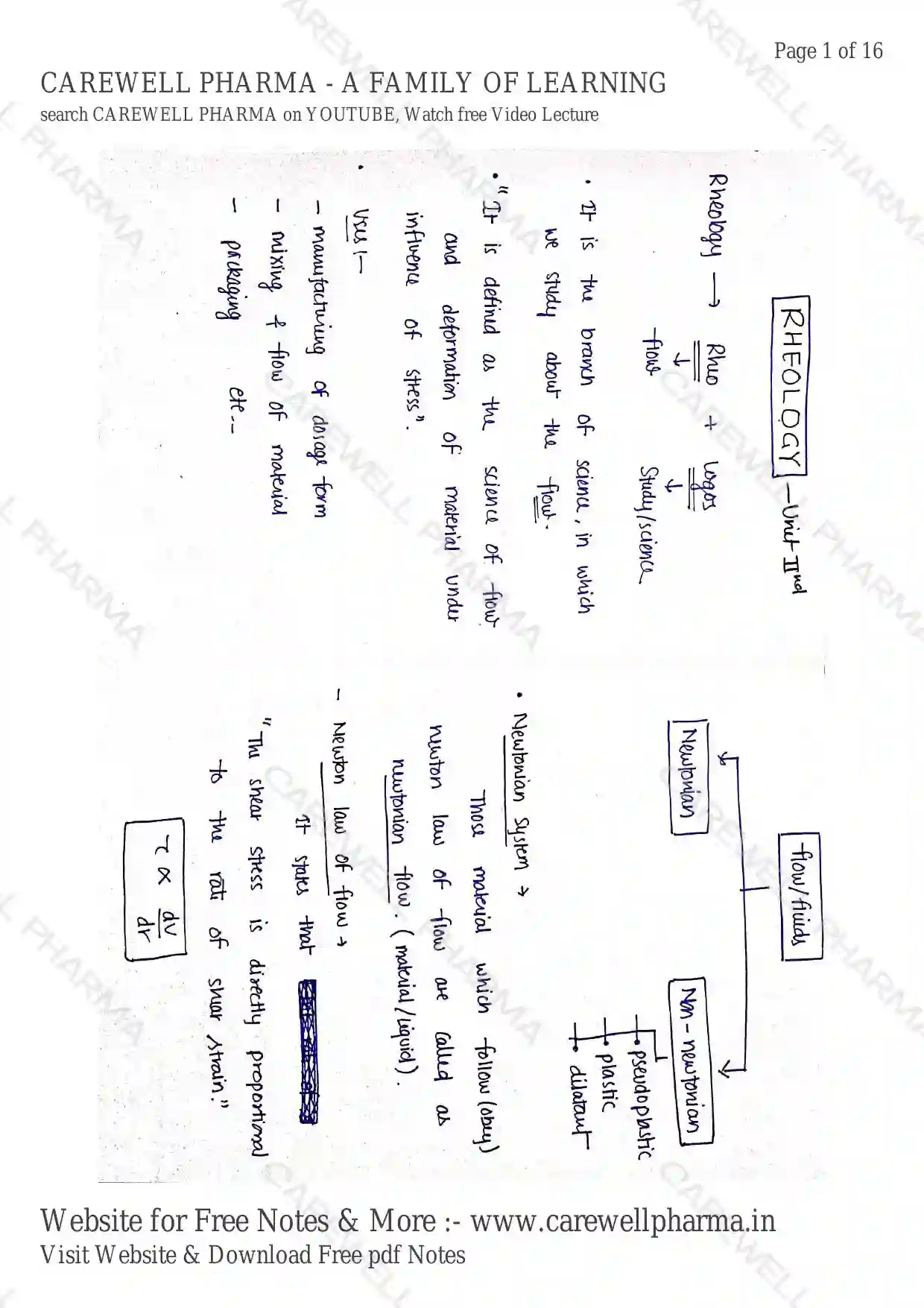
RHEOLOGY
Rheology Rheo (flow) Logos (Study/science)
- It is the branch of science, in which we study about the flow-
- "It is defined as the science of flow and deformation of material under influence of stress".
Uses
- manufacturing of dosage form
- mixing & flow of material
- packaging
- etc..
Flow/Fluids
- Newtonian System
- Non-newtonian
- Psedoplastic
- Plastic
- Dilatant
Newtonian System : Those material which follow (obey) newton law of flow are Called as newtonian flow. (material/Liquid).
Newton law of flow :
It states that
"The shear stress is directly proportional to the rate of shear strain."
where,

Rate of Shear Strain :
Defined as change in velocity ($dv$) b/w two planes (layer) of liquid which is separated by distance ($dr$).
[Image description: Velocity profile diagram showing and with planes and streamline/laminar flow]
Shear Stress : Ratio of shear force ($F$) to the cross sectional Area ($A$) required for flow.
Newton's law
Curve for newtonian fluids (system)

Eg. for newtonian fluids
- Water
- Benzene
- Ethyl alcohol
and the solutions of simple molecules etc....
Kinematic Viscosity :
It is the ratio of viscosity of fluid to its density.
- unit
Where,
- It is measure of the resistive flow of the fluid under influence gravity.
Effect of Temperature : Viscosity is highly dependent on temp. In case of Liquids.
Viscosity decreases with increases in temp.
Temp = Viscosity - for Liquids
| water | viscosity |
|---|---|
| at | 1.0016 mPas/s |
| at | 0.35 |
| at | 0.2822 |
In case of gases, viscosity increases with increases in temp.
Temp = Viscosity - for gases.
| Gases | |
|---|---|
| Oxygen | 2.04 |
| 3.76 |
Relationship curve b/w viscosity & temp for liquid & Gases

The relationship b/w temp. & viscosity is expressed by Arrhenius equ.
Where,
Non-newtonian System : Non-newtonian fluids (flow) are those, which does not follow newton law of flow.
- In which, shear stress and rate of shear is not constant. Viscosity is not constant.
Eg. Emulsion, Gel, Ointment etc....
Three types
i) Plastic
ii) Pseudoplastic
iii) Dilatant
i) Plastic Flow
- Those material/substance which follow plastic flow are called bingham bodies.
- In this flow, when we apply shear stress initially their are no change in shear strain (Rate of shear) until shear stress reached yield value.
- Yield Value : The amount of shear stress required to break the floccules is called yield value f.

- After yield value, they follow newton law of flow.
- Mathematically,

Acc. to newton law, Shear stress Rate of shear
, .
Eg: Flocculated system, suspension of zinc oxide in mineral oil etc-
ii) Pseudoplastic Flow :
In this flow,
"Viscosity decreases when we increase shear stress".
There are also change in rate of shear but not linear (constant rate).
Eg. Polymer (HPMC, CMC), Gum etc..

iii) Dilatant Flow : Those fluids in which,
"Viscosity Increases when we increase shear stress".
- The material returns to its state of fluidity when the shear is removed.
Eg. Suspensions, which contain more than 50% deflocculated particles.- Corn starch in water

- particles bunch up together & large voids develop & act as a solid
- viscosity curve: Called as shear thickening system.

Thixotropy : "It is defined as the isothermal and comparatively slow recovery of a system whose consistency is lost through shearing".
- This property exhibited by some non-newtonian pseudoplastic fluids.
- Because these fluids show change in viscosity when we apply shear on it.
Thixotropy
thixis stirring/shake Tropy change
- "It is defined as isothermal and comparatively slow recovery of a system whose consistency is lost through shearing".
- Thixotropy is a property exhibited by some non-newtonian pseudoplastic fluids.
Eg. Polymer (HPMC, CMC) in water (gel) . etc..

- Thixotropy in pseudoplastic system.
- Hysteresis loop :- It is the up and down curve of thixotropic system.

Negative Thixotropy : Also known as antithixotropy.
- In this thixotropy, viscosity of system is increased on applying shearing stress and when we remove shearing stress it regain its viscosity.
Eg: Flocculated system (suspension containing more number of deflocculated particles) which contain less floccules particles.
- In this thixotropy, viscosity of system is increased on applying shearing stress and when we remove shearing stress it regain its viscosity.
magnesia magma
Sol (Viscosity \downarrow$) $\xrightarrow{F} Gel (Viscosity \uparrow$) $\xrightarrow{-F} Sol (Viscosity $\downarrow$)
- Negative thixotropy Rheogram

Bulges : Substance which can swell in presence of water give a bulge.
Eg. Bentonite gel (magma) 10-15% w/v.
Spurs : In some highly structured thixotropic material, the bulged curve actually develop into spur. eg. procain penicillin gel for injection in 2% carboxymethyl cellulose sol^n).

- This value represents a (spur value) sharp point of structural breakdown at low shear rate.
Rheopexy : It is a phenomenon in which gel formation take place more readily when gently shaken or an regular movement.
Gel Sol Gel
Thixotropy in Formulation :
- A well formulated thixotropic suspension will not easily settle in the container and it will become fluid by shaking and easy to dispense.
- "Thixotropy is an important property in liquid pharmaceutical system."
- Greater the thixotropy, the higher is the physical stability.
- Rest during storage suspension become gel & more stable.
- Thixotropic properties eg. Creams, ointments, pouring of lotions from containers etc_ procaine penicillin G in water.
DETERMINATION OF VISCOSITY
i) Capillary viscometer
ii) Falling Sphere viscometer
iii) Rotational viscometer
Viscosity : It is an expression of the resistance of a fluid to flow under applied stress.
(Higher the viscosity greater the Resistance)
Viscometer : These are those devices or equipment, which is used to measure viscosity.
i) Capillary Viscometer : Ostwald viscometer is mostly used in capillary viscometer.
- Also known as U-tube viscometer.
- It is mostly used for newtonian fluids.
- Apparatus :
- It consist of U-shaped glass tube.
- consist 2 bulb.
- one suction tube will be apply on tube-2.

Method/Principle/Working
- Firstly viscometer is fixed to a stand in vertical position.
- Now, take one fluid (standard fluid) which we know thier viscosity and density.
- Filled this in bulb A through tube 1. (filled upto mark).
- Now suck this fluid (liquid) through tube 2 upto mark A of bulb B.
- Now, note the time taken (with the help of stop clock) to reach liquid at mark B from Mark A.
- Note down all reading and now clean the viscometer.
- Now, take another fluid (which we have to determine viscosity)
- Now do same as Liquid 1 (standard fluid) and note down all reading.
Formula
On re-arranging!- $\eta_1 = \frac{\rho_1 t_1}{\rho_2 t_2} \times \eta_2$
where,
put the value and determine (get) the viscosity.
ii) Falling Sphere Viscometer
- Also called as Hoeppler falling sphere viscometer.
- Based on the principle of stokes law.
- Apparatus
- Consist of a cylindrical glass tube, which is filled by test viscous liquid.
- Tube is enclosed by a constant temperature jacket In which water is circulate around the tube.

- A glass/steel ball.
- Method
- Firstly fill the test liquid in cylindrical glass tube.
- Maintain temperature constant.
- Now, allow the ball to fall down and record that time.
Formula
Where,
- Now put the value, & determine (get) the viscosity.
- More accurate, low time-consuming, etc_
iii) Rotational Viscometer
- These viscometer are used for both Newtonian and Non-newtonian fluids.
- It is of various type, we take most common viscometer for it.
Cone and Plate Viscometer : Also known as absolute viscometer.
- Apparatus
- It consist of flat stationary plate and a wide angle rotating cone is placed centrally above it.

Method
- The sample is placed at centre of stationary plate and then it is raised into the position under the cone.
- Now, the sample is sheared in narrow gap between stationary plate and rotating cone.
- Now, the rate of shear in rpm is increased or decreased.
- Torque is produce on the cone which is measured.
Formula
Where,
DEFORMATION OF SOLIDS
- Plastic and Elastic Deformation
- Heckel Equation
- Stress
- Strain
- Elastic Modules
Deformation : It is defined as change in the size and shape of an solid.

Strain : It is the deformation of solid which we get after applying shear stress. [Change in solid]. OR It is the measure of the amount of deformation.
External force (stress) Strain ($E$) =
Stress : It is a force which we applied on solid deform it.. OR It is the force per unit area that applied to an object to deform it. $\text{Stress } (\sigma) = \text{Force/Area}$

TYPES OF DEFORMATION
- Basically two types
i). Elastic Deformation
ii). Plastic Deformation
i) Elastic Deformation :
It is a reversible process.
When stress is applied, solid (material) get deformed but the material return to its original shape when force (stress) is removed.
eg. metals, rubbers and polymers etc.....
ii) Plastic Deformation :
- It is an irreversible process.
- When stress is applied, solid get deformed but the material does not return to its original shape when force is removed.
- Ability of metals to undergo plastic deformation is called ductility.
HECKEL EQUATION
- It is most useful method for estimating the volume reduction under the compression pressure in pharmacy.

- If follow (obey) first order kinetics, where the pores in the powder are the reactant, and the densification of the powder bed as the product.
Formula :
Where,
Porosity :
Where, $V_p = \text{Volume at any applied load}$ $V = \text{Volume at theoretical zero porosity}$
- Used to check porosity.
- Used for powder mixtures.
Heckel Plots : Density Vs Applied pressure
- It can be affected by the Time of compression, the degree of lubrication and the size of the die.

Elastic Modulus :
It is the ratio of stress to strain.
- The elastic modulus determines the amount of force (stress) required per unit deformation.

- A material with large elastic modulus have less deformation.
- A material with small elastic modulus have more deformation.