Physical Pharmaceutics 2 - Unit 1
Syllabus
Colloidal dispersions: Classification of dispersed systems & their general characteristics, size & shapes of colloidal particles, classification of colloids & comparative account of their general properties. Optical, kinetic & electrical properties. Effect of electrolytes, coacervation, peptization& protective action.
Scroll to Download
PHYSICAL PHARMACEUTICS IInd UNIT-Ist
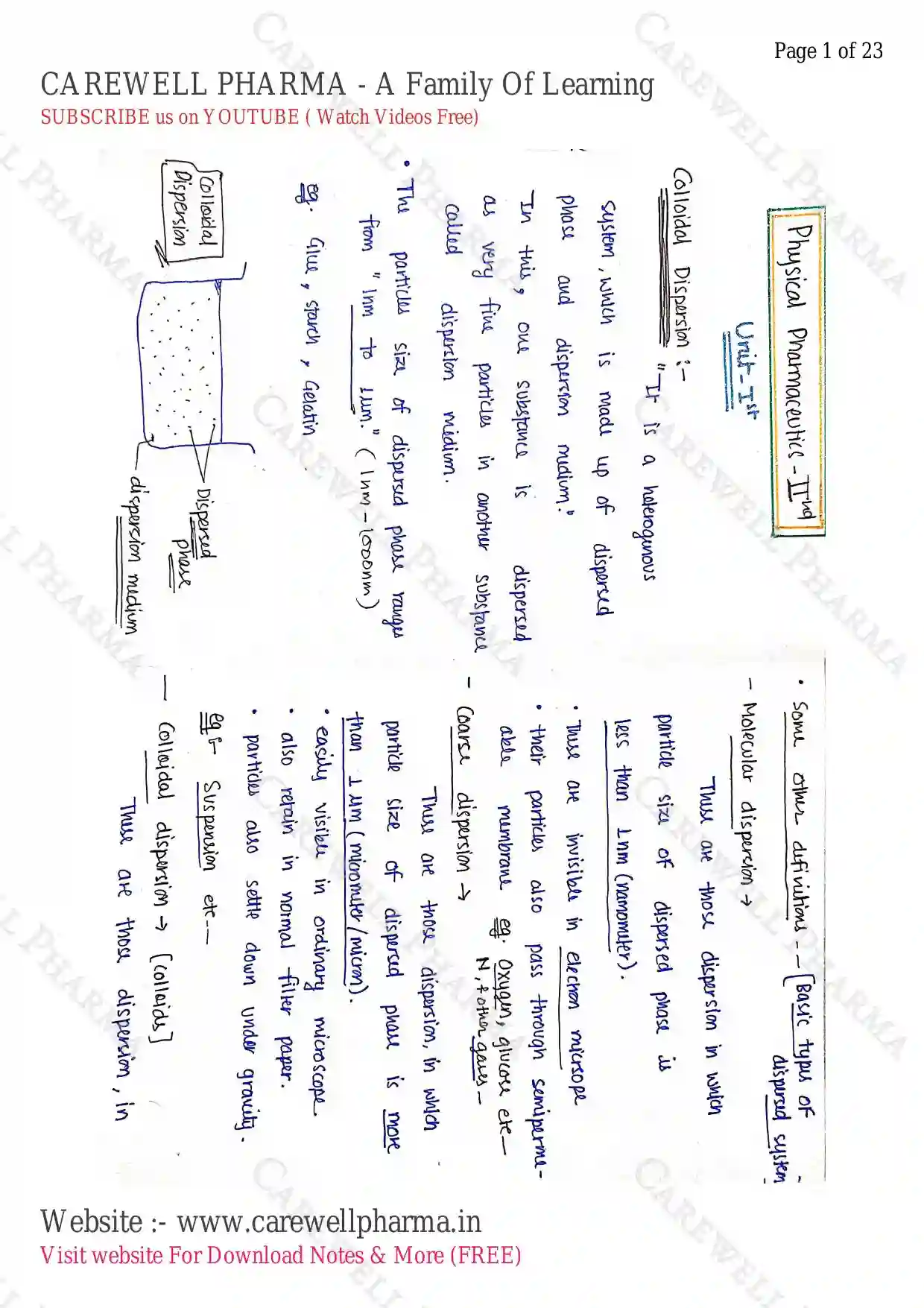
Colloidal Dispersion
"It is a heterogenous system, which is made up of dispersed phase and dispersion medium. In this, one substance is very fine particles in another substance called dispersion medium."
Basic types of dispersed system
- Molecular Dispersion : These are those dispersion in which particle size of dispersed phase is less than 1nm (nanometer).
- These are invisible in electron microscope.
- their particles also able to pass through semipermeable membrane.
Eg. Oxygen, glucose etc., & other gases.

- Coarse Dispersion : These are those dispersion, in which particle size of dispersed phase is more than 1 (micrometer/micron).
- easily visible in ordinary microscope.
- also retain in normal filter paper.
- particles also settle down under gravity.
Eg. Suspension etc.
- Colloidal Dispersion (colloids) : The particles size of dispersed phase ranges from "1nm to 1$\mu m$" (1nm - 1000nm).
- cannot visible in ordinary microscope, but can be seen through electron microscope.
- Pass through filter paper but not pass through semi permeable membrane.
- Eg. Milk, fog etc.
Classification of Dispersed System
On the basis of their dispersion phase & dispersion medium (Acc. to physical state).
- They are of Eight types:
| S.No. | Dispersed phase | Dispersion medium | Name | Examples |
|---|---|---|---|---|
| 1 | Solid (S) | Solid (S) | Solid sol | Colloidal gold |
| 2 | Liquid (L) | Solid (S) | Gels | wax, gels |
| 3 | Gas (G) | Solid (S) | Solid foam | foam, rubber |
| 4 | Solid (S) | Liquid (L) | Sols | Moist paints, proteins |
| 5 | Liquid (L) | Liquid (L) | Emulsions | Milk |
| 6 | Gas (G) | Liquid (L) | foam | Soap lather, Soda water |
| 7 | Solid (S) | Gas (G) | Aerosols of Solids | Smoke, Dust storm |
| 8 | Liquid (L) | Gas (G) | Aerosols of Liquid | fogs, clouds |
- Gas in Gas is not formed, because Gas mixed in gas homogeneously and colloidal dispersion are always heterogeneous.


General Characterstics of Dispersed System
| Properties | Molecular Dispersion | Colloidal Dispersion | Coarse Dispersion |
|---|---|---|---|
| Particle Size Range | less than 1nm | 1nm to 1000nm | more than 1$\mu m$ |
| Visibility | Invisible in Electron M. | Visible under Electron M. | Visible under Normal Microscope |
| Diffusion Rate | Rapid Diffusion | Very slow | Not diffuse |
| Separation | Not possible | through Semipermeable membrane | through filter paper |
| Settling of Particles | Not settle | Under centrifugation | Under gravity |
| Nature | Homogenous (True) | Heterogenous | Heterogenous |
| Appearance | Transparent | Opaque (cloudy) | Opaque (cloudy) |
| Tyndall Effect | Don't show | Show | Show |
| Brownian motion | Negligible | Show (occured) | May be / may not |
| Examples | Oxygen & other gases, Glucose solution etc. | Cheese, Butter, Jelly, paint, Natural and synthetic Polymers, Blood etc. | Suspension, Emulsion, blood cells, Grains of sand, mud etc. |
Size & shapes of colloidal properties
Particle size
Acc. to particle size, they are of three types
i) Molecular dispersion (less than 1nm)
ii) Colloidal dispersion (range between 1nm - 1000nm)
iii) Coarse dispersion (more than 1$\mu m$)
- Particle size influence the color of a dispersion. It is because wavelength of light is absorbed by particles.
- So, the larger the particle, shorter the wavelength transmitted.
Eg.
- Gold (Colloidal dispersion) Red colour
- Gold (coarse dispersion) Blue color
- Decreasing in particle size tend to increase Surface area & large surface area enhance solubility.
Particle Shapes
Shape of colloidal particles are depending upon method by which they are prepared and the type of interaction b/w dispersed phase with dispersion medium.
- They may be exists in cubical, spherical, cylinderical, disc & rod shaped, spiral thread.
- It visible in electron microscope and look like as:

- It also influenced the color of particles
- Eg. Gold (spherical shape) Red color,
Gold (Disc like shape) Blue color.
Classification of colloids & comparative account
Based on nature of interaction (affinity) b/w dispersed phase and dispersion medium three types
i) Lyophilic colloids
ii) Lyophobic colloids
iii) Association Colloids
i) Lyophilic Colloids :
- Also called as solvent loving colloids (Lyo Solvent, Philic Loving).
- These are those solution, in which the dispersed phase has great attraction for the dispersion medium.
Types:
- Hydrophilic: When dispersion medium is water. eg. Acacia, Albumin & Gelatin in water.
- Lipophilic: When dispersion medium is oil (other than water). eg. Rubber, Polystyrene in non-aqueous (eg. Benzene).
- These are thermodynamically stable (high stability).
- Viscosity of these sol^n generally increase on addition of dispersed phase.
ii) Lyophobic Colloids :
- Also termed as solvent hating colloids (Lyo Solvent, Phobic Hating).
- In which the dispersed phase has very less interaction (no affinity) for the dispersion medium.
- They are thermodynamically unstable (low stability).
- Viscosity of these sol^n does not increase on addition of dispersed phase.
- If the dispersion medium is water they also called as Hydrophobic Colloids. Metal such as Gold, Silver in water.
iii) Association Colloids :
- Also called as Amphiphilic colloids.
- Molecules/Ions have both polar and non-polar group.
- They exists separately at low concentration.
- They associate at CMC (critical micelle concentration) to form micelle of colloidal size.
- They are also thermodynamically stable.
- CMC (Critical micelle concentration) :
- The minimum concentration at which micelles are formed in water (as a dispersion medium).

- These amphiphiles also known as surfactants.
- Viscosity increases with addition of amphiphiles.
Comparative account of their general properties
| S.No. | Features / properties | Lyophilic Colloids | Lyophobic colloids | Association Colloids |
|---|---|---|---|---|
| 1 | Nature of Interaction | strong, high affinity | Little affinity (very low) | Depend on type of dispersion medium |
| 2 | Dispersed phase | Mostly Organic molecules | Mostly inorganic | Aggregation of surfactants |
| 3 | Size | Small | large | Small |
| 4 | Viscosity | increased | Same as dispersion medium | increased |
| 5 | Reversibility profile | Reversible | Irreversible | Reversible |
| 6 | Stability | Stable high | Less stable | Stable |
| 7 | Method of preparation | Simple & Easy | Special method Required | Depends on CMC |
Optical, kinetic & Electrical Properties
1). Optical Properties
2). Kinetic Properties
3). Electric Properties
1) Optical Properties of Colloids
These properties helps to known about size, shape, structure & molecular weight of colloids.
These are followings
i. Tyndall Effects [Light Scattering].
ii. Ultramicroscopy
iii. Electron Microscopy
iv. Turbidity
i) Tyndall Effects : When a beam of Light is passed through a colloidal solution (dispersion) kept in dark, the path of the beam get illuminated with blue color.
This phenomena is known as tyndall effect and path is known as tyndall cone .
- The tyndall effect is due to the scattering of Light by colloidal particles. eg. Milk.

- True (Homogeneous) solution does not show this, they have small particle size.
- Heterogeneous [colloidal] dispersion show this.
- Lyophobic show more, Lyophilic show less (no effect).
ii) Ultramicroscopy : When a intense light beam is passed through the sol (colloidal dispersion) against a dark background at right angles to the plane of observation.
The particles will appear as the bright spot which can be observed and counted.

iii) Electron Microscopy :
- It give actual picture of the colloidal particles.
- High energy electron beam are passed, it is used to observe the size, shape and structure of colloid particle.
- Useful in lyophilic.
iv) Turbidity : All colloidal dispersion show turbidity according to molecular weight of colloids particles. Spectrophotometer are used to check this.
Turbidity Molecular weight.
2) Kinetic Properties of Colloids
These properties helps to known about the motion of colloidal particles in dispersion.
i) Brownian Movement (motion)
- It is the zig-zag motion of colloidal particles in colloidal dispersion in continuously random manner.
- It is given by scientist Robert Brown. Particles continous strike to each other and to the wall of container.
- velocity 1 / particle size .
- Brownian movement Stability .
ii) Diffusion :
- It is the movement of particles from an area of higher concentration to the area of lower concentration.
- It is based on Fick's first law, that particles diffuse continuously until equilibrium is reached.
iii) Sedimentation :
- It is the settling down of dispersed phase particles into dispersion medium due to gravity.
- It is depends upon mol. weight of colloidal particles (Mol. weight = sedimentation $\uparrow$).
- It is also depends upon the density difference of dispersion phase to the dispersion medium.
iv) Viscosity :
- It is the resistance to fluid flow under an applied stress.
- It is depend upon shape,
- size, molecular weight
- Interaction b/w dispersed phase and dispersion medium.
- Molecular weight viscosity.
- Einstein describe an eq^n of flow to dilute colloidal dispersions of spherical particles: where, = viscosity of dispersion medium = viscosity of dispersion = volume fraction.
3) Electrical properties of colloids
These properties helps to known about the charge on colloidal particles in dispersion (colloidal dispersion).
i. Electrophoresis
ii. Electrical double layer
i) Electrophoresis : When an electric field is applied on colloidal dispersion, then the particles carrying charged move towards opposite charge electrode i.e.
- Negative charged particle move towards anode (kaoline, Sulphur).
- Positive (+) ve charged particle move towards cathode (ferric Hydroxide).

ii) Electrical Double Layer :
- Helmholtz explain it in 1879.
- In this theory, at the first layer charge is imparted to the surface of particles which is immovable also known as static layer [or helmholtz layer]. and the second layer consists of diffused mobile ions (acc. to first layer).
- The charge develop (present) on both the layer are equal.
- The potential difference between two layer i.e static and diffuse layer is called as zeta potential or Electrokinetic potential.

Stability of Colloids
- Effect of electrolytes
- Coacervation
- Peptization
- Protective action
1) Effect of Electrolytes
- On addition or removal of electrolyte in dispersion may affect the stability of colloids.
- On addition of excess of electrolytes, particles of colloidal dispersion precipitate due to accumulation of oppositely charged particles.[stability decreases]

- Hardy Schulze Law (rule) : The phenomena of deposition of colloid particles when oppositely charged electrolyte on it. [stability decreases].

- But If we add same charged particles then particles and electrolytes repel each other and Increase stability of colloidal dispersion.

2) Coacervation :
- When two opposite charged hydrophilic colloids are mixed, then there will be separation of the colloid rich layer.
- The colloid-rich layer is known as coacervate. The phenomena is called coacervation.

3) Peptization :
- It is used for the formation of stable colloidal dispersion.
- "It is the process of converting a precipitate into colloidal dispersion by shaking it with a dispersion medium in the presence of small amount of electrolyte/peptizing agents."

4) Protective Action :
The addition of lyophilic colloidal into a lyophobic colloidal solution prevents a lyophobic sol from coagulation.
This phenomena is known as protective action and the lyophilic colloid used for this purpose is known as protective colloids.
- Mechanism : When lyophilic colloid added to a lyophobic colloid, the particles of lyophilic cover the surface of lyophobic particles and behave as protective colloids.

- Gold Number : the amount of protective colloids in mg, which prevents the coagulation of Gold solution (10 ml) when 1ml of 10% NaCl added to it.