Pharmacology 1 - Unit 2
Syllabus
General Pharmacology
- Pharmacodynamics- Principles and mechanisms of drug action. Receptor theories and classification of receptors, regulation of receptors. drug receptors interactions signal transduction mechanisms, G-protein-coupled receptors, ion channel receptor, transmembrane enzyme linked receptors, transmembrane JAK-STAT binding receptor and receptors that regulate transcription factors, dose response relationship, therapeutic index, combined effects of drugs and factors modifying drug action.
- Adverse drug reactions.
- Drug interactions (pharmacokinetic and pharmacodynamic)
- Drug discovery and clinical evaluation of new drugs -Drug discovery phase, preclinical evaluation phase, clinical trial phase, phases of clinical trials and pharmacovigilance.
Scroll to Download
Pharmacology-I
Pharmacodynamics
Unit-1st
Pharmacology
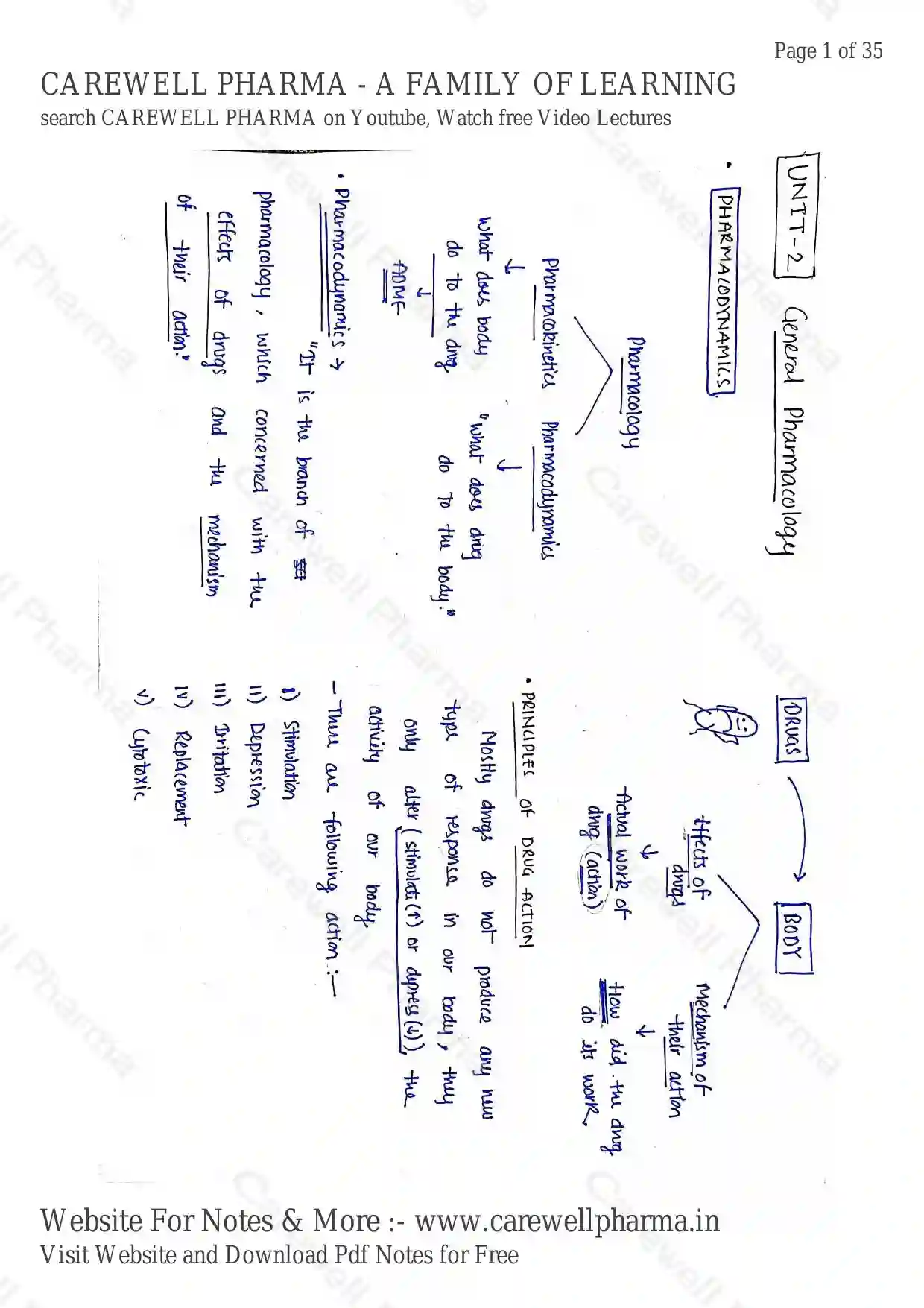
- Pharmacokinetics What does body do to the drug ADME
- Pharmacodynamics "what does drug do to the body."
- Pharmacodynamics "It is the branch of pharmacology, which concerned with the effects of drugs and the mechanism of their action."

PRINCIPLES OF DRUG ACTION
Mostly drugs do not produce any new type of response in our body, they only alter stimulate or depress , the activity of our body.
There are following action :
- Stimulation
- Depression
- Irritation
- Replacement
- Cytotoxic
1) Stimulation It refers to selective enhancement of the level of activity in our body.
eg :
- Adrenaline stimulates Heart
- Caffeine stimulates CNS
Excessive stimulation causes depression.
2) Depression (diminution) It refers to selective decrease ($\downarrow$) of the level of activity in our body. eg
- Quinidine depressed Heart
- Barbiturates depress CNS
There are also some drugs, which has both properties (stimulate one activity & depress another)
3) Irritation This is a non-selective, often harmful effect and especially applicable to less specific cells. results in inflammation, swelling, necrosis etc.
eg: Balm etc.
4) Replacement When our body fail to produce their original response (activity) by secreting chemicals, hormones, enzymes etc..
Then some drugs are given in our body which makes up this deficiency.
eg:
- Insulin in diabetes mellitus
- Iron in anaemia etc..
5) Cytotoxic action It refers to kill of cells which cause disease in our body without affecting the host cells.
eg. penicilline (antibiotics) etc.. anticancer drugs.
Mechanism of drug Action
How any drugs produce their effect or action is know as mechanism of drug action.
- There are only some drugs which produce their effect/action by virtue of their simple physical or chemical properties.
eg: laxatives (ispaghula)
Antacid (neutralization of gastric HCl).
- Most of the drugs produce their effect (action) by interacting with target biomolecules (proteins).
- Enzymes
- Ion Channels
- Transporters
- Receptors
1). Enzymes
- Almost all biological reactions are carried out under catalytic influences of enzymes.
- So, when drug interact with enzymes it can either increase or decrease the rate of enzyme activity and also the biological activity.

Enzyme induction When drug bind with enzyme and increase its activity is known as enzyme induction.
Enzyme inhibitor When any drug decrease the activity of enzyme is known as enzyme inhibition (inhibitors).
- Competitive (structurally same as substrate so fight for same binding sites)
- Non-competitive (it decrease the enzyme activity by binding with adjacent site or allosteric site).
2) Ion Channels
- Their are many ion channels in our body which helps transmembrane signaling and regulate intracellular ionic composition.
- Drugs can affect ion channels.
- Drugs can also affect ion movement by directly binding on channel.

eg. Quinidine blocks myocardial channel.
Some channels are Receptors and drugs also affect these channels.
- ligands gated channels
- G-protein regulated channels etc..
3) Transporters Several substrates are move across membrane by binding to specific transporter (through facilitate diffusion).
- Many drugs affects this, they interact with solute carrier and inhibit the movement of metabolite/ion (substrate).

eg. Amphetamines selectively block dopamine reuptake in brain neurons by dopamine transporter (DAT).
4) Receptors Receptors are proteins or binding site which present on surface and inside the cells, drugs bind with it activate it and give its pharmacological response.

- Agonist An agent which activate receptor to produce effects. (drugs receptor)
- Antagonist An agent which inhibit the action of agonist. (Competitive, Non-competitive)
- Inverse agonist activate receptor but opposite action (effect).
Receptor theories
Drug + Receptor Drug-Receptor complex Effect (Response)
- there are following some rec theories:-
- Induced fit theory
- Occupation theory
- Rate theory
- Two state model
1) Induced fit theory
- It is based on "lock and key" concept.
- When drug mutually fit in the receptor is then gives its pharmacological action (biological effects).
- Aganist induces full response.
- Antagonist does not induce any response.
- Partial aganist induces partial response.

2) Occupation theory
According to this theory, pharmacological response is depend on that how much drug occupied the receptor
Pharmacological effect of drug No. of Receptor occupied.
- Maximum response occurs when all the receptors are occupied.
3) Rate theory
According to this theory, The response is proportional to the rate of drug-receptor formation.
Pharmacological effect of drugs Formation of Drug-Receptor Complex.
- The more drug bind with receptors, the more receptor will be activated.
4) The two state receptor model
The receptor is present in two states - Ra (Active) and Ri (Inactive) and also in equilibrium.
- Now drug bind with these receptor and give its receptor.
Regulation of receptors
Maintain the homeostatic of receptors.
- Up-Regulation: + Activation, + Deactivation, + Destruction, + Manufacturing.
- Down-Regulation
1) Up Regulation
- There are increasement in sensitivity of receptors.
- Increase in the number of receptors on the surface of target cells.
- Increases of cellular components.
- Due to:- prolonged use of antagonists Drug effects .
2) Down Regulation
- there are decreasement in sensitivity of receptors.

DRUG RECEPTOR INTERACTIONS
"The drug bind with receptor" is know as drug-receptor interaction.

Drug is of different types on the basis of their action -
- Agonist Response
- Antagonist NO Response
- Partial agonist partial (low) response
- Inverse agonist opposite response
Classification of Receptors
- G-protein-coupled receptor
- Ion channel receptor
- Enzyme linked receptor
- JAK-STAT binding receptor
- Receptor that regulate transcription factors.
SIGNAL TRANSDUCTION MECHANISM
It is the mechanism pathway by which receptor's activation is linked to the response.
eg: Muscarinic cholinergic receptor acts through G-protein, while Nicotinic gates influx of ions. etc..
The transducer mechanism can be grouped into 5 major categories and also a receptor types:-
- G-protein-couple receptors - very imp.
- Ion channel receptors
- Transmembrane enzyme linked receptor
- Transmembrane JAK-STAT binding receptor
- Receptor that regulate transcription factor.
GPCR - G-Protein Couple Receptor
- Also known as
- Hepta helical Receptor
- 7-transmembrane Receptor
- Metabotropic Receptor
- G-protein = Guanine nucleotide-binding proteins.
- These are the cell surface receptors.
- It constitute a large protein family of receptors that sense molecules (ligands) outside the cell (extracellular) and activate inside transduction pathway and give responses.

- It has 7 $\alpha$-helical membrane which has 3 intracellular and 3 extracellular loops.
- G-protein present in trimeric complex form ($\alpha, \beta, \gamma$), in which GDP is attached on (alpha).
- The G-protein float in the membrane with their exposed domain lying in the cytosol.
Mechanism
Drugs (Agonist) bind Current flow through with receptor loops GTP replace GDP Activate G-protein Breakdown of trimers (The pathway splits into two branches)
Left Branch: Activate Effector enzymes
- Adenylyl cyclase
- Phospholipase C
Right Branch: dimers
Ion channel Regulation

Types
i) Gs Adenylyl cyclase Action, channel opening
ii) Gi Adenylyl cyclase inhibition, channel opening
iii) Go channel inhibition
iv) Gq Phospholipase C activation.
The GPCR produce their action by three pathways:-
i) cAMP (cyclic AMP) pathway (Adenylyl cyclase)
ii) IP3-DAG pathway (Phospholipase C).
iii) Channel Regulation.
i) cAMP pathway
- Activated by
- Inhibited by
- After activation of AC, Adenylyl cyclase (AC) convert ATP into cAMP, which further activate protein kinase (Pka) enzyme also known as cAMP-dependent protein kinase, then Pka phosphorylates and alter the function of many enzymes, ion channel etc -
- function increased cardia contractility LASH (Liver, Adipose tissue, Smooth muscles, Heart & kidney) relaxation in smooth muscles, Glycogenolysis, Lipolysis, release of hormones etc.. open channel in heart, brain etc.
ii) IP3-DAG pathway (Phospholipase C)
- Activated by
- Phospholipase C (PLC) Convert into &
- Phosphatidyl inositol 4,5-biphosphate
- Inositol 1,4,5-triphosphate
- Diacylglycerol
- activate Pkc (Protein kinase C)

iii) Channel regulation
- Activated by
- Activated G-protein can open channel movement of ions.
- open channel in myocardium
- & open channel in heart & smooth muscles
- Responses such as transmitter release, smooth muscle relaxation, inotropy, chronotropy, etc
Ion Channel Receptor
- Also known as Ligand gated ion channel.
- These are cell surface receptors.
- Ion selective channel for or .
Mechanism
- Drug (Agonist) bind with ion channel and open the channel
- Ion move inside the cytosol (intracellular)
- Changes in ionic composition
- Responses such as depolarisation/hyper polarisation.
- Receptor includes in this category Nicotinic cholinergic, , etc...

- In these receptors the agonist directly operates ion channel (no requirement of secondary messenger)
- The onset and offset of responses through this class of receptors is the fastest (in milliseconds).
Transmebrane enzyme linked receptors
- These are plasma membrane receptors
- Made up of single transmembrane chain, which has ligand binding domain in extracellular and 'Receptor tyrosine kinases' (RTKs) intracellular as a catalytic site with enzymatic property.

- Mostly peptide hormone are bind with receptor as a ligands.
- When no ligands bind, Receptors are in monomeric state and 'Receptor tyrosine kinases' (RTKs) are in inactive form.
Mechanism
Ligand bind with receptor (Hormone bind) monomeric receptors move laterally in the membrane and form dimers. Dimerisation activates RTKs RTKs activity of the intracellular domain Autophosphorylate tyrosine Residue on each other Increase affinity for protein Protein bind on RTKs Cellular Responses.

Transmembrane Jak-Stat Binding Receptor
- Similar as RTK's receptor, but they do not having any catalytic domain.

Mechanism
- Agonist binds and induced dimerization
- which alter the intracellular domain conformation to increase its affinity for a cytosolic tyrosine protein kinase JAK (Janus kinase).
- On binding, JAK gets activated and phosphorylate tyrosine residues of the receptor.
- STAT which now bind another free moving protein STAT (Signal transducer and activator of transcription) which is also phosphorylated by JAK.
- Pair of phosphorylated STAT dimerize
- Translocate to the nucleus to regulate gene transcription
- Biological Responses

Receptor Regulating Gene Expression.
- These are intracellular receptor which are present inside the cell
- They contain soluble protein which responds to lipid soluble chemical messengers that penetrates the cell.
- The receptor protein is inherently capable of binding to specific gene, but it attached proteins HSP-90 or any others to prevent it from adopting the configuration needed for Binding to DNA.
Mechanism
- Hormone binds near the carboxy terminus of the receptor.
- the restricting proteins (HSP-90) are released
- The receptor dimerizes and the DNA binding regulatory segment folds into requisite necessary conformation for regulation.
- The liganded receptor dimer moves to the nucleus and bind other co-activator/co-repressor proteins (which have capacity to alter gene function)
- The whole complex then attaches to specific DNA sequences of the target genes and facilitates or repress their expression.
- (Transcription) Specific mRNA is synthesized or repressed on the template of the gene
- Synthesis of specific protein
- Regulate activity of target cells

- All Steroidal hormone (Glucocorticoids, mineralocorticoids, androgens, estrogens, progestrone), thyroxine, vit D and vit A function in this manner.
DOSE RESPONSE RELATIONSHIP
Dose
The quantitative amount of drug which required for produce effect in body, which is taken by a patient at a time.
eg: Dolo 650 mg, Brufen 200mg, Disprin Acetylsalicylic acid (325 mg). Dose = खुराक.
Response
The effect produck by the drug in body is knonw as the response of that drug (Drug Responses).
Generally, the responses increases with increases in dose.
Dose Response.
Dose Response Relationship
It has two components
i) Dose-plasma concentration relationship.
ii) Plasma concentration-response relationship.
i) Dose-plasma when drug reaches into blood plasma. the more drug administrated systematically the more dose reaches into plasma concentration.
Dose plasma concentration.
ii) Plasma-Response Response: The effect produce by the drug in body is known as the Response of that drug (Drug's Response).
- Generally, the responses increases with increases in dose.
- As much as plasma concentration of drug is increased their response will also be increased. Plasma Response.
Dose PLASMA CONCENTRATION RESPONSE (Dose Response)
- Generally, the intensity of response increases with increases in dose and the dose-response curve is a rectangular hyperbola.
- The drug receptor dose-response interaction obey law of mass action:-
where, $E =$ observed effect $D =$ Dose $E_{max} =$ maximal response $K_D =$ dissociation constant (equal to the dose at which half maximal response is produced).
DRC (DOSE RESPONSE CURVE)
When a graph (curve) plotted for dose-response relation in which dose is plotted on X-axis and response is plotted on Y-axis, is known as dose response curve or DRC.

- If the dose is plotted on a logarithmic scale, the curve become sigmoid and the response is seen in the intermediate (30-70% response) zone.
- Response is proportional to an exponential function of the dose [log-dose].
- In which 100% fractional change in the former case but only 10% change in the latter case.
- Sigmoid curve has three phase i) lag phase (initially very low response) ii) Exponential log phase (fast response) iii) stationary phase (stunted).
Log-Dose-response curve is better than dose-response curve
- A wide range of drug doses can be easily display on graph.
- Comparison b/w agonist and study of antagonists become easier.
Drug potency
The amount of drug needed to produce a certain response (which is maximum and also safe).
Drug Efficacy
Maximum response produced by a drug.
eg 10 mg of morphine = 100 mg of pethidine (as analgesic).
- morphine is 10 times more potent than pethidine.
- morphine is more efficacious than Aspirin.
THERAPEUTIC INDEX
The ratio of the dose that produces a toxic (Lethal) effect to the desired therapeutic effect.
OR $$\text{Therapeutic index} = \frac{LD_{50}}{ED_{50}}$$
where $LD_{50} =$ That dose which kills 50% recipients (animals). $ED_{50} =$ That dose which produced specified effect and cured 50% individuals.
- It helps to decide the dose for patient of any drug (which is maximum effects with minimum side effects).
- "Therapeutic index is a quantitative measurement of the relative safety of a drug."

COMBINED EFFECTS OF DRUGS
When two or more drugs given in combination, then they either increase or decrease the effect of the drugs.
- divided into two parts :
i) Synergism
ii) Antagonism
i) Synergism Syn together, ergon work.
- When two or more drug is given in combination, then the action of one drug is increased by other.
a) Additive
- effects of the two drugs is in same direction and simply adds up.
- effect of drug A+B = effect of drug A + effect of drug B.
eg Aspirin + paracetamol an analgesic/antipyretic. Ephedrine + theophylline bronchodilator etc.
b) Supra-additive (potentiation)
- effect of combination is increase multitimes.Effect of A+B > effect of A + effect of B. eg Acetylcholine + physostigmine inhibition of break down. Adrenaline + cocaine Inhibition of neuronal uptake.
ii) Antagonism anti opposite, ergon work.
- When two or more drug are given in combination then one drug decreases the action of another.
- Effect of A+B < effect of A + effect of B
- In antagonistic pair, one drug is inactive but it decrease the effect of other.
Factors
Physical antagonism : Based on the physical property of the drug.
eg. charcoal absorbs alkaloids and can prevent their absorption (used in alkaloids poisonings).
Chemical antagonism: two drugs reacts chemically and form an inactive products.
eg. Tannins + alkaloids insoluble alkaloids tannate is formed.
Receptor antagonism one drug (antagonist) blocks the action of other drug (agonist).
Competitive antagonism: antagonist shape is similar as agonist and bind with the same receptor and inactivate receptor.
eg Acetylcholine Atropine (antagonist), Morphine Naloxone.Non-competitive antagonism: antagonist bind with another site (allosteric) of receptor and inactive it. so drug does not give any effect.
eg. Diazepam Bicuculline.
ADVERSE DRUG REACTION
Drug + Receptor Drug-Receptor complex Response Desirable (Therapeutic effect) OR Undesirable (Adverse drug effect Adverse drug Reaction)
Adverse drug reaction
- ADRs is an undesirable effect of drug in our body which we does not want.
- It may include all kind of noxious effect such as trivial, serious, even fatal.
- Adverse effects may develop instantly or only after prolonged midication or even after stoppage of the drugs.
Causes
- Expire medicine
- Overdosing
- Allergies to the particular medicine
- Idiosyncrasy
- Take other's medicines etc...
- Types
- Adverse drug reactions are classified into six types:-
i) Type A
ii) Type B
iii) Type C
iv) Type D
v) Type E
vi) Type F
i) Type-A
- Also known as augmented reactions.
- These reactions occurs in case when amount of drug is increase in body.
- This type of Adverse drug reaction can be minimize by using dose adjustment or other combination of drugs.
- Effects include side effects, toxic effects and consequences of drug withdrawl.
- They are more common, dose related and mostly preventable, predictable and may be reversible.
ii) Type-B
- Also known as Bizarre reaction.
- This types of reaction occurs suddenly with unknown reason and effect of drug is not known.
- It include allergy and idiosyncrasy.
- They are less common, aften non-dose realated, generally more serious and require withdrawl of drugs it is unpredictable.
iii) Type-C
- These types of ADRs occurs due to use of any dose or drug for a long time.
- Chronic use of any drugs.
iv) Type-D
- In this type of ADRs the effect of drug will be delayed after the prolonged use of any medication.
v) Type-E
- This types of ADRs occurs when we suddenly stop of use of any drug which we take from a long time OR
- This type of effects appear after ending of any medication.
example: Angina after atenolol, Rebound hypertension after clonidine etc.
vi) Type-F
- This type of ADRs occurs when drug failed to show their efficacy. (failure of Efficacy).
- In this, drug does not show their own response
- Some other Adverse effects : Side effects, Toxic effects, secondary effects, Intolerance, Idiosyncrasy, Drug allergy, Photosensitivity, Teratogenicity etc.
Prevention of adverse effects to drugs
- It may be minimized but not eliminated.
- Avoid all inappropriate use of drugs.
- During medication, consider previous history of drug reaction.
- Check history of allergic disease.
- Rule out possibility of drug interaction when more than one drug is prescribed.
- Iatrogenic ADRs: due to physician.
- Drug dependence: Depend of any drug (particular drugs).
- Teratogenicity: during pregnancy, effect on fetus/child.
- Carcinogenesis: cause cancer.
- Drug abuse: misuse of drugs (cocaine etc).
- Drug withdrawal system: suddenly stop use of drugs.
DRUG INTERACTIONS
"When one drug alter the action or physiochemical properties of any other's drug by interact with it is known as Drug interaction." (Increase OR decrease effects).
Causes:
- Multiple dose at same time
- Multiple prescriber
- Patient compliance
- Taking some contra-indicated drug
- It may be good or bad (harmful). eg Hydrazine + Propranolol antihypertensive drug - good.
Types: According to site of interaction, divided into two parts:-
- Pharmacokinetics: What does body do to the drug. affect ADME.
- Pharmacodynamic: What does drug do to the body. Affects mechanism and action of drug.
It also divided into:-
- In-vitro (outside the body). eg. Penicillin + Gentamicin Cause killing.
- In-vivo (inside the body). Pharmacokinetic, Pharmacodynamic.
- Drug-drug interaction, Drug-food interaction, Drug-disease interaction, Drug-herb interaction etc.
1. Pharmacokinetic drug interaction
These are those interaction in which any (one) drug alter the ADME properties of other drug. four types
i) Absorption interaction:- Absorption of drug is altered. eg Atropine and morphine slow gastric emptying Absorption . Antacid + Iron containing make insoluble substance not absorb . drugs may make unabsorbable complex. Aspirin + metoclopramide Gastric emptying , Absorption .
ii) Distribution interaction:- Distribution of any drug is altered through interaction. Mechanism Alteration in protein drug binding and the binding sites receptor etc. When drugs are extensively protein-bound on large site. Second drug can displace it to the non-bound active form. Tolbutamide displace Sulphonamides Hypoglycemic. Diazepam displace phenytoin increase risk of toxicity.
iii) Metabolism interaction:- metabolism of drug is altered. Metabolism is done with the help of enzyme but many drug can alter this by affect the activity of enzyme.
- Enzyme induction increase the activity of enzyme Metabolism . eg Oral contraceptives + Rifampicin.
- Enzyme inhibition decrease the activity of enzyme metabolism . eg. Tyramine rich food + MAO inhibitors.
iv) Excretion interaction:- excretion of drug is altered. Due to: alteration in renal excretion (renal blood flow). alteration of urine pH. etc. eg penicillin + probenecid prolongs the duration of action of penicillin.
2. Pharmacodynamic interaction
"These are those interaction in which the effects of one drug changed by the presence of another drug at its site of action".
- Atropine opposes the effect of physostigmine.
- Naloxone antagonize morphine.
Effects: Synergism, Antagonism.
i) Synergism : When two or more drug is given in combination, then the action of one drug is increased by other.
eg * Additive effect double. eg. Aspirin + paracetamol an analgesic.
- Supra-additive effect multiple times. eg. Acetylcholine + Physostigmine Inhibition of break down.
ii) Antagonism : When two or more drug are given in combination then one drug decrease the action of another.
eg. Atropine antagonize acetylcholine. Organic nitrate (anti-anginal) + Phosphodiesterase inhibitors Severe hypotension.
3. Drug-food interaction
When Drug interact with food inside the stomach, resulting change in their effects.
eg. Tetracycline + milk Bioavailability .
- Rifampicin should be take at empty stomach etc.
DRUG DISCOVERY AND CLINICAL EVALUATION OF NEW DRUGS
- Drug discovery is the process in which new medicines are identified and introduced into market.
- It will take approx. 10-15 year and lots of money for a new drug.
- Involves two stages:- i) Drug Discovery ii) Drug development
- In ancient times, drug have been discovered either by identifying the active ingredient from traditional remedies or by Serendipitous discovery (sudden profit).
- But now a days drug is discovered on the basis of disease.
Aim - Drug should be: Safe, Effective, potent, less or without toxic effect.
Drug discovery and development involves total six steps
i) Target Identification
ii) Target validation
iii) Lead identification
iv) Lead optimization
v) Preclinical trials
vi) Clinical trials
1) Drug discovery phase
It involved four steps
i) Target identification
ii) Target validation
iii) Lead identification
iv) Lead optimization
- In drug discovery phase, we have to identified the disease or problem then identified the drug which is used to cure that disease.
i) Target identification : Firstly we have to identified the problem for which we have to find out the drug.
- In this step identified the disease Causes / Reason behind the disease Organ involves (that particular organ which involve or defective due to disease
- It can be any organ, gene, tissue, protein etc.
- Some receptor involves on this: GPCR, Ion channel, Nuclear receptor, Enzymes etc).
ii) Target validation : Now, in this step choosen target is analyze and validate that above information is correct or not.
- Short listed the causes and affect of disease.
- Also check the druggability that is can a target actually bind to the drug.
iii) Lead identification : In this step, identified the drugs actually used to cure that disease (Lead compound).
- It can be synthesized in Laboratory.
- Identified that drugs which have potential to bind to the identified target successfully.
- Approx. 5000-10000 compound should be choosen.
iv) Lead optimization : After successfully choose lead compounds, now optimize it.
- Modify compounds for increase its effectiveness and safety.
- Drugs can be optimized through various methods -
- Functional group modification,
- SAR (structure activity relationship),
- QSAR.
- Approx. 250 compounds send for the pre-clinical trials.
Drug development phase
In this phase, drug is develop for the market use.
It involve two steps
i) Pre-clinical evaluation phase
ii) Clinical trial phase
i) Pre-clinical trial phase:-
- Before testing a drug on peoples, we have to confirm that drug is safe and it does not give any harmful effects to the peoples.
- For this purpose, firstly drugs is tested on animals instead of humans.
Aim
- to check the safety and effectiveness of drug.
- to check the drug's pharmacokinetic properties.
- Check toxicology.
- Evaluation of therapeutic index.
two types of preclinical testing :
i) In-vitro experiment are conducted outside the animal. In this collect animal's tissue, plasma etc and test drug on that in laboratory.
ii) In-vivo Experiment are conducted inside the animals by introduce drug inside animals.
Animals used for trials : Guinea pigs, mice, rats, dogs, monkey, cat etc.
After all this collect information, Now these studies must provide details information on dosing and toxicity levels.
INDA
Investigational new drug application is applied and after the preclinical studies show success and if the INDA submission is accepted the product is further forwarded to the clinical trials.
- Both drug discovery and preclinical phase take approx. 6.5 years.
- Now approx. 5 compound send in the clinical trials.
ii) Clinical trial phase
- In this phase, drugs is applied on humans.
- It involves four phase:- Phase I, Phase II, Phase III, Phase IV.
i) Phase I : In this phase, drug is tested on 20-80 healthy volunteer. Main purpose of this phase to check the safety and side effect (toxicity) of the drug. tolerability, side effects and toxicity at different doses, (70% drugs passed this).
ii) Phase-II : (Therapeutic exploration / investigation, study). In this phase, approx 100-500 patients are selected with that targeted disease. Now drug is tested on patients. Length of this phase - [months-2 year]. Main purpose of this phase to check the efficacy and side effect of drugs. purpose finding the dose range (minimum and maxi. effective dose), Effectiveness for the treatment of the disease, Maximum Tolerated Dose (MTD), Common short time side effects. approx. 33% of drugs are passed this phase and move to next phase.
iii) Phase III : (Therapeutic confirmatory). In this phase, approx. to 1000-5000 patients is selected with that targeted disease. Now drug is tested on patients. Length of this phase - [1-4 years]. purpose Long term safety, Tolerability, Drug interaction, common side effects, Assessment of safety and efficacy.
- After completing the phase-III trials, drug is undergoes for the FDA (Food and Drug Administration) approval. After FDA approval, the product is launched into the market.
iv) Phase IV :- (Post marketing therapeutic use). In this phase collect data of drug that drug is safe or not. purpose: perform Quality of Life trails, Collection of long term safety information.
Pharmacovigilance
Pharmaco drug Vigilare keep Watching.
"The science and activity relating to the detection, Assessment, understanding and prevention of adverse effects or any other possible drug-related problem."
Aim:
The main purpose of pharmacovigilance is to reduce the drug related harm to the patients and protect patients and peoples. to improve patient care and safety in relation to the use of medicine. to improve public health and safety in relation to the use of medicines.
- Now, If any patients have any problem with any drug, patient informed the Physician and fill the yellow form.
yellow form format -
- Brand name
- Dose used (amount of mg)
- Manufactur by
- Batch no.
- Expiry date
- Route of administration
- frequency
- Reason for prescription
- Thereby pharmacovigilance should be carried out by Healthcare of professions.
- Patients with high risk of ADRs and should be closely monitored: Renal or Hepatic impairment. In case of any allergies or Idiosyncrasy.
- All ADRs related information of any drug is collected to the pharmacovigilance center.