Pharmacognosy 1 - Unit 3
Syllabus
Plant tissue culture:
Historical development of plant tissue culture, types of cultures, Nutritional requirements, growth and their maintenance.
Applications of plant tissue culture in pharmacognosy.
Edible vaccines.
Scroll to Download
UNIT-3 PHARMACOGNOSY
Plant Tissue Culture
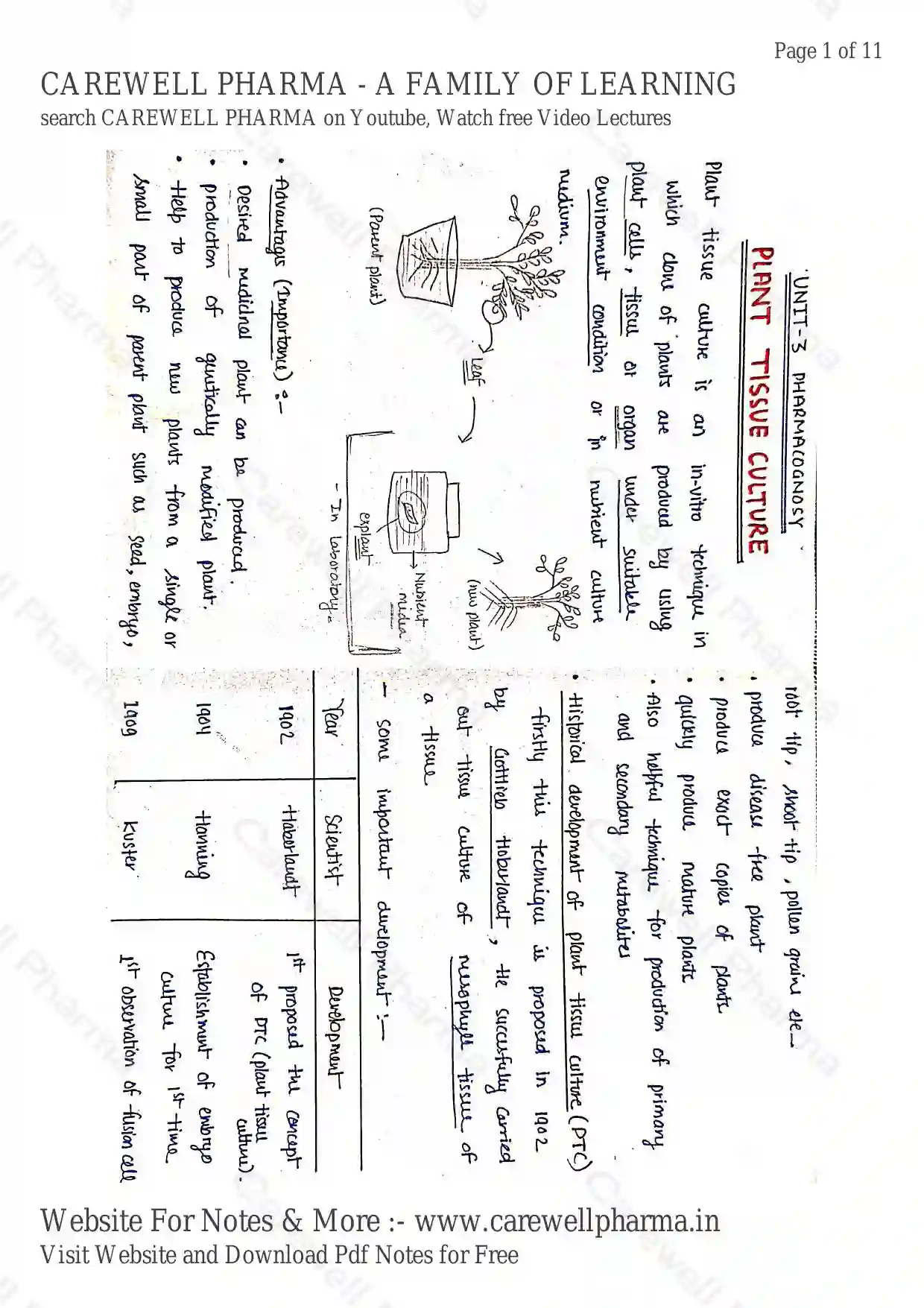
Plant tissue culture is an in-vitro technique in which clone of plants are produced by using plant cells, tissue or organ under suitable environment condition or in nutrient culture medium.

Advantages (Importance)
- Desired medicinal plant can be produced.
- production of genetically modified plant.
- Help to produce new plants from a single or small part of parent plant such as seed, embryo, root tip, shoot tip, pollen grains etc...
- produce disease-free plant
- produce exact copies of plants
- quickly produce mature plants
- Also a helpful technique for production of primary and secondary metabolites.
Historical Development of Plant Tissue Culture (PTC)
Firstly this technique is proposed in 1902 by Gottlieb Haberlandt, He succesfully carried out tissue culture of mesophyll tissue of a plant in Laboratory.
Some Important Development
| Year | Scientist | Development |
|---|---|---|
| 1902 | Haberlandt | 1st proposed the concept of PTC (plant tissue culture). |
| 1904 | Hanning | Establishment of embryo culture for 1st time |
| 1909 | Kuster | 1st observation of fusion cell |
| 1922 | Robins, kotte | In-vitro cultivation of root tips |
| 1934 | White | permanent root culture for 1st time (tomato) |
| 1934 | Gautheret | 1st permanent callus culture using vit B & auxins |
| 1953 | Muir | Develop Single cell culture |
| 1955 | Mothes & skoog | 1st report of metabolites production in liquid medium. |
| 1965 | Vasil & Hildebrandt | Regeneration of a plant from one single cell |
| 1977 | Noguchi | Cultivation of tobacco cells |
| 1902 | Simon | Obtained success in regeneration of bulky callus, buds and roots |
Totipotency
The ability of a plant cell to develop into a whole plant.
- PTC (Plant tissue culture) is based on this Totipotency.
General Procedure Involved in PTC
It involve several steps
- Sterilization of glasswares
- Preparation & Sterilization of explant.
- Production of callus from explants.
- Proliferation of cultured Callus
- Subculturing of Callus
- Suspension Culture
1) Sterilization of Glasswares
- Firstly all the glasswares which we used in tissue culture are properly washed and sterilized.
- All the glassware should be kept overnight dipped in sodium dichromate / sulphuric acid sol^n and next day glassware should be washed with fresh tap water and then distilled water.
- All glassware also should be sterilize in hot air oven at for 1½ to 2 hours.
2) Preparation and Sterilization of Explant
- Explant - It is an any part of a plant which we taken to produce a new plant such as root, stem, leaf, stamen, anther etc.
- For the sterilization of explant chromic acid, mercuric chloride (0.1%) and alcohol (70%) can be used.
3) Production of Callus from Explant
Callus - It is an unorganized and undifferentiated cell mass.
Procedure
Sterilized explant is transferred aseptically on to the nutrient medium contained in flask.
Now, the flask is transferred to BOD incubator for maintenance of culture.
temp is adjusted to (approx.) and also provide some amount of light.
Sufficient amount of callus is produced within 3-8 days of incubation.

4) Proliferation of Callus
After development of callus, it should be cut into small pieces.
transfer into another fresh medium containing harmone (which support growth)
proliferation of callus.Proliferation Medium - That medium which used to produce more amount of callus, it contain harmone (growth harmone).
5) Subculturing of Callus
- In this, Callus periodically transfer to fresh medium to maintain the viability of callus (cells).
- This can be done b/w 4-6 weeks.
6) Suspension Culture
- It contains a uniform suspension of separate cells in liquid medium.
- For the preparation of suspension culture, Callus is transferred to liquid medium, which is agitated continuously to keep the cells separate.
After subculturing of callus, Callus grow into plants (Rooting and Hardening of plantlets) and formed new small plant.
Now, this transfer to green house and then it use and also can be shift in field.


Types of Plant Culture
i) Callus culture
ii) flower culture (complete)
iii) Anther & pollen Culture
iv) Embryo Culture
v) Seed Culture
vi) Protoplast Culture
vii) leaves culture
viii) Root Culture
i) Callus Culture
It is undifferentiated mass which produced from an explant of plant in nutrient medium under aseptic condition is known as callus culture.

Importance
- It is the source of tissue for plant regeneration.
- Several biochemical assay are performed from callus culture.
- Can be used for long term maintenance of cell lines.
- For maintain the callus culture for growth, it is necessary to subculture the callus.
- Plant growth in callus culture in four phase (sigmoid curve)! Lag phase, log phase, stationary phase, Death phase.
ii) Flower Culture
In which new plant is generate from a flower.
Procedure
Flower bud or mature flowers are collected
Washed & dipped in 5% teepol sol^n for 10 min (sterilization) then rewashed
In laminar air flow cabinet using sterilized forceps, transfer the flower bud or mature flower to nutrient media.
Incubate the culture for 16 hrs at under light.
iii) Anther and Pollen Culture
a). Anther excised from flower sterilized & washed with double distilled water Directly transferred in nutrient agar or liquid media. the plantlet are formed after 4-5 weeks of inoculation (embryogenesis occurs)
- Pollen grains are aseptically removed from the anther and cultured $\downarrow$ on liquid medium then incubated at in dark for 2-3 week. $\downarrow$ Obtain haploid embryo of callus.
iv) Embryo Culture
- Embryo is obtained or excised/isolated from ovule, seed or fruit. $\downarrow$ transfer into nutrient medium under aseptically. (salts, sugars, agar & vitamins) $\downarrow$ Incubate at for 16 hrs $\downarrow$ Sub-culturing is done in fresh medium in the interval of 3-4 weeks.
v) Seed Culture
- Seeds are cultured in-vitro to generate seedlings or plants in aseptic conditions for raising the sterile seedling. $\downarrow$ plants
- It increase the efficiency of germination of seeds.
vi) Protoplast Culture
Protoplast - A cell without cell wall is known as protoplast.
Procedure
Leaf is excised from plant then sterilize $\downarrow$ removal of epidermal tissue then cut into small fragments $\downarrow$ Cell wall is removed through enzymatic method (enzyme like cellulase and pectinase) $\downarrow$ Protoplast obtained $\downarrow$ Protoplast transfer into petriplates which contain nutrient medium $\downarrow$ Incubate in BOD Incubator $\downarrow$ wall regeneration $\downarrow$ within 2-3 weeks cell division Callus forms $\downarrow$ Then, Callus is subculture on fresh medium containing plant harmones. $\downarrow$ Plant regenerate $\downarrow$ Develop plantlet/plant.

vii) Leaf Culture : Leaf excised from plant & sterilize $\downarrow$ placed on solidified medium $\downarrow$ maintain a culture & develop into plants.
viii) Root Culture : Roots are excised from plants $\downarrow$ Sterilized & transferred to fresh medium $\downarrow$ the lateral roots continue to grow and provide roots $\downarrow$ Maintained, they develop into whole plant after some days.
Nutritional Requirement of Plant Tissue Culture
To maintain the vital functions of a culture, the culture media consists of various elements,
They are as follow:
i) Inorganic salts (macronutrients, micronutrients)
ii) Organic nutrients (vitamins, Carbon/energy source)
iii) Solidifying agent
iv) Antibiotics
v) pH
vi) Growth regulators (Phyto harmones)
Nutritional medium contain all essential supplement which required to growth of plant, so we can say that it is the house for plants (explants).
i) Inorganic Salts
Macronutrients - required in large amount.
eg - Nitrogen (N), Calcium (Ca), Sulphur (S), Potassium (K), Magnesium (Mg), Phosphorus (P).Micronutrients - required in very small amounts for growth and development.
eg - Iodine, Copper, Cobalt, Manganese, Iron, Zinc etc--
ii) Organic Nutrients
Vitamins cell in culture can synthesize in less amount so required externally in small quantity for better growth & development.
eg. thiamine (Vit B1), Pyridoxine (vit B6), Nicotinic acid (vit B3) etc-Carbon/Energy source In culture, plant need external source of energy. they required - Sucrose, Maltose, Glucose, Galactose, lactose, sorbitol etc.
Growth Regulators/Phytohormones
Plant harmones.
The growth regulators or plant hormone required to promote the growth of cells (plant cells):-
eg Auxins, Cytokinin, Abscisic acid, Gibberellins, Ethylene etc-
iii) Solidifying Agent
- Solidifying agent are used in the preparation of semi-solid or solid tissue culture medium.
eg. Agar, Gelatine, pellets, starch, silica gel etc.
iv) Antibiotics
- It prevent the growth of microbes in plant tissue culture.
eg. Streptomycin, Kanamycine etc-
v) pH
- the pH of nutritional medium is generally adjusted b/w 5 to 6.
- Nutritional medium depends upon the type of plant tissue or cell which we used for culture (PTC).
Applications of Plant Tissue Culture
- To conserve rare species or endangered plant species.
- Production of genetically modified plants.
- Micropropagation (regeneration of whole plant through tissue culture).
- Production of haploid plants (contain single set of chromosomes) for improving crops.
- Production of microbes free plants and also disease free plants.
- To study the respiration & metabolism of plants.
- Production of secondary metabolites (responsible for protection of plants).
- Production of phytoconstituents in increased amount.
- Production of plant clones with new characteristics.
- For the evaluation of organ functions in plants.
- For the improvement in crops.
EDIBLE VACCINES
Eatable (Capable of being eaten)
Vaccine : It is a biological response which contain antigenic material and it stimulate the immune system to fight against disease (virus).
Edible Vaccines : Those vaccines which can eat. "Edible vaccines are transgenic plant and animal based production which contain genetic material which can stimulate the immune responses of animals".
The concept of Edible vaccine was developed in 1990 by Charles Arntzen.
Edible vaccines contain DNA fragments from the orginal pathogen which code of a surface protein of pathogen responsible for stimulating the body's immune response.
these are the mucosal target vaccines which cause stimulation of both systematic and mucosal immune response (Body's first line of defence).
Initially, they were only used for preventing infectious disease. But now, it has also found application in prevention of autoimmune disease, Cancer therapy etc-
Plants Used for Edible Vaccines
- Potato, Banana, Rice, Carrots, Peanuts, Wheat, corn, Soyabean etc-
Advantages of Edible Vaccines
- they are cheap so they can be produced in large scale.
- they can be ingested by eating the plants/part of the plant.
- Ease of administration.
- Avoidance of sterile infection.
- Heat stable, eliminating the need for refrigeration [cold storage are not required]. Easy to store.
- Generation of systemic and Mucosal immunity.
Limitations
- Selection of best plant is difficult.
- Certain foods like potato are not eaten raw, & cooking the food might weaken the vaccine antigen present in it.
- Difficult of survival of antigen in acidic condition of stomach (systematic).
Examples
| Vaccines | Vector used | Disease |
|---|---|---|
| Hepatitis B Virus | Tobacco, potato | Hepatitis B |
| HIV virus | Tomato | AIDS |
| Rabies Virus | Tobacco | Rabies |
| etc... |