Pharmacognosy 1 - Unit 2
Syllabus
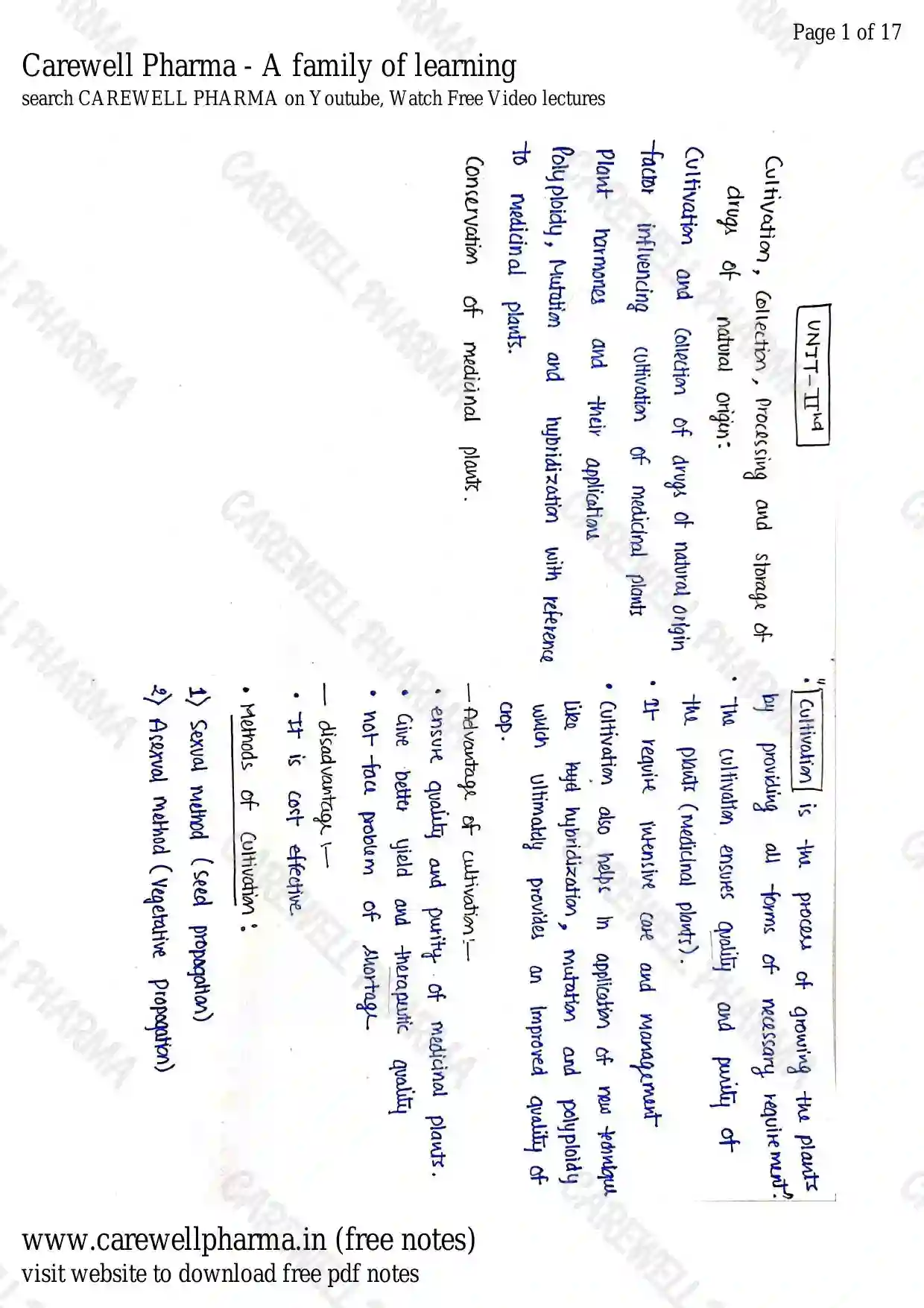
Cultivation, Collection, Processing and storage of drugs of natural origin:
Cultivation and Collection of drugs of natural origin
Factors influencing cultivation of medicinal plants.
Plant hormones and their applications.
Polyploidy, mutation and hybridization with reference to medicinal plants.
Conservation of medicinal plants
Scroll to Download
Pharmacognosy 1
Unit-II
Cultivation, Collection, Processing and storage of drugs of natural origen:
- Cultivation and Collection of drugs of natural origin
- factor influencing cultivation of medicinal plants
- Plant harmones and their applications
- Polyploidy, Mutation and hybridization with reference to medicinal plants.
- Conservation of medicinal plants.
Cultivation
Cultivation is the process of growing the plants by providing all forms of necessary requirement.
- The cultivation ensures quality and purity of the plants (medicinal plants).
- It require intensive care and management.
- Cultivation also helps in application of new technique Like hybridization, mutation and polyploidy which ultimately provides an Improved quality of crop.
Advantage of cultivation
- ensure quality and purity of medicinal plants.
- Give better yield and therapeutic quality
- not face problem of shortage
Disadvantage
- It is cost effective
Methods of Cultivation
- Sexual method (seed propagation)
- Asexual method (Vegetative propogation)
1) Sexual method
- Also known as seed propagation.
- In this method, the plant are raised by propagating the seeds.
- These plants are known as seedlings.
Condition for seed propagation
- seeds must be of good quality
- They should be free from insects & microbes.
- They should have high germination rate.
- If seed have slow germination rate then special treatment can be given to the seeds which increase the germination rate.
- eg. soaking the seeds in water for 24 hours or 0.2% solution of gibberellic acid for 48 hrs.
Methods for seed propagation
Broad Casting method :
- In this method, small seeds are scattered on the area of cultivation. eg. Isabgol, Linseed etc
Dibbling method :
- In this method, average size seeds are sown in a hole. eg. papaya seeds, castor seeds etc..
Miscellaneous method :
- There are also some plants (seeds) which sown in nursery beds (require more care).
eg. Cinchona, cardamom, clove etc..
- There are also some plants (seeds) which sown in nursery beds (require more care).
Advantage
- Easy and cheap
- The plant propagated by this method (seedlings) are long-lived and bear more heavily (fruits).
- choice of superior quality for production.
eg. Orange, papaya etc...
Disadvantage
- take longer time for cultivation.
- the cost of harvesting, spraying of pesticides etc is more than the grafted trees.
2) Asexual method
Also known as vegetative propogation. In this, a vegetative part is detached from the body of mother plant and this detached part grows up into a new independent plant under suitable conditions.

Methods for asexual propagation (vegetative propagation)
Cutting : Stem and root cutting are taken from plants and put into moist soil where they strike root at the base and develop adventitious root which grow and develop into new plants.
eg. Lemon, Sugarcane etc..

Layering :
- The stem-branch which is to form a new plant, remain attached to the parent plant.
- It is pegged down so that part of it lie along the ground and form adventitious root, these horizontal pieces are covered with soil and when it is well rooted, the branch can be removed and planted elsewhere.
eg. Rose etc..

Budding :
- It is same as a grafting, but in which single bud from the desired scion is used rather than entire scion.
- After about 15-20 days bud and stock grow together and that the bud has become a part of the new plant.
eg Apples, Pears, peaches etc...
- Grafting : Two cut surfaces of different but closely related plants are placed so as to unite and grow together. The rooted plant is known as Stock and the portion cut off is called as scion or graft. this method is used to get desired varieties of mango, rose, pear, lemon etc-

Other example obtained from vegetative propagation
- bulbs - Garlic, squill
- Tubers - Potato, Aconite (poisonous plants)
- Rhizomes - Ginger, turmeric
Advantage of vegetative propagation
- It is an easy, cheap & rapid method of multiplication
- More resistant against disease
- no variation between plant grown & parent plant.
- Seedless variety of plants can be propagated. eg. Grapes, turmeric etc..
Disadvange
Degeneration of the species due to lack of sexual stimulus.
COLLECTION OF THE DRUGS
After sufficient growth, the plant should be collected from wild or cultivated plants at specific season and also at specific time period to get best quality of products.
- Skill labour has collect drugs in a highly scientific manner. eg. digitalis, belladona
- Barks are usually collected in spring or early summer.
- Fruits should be collected when fully ripe
- The gum, resin and latex has collected in dry weather. etc_
- Free from pest and disease Plant parts should be free from pests, insects, disease or injury.
Method of collection (Harvesting)
- It is depend on type of drugs
- For speed and reduced cost the collection of crude drug is done by mechanical devices like pickers, mower, stripper etc-
- The underground parts of plant like root and rhizomes may be dug by hand or by mechanical devices like plow, digger, lifter etc-
PROCESSING AND STORAGE OF DRUGS
After collection, the drug is subjected to processing then Storage:-
- Washing
- Drying
- Garbling (Dressing)
- Storage.
Washing
They are washed in special washing machine to remove adhering dirt, soil and undesirable materials. Also prevent from pest and disease during washing.
Drying
Depending upon the presence of chemical constituents, the drug are air dried, sundried, shade dried & artificial dried.
- If drug contain any enzyme action, the drug is slowly dried with moderate temperature. eg. vanilla pod, cocoa seed etc... but if not, the drug dried as soon as possible.
- Some of the drug are dried in shade because natural color is to be maintained or contain volatile compounds.
- Drying in artificial heat is most acceptable, it stop enzymatic action & drying more quickly. dryers tray dryer, spray dryer, oven etc-
Garbling
In this, all extra undesirable material removed from drugs and make it shine through polishing for better market value.
Storage
Now drug is packed based on their chemical constitution, storage, transportation (packing)
- All the drugs should be preserved in well closed container and also safe from any crisis.
Factor Affecting Cultivation of Medicinal Plants
- There are following factor which affect the cultivation:-
- Altitude
- Light
- Temperature
- Humidity
- Rainfall
- Soil and Soil fertility
- Fertilizer
- Pest and pest control
i) Altitude : It is a height from sea level. important factor for cultivation.
- Tea, Cinchona need high altitude ($1000-2000m$)
- Cinnamon, Cardamom ($500-1000$ meter)
- Senna can be cultivated at sea-level.
ii) Light : It influences photosynthesis, opening & closing of stomata, flowering etc.
iii) Temperature : It affects the growth of plants -
- Cinchona
- Coffee
- Tea etc_
iv) Humidity : Also effects of cultivation of plants.
- eg. Saffron needs only cold climate and pyrethrum requires dry weather for cultivation.
v) Rainfall : Majority of plants need sufficient amount of rainfall for the growth.
- But some plants required less such as aloe, acacia etc
vi) Soil : It is the most important natural resource as it provide mechanical support, water and essential food/nutrients for the development of plants.
- soil fertility : The capacity of soil to supply plant nutrient and provide suitable medium for plant growth.
vii) Fertilizers : The fertilizers are added to the soil to supply nutrients for the growth of plants
- chemical fertilizers - Urea, ammonium sulphate etc...
- manures - animal feces, cow dung etc
- Biofertilizers - Rhizobium, blue green algae etc
viii) Pest and Pest control : The pest are undesirable plant and animal species that cause a great damage to the plants.
eg. Insects, microbes etc- weed
- Due to this, it leads to loss of nutrients, water etc and also reduce quality.
- So, to get the best quality of plant product it is very necessary to control the pests.
Pest control methods
i) Mechanical Method : Hand-picking, burning and trapping of pests
ii) Agriculture Method : Advance plant breeding technique
iii) Biological Method : It is practiced by combating the pests, mostly the insects with other living organism.
iv) Chemical Method : Use of pesticides like -
- Insecticides, fungicides, Herbicides
- Acaricides etc..
PLANT HARMONE AND THEIR APPLICATIONS
- Also known as plant growth harmone
- Phytoharmones, growth bioregulators.
These are those chemical substances which are responsible for the growth of plant and also control its physiological process.
Various types of harmones
- Auxins
- Ethylens
- Absclsic Acid
- Cytokinins
- Gibberellins
1. Auxins
Derived from a greek word "auxein" which means to grow.
It is the major plant harmone to be discovered.
Functions
- Auxin enhanced cell elongation and stem elongation.
- It cause root formation, delaying leaf senescence, fruit ripening and used in embrogenesis.
- It It promote xylem differentiation.
- Promote leaf growth, fruit growth etc..
- Production
- It is made in actively growing tissue which include young leaves, fruits and especially the shoot apex.
- made in cytosol of cells.
- It has basipetal transport (toward the base), move from up to down
- Types
- Commonly used natural auxin is Indole-3-acetic acid (IAA) & indole-3-butyric acid (IBA).
- Commonly used synthetic auxin are 1-naphthalene acetic acid (NAA).


ii) Cytokinin
Cyto (Cell) + kinin (division).
- these are those plant harmone which regulate & promote cell division.
- they contain purine ring in its structure
- It has acropetal transport (toward the top)
- Functions
- Stimulation of cell division.
- Release and induced bud formation.
- Development of embryos during seed development.
- (Cell division is regulated by the joint action of auxin and cytokinin).
- Types & Examples
- Naturally occuring Cytokinins - Zeatin (effect on leaf senescence)
- Synthetic derived - Kinetin (play the role in nucleic acid metabolism).


- Cytokinin primarily synthesized in meristematic region of the roots, and also produced in developing embryos.
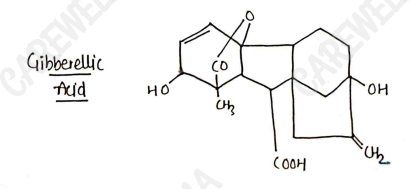
iii) Gibberellin
They belong to the class of endogenous plant growth regulators.
- It is about 50 gibberellins at present in which 40 occurs in green plants and othere in some fungi.
- "These are plant harmone that promote growth, seed germination and leaf expansions".
- They are present in different types of organs and tissue such as roots, shoots, buds, leaves, root nodules, fruits etc...
- Transport across xylem, phloem, cell to cell or made in that tissue which it is used.
- is called as Gibberellic acid and used to increase the shoot elongation.
- Mechanism : induced activity of gluconeogenic enzyme rapidly convert lipid to sucrose which further used in growth & development.
Functions
- It promote flowering, seed germination and stem elongation.
- Increase in the size of leaves and stem or shoot elongation.
- Rarely used compared to auxin and cytokinin able to produce morpholigal changes in plants.
iv) Ethylene
- It is a gaseous harmone synthesized in an cultured cell, fungi and bacteria
- At higher concentration it inhibit growth of plant (decrease plant elongation) so also known as plant growth inhibitor harmone
- Synthesis
- Simple organic molecules.
- Synthesized from methionine on large scale produced by incomplete burning of carbon rich substance like natural gas, coal or petroleum.
- Structure (Ethylene)
Functions
- It promotes fruit ripening, senescence and leaf abscission-natural detachment of old leaf from plants (बुढापा)
- At low concn sometimes it promote growth but at higher always inhibit growth.
- It can increase cell expansion.
- In 1934, Gane reported that plant synthesize ethylene.
v) Abscisic acid (ABA)
- A plant harmone which promote leaf detachment, induced seed and bud dormancy, and Inhibit seed germination. (कली, inactive/slow down)
- It is a natural plant growth inhibitor.
- ABA concentration are found to be enhance in stress condition like mineral deficiency, injury etc- so also called as "stress harmone".
- It is naturally produced in plant tissue.
- In 1963, fedrick Addicott isolate two compound Abscisin I & Abscisin II (Abscisic acid).

- Functions
- closing of stomatal aperture & abscission of leaves.
- control of water and ion uptake by roots.
- seed and bud dormancy.
- inhibit auxin promoted cell wall acidification loosening and slow cell elongation.
POLYPLOIDY, MUTATION AND HYBRIDIZATION WITH REFERENCE TO MEDICINAL PLANTS
Polyploidy
Poly Many Ploidy pair of chromosomes
- A cell or organism having more than two set of chromosomes is known as polyploidy and offsprings named polyploids [polyploidy].

- Haploids (n), Diploids (2n), Triploids (3n), Tetraploids (4n)
- The specific number of chromosomes is a character of each species and is called genome which is observed in all types of organism.
- When the organism contain more than two genome.
Causes
- It may occurs during abnormal cell division or through cell generation.
- Physical agents - X-rays, centrifugation, temperature shock etc-
- Chemical agents - colchicine, veratrine, sulphanilamide, Mercuric chloride etc-
- "The chemical agent cause disturbance to mitotic spindle of dividing diploid cell and cause duplication of chromosome and thus convert diploids into tetraploids cells"
Classification
On the basis of their chromosomal composition!-
- Euploids
- Aneuploids
i) Euploids : when a cell or organism has one or more than one complete set of chromosomes.
- Autopolyploidy (polyploidy b/w same species)
- Allo polyploidy (polyploidy b/w different species)
ii) Aneuploids : The abnormal condition, where chromosomes complement are not exact multiple of basic no.
There is addition or loss of usually 1 or 2 chromosomes.
- hypoploidy (no. is less) (2n-1)
- hyperploidy (no. is more) (2n+1)
Applications
- It has greater significant to medicinal plant.
- It may cause formation of new species.
- Polyploidy plant is usually healthier, stronger and larger than their diploid counterparts.
- Chemically induced polyploidy do a variation in composition of plants and make it more potent.
- increase in tropane alkaloids in belladona, Cinchona etc.
- increase morphine concentration in opium.
- It increase the yield of secondary metabolites in plants.
MUTATION
A mutation is the permanent alteration in the genetic material or character of an organism.
- This gives rise to a new genetic traits or changed genotype.
- A cell or an organism which shows the effect of mutation is called a mutant!
- And the agent which cause mutation is known as "mutagens" or "mutagenic agents".
Types of mutation
i) Spontaneous mutation
ii) Point mutation
iii) Frameshift mutation.
i) Spontaneous Mutation : It occurs due to some unknown reason from nature (naturally).
eg. in plants, bacteria, viruses etc...
ii) Point Mutation : also called as base substitution. It occurs as a result of substitution of a single nucleotide in a different nucleotide (one nucleotide is replaced with another).
- Transition type (one purine to another purine).
- Transversion type (purine converted into pyrimidine).
iii) Frameshift Mutation : It results from an addition or loss of one or more nucleotides in a gene and it termed as Insertion or deletion mutation respectively.
Artificial Mutation : In which mutation Induced artificially by the use of various mutagens.
Mutagens
Physical Mutagenic Agents : radiations such as UV rays, X rays, ionizing radiation, certain physical condition like temperature etc.
Chemical Mutagens : Nitrogen mustard, formaldehyde and other alter chemical constitution of DNA base & cause change. Nitrous acid, manganese chloride etc.
Applications
- Mutation affect the chemical composition of medicinal plants are important to pharmacognosy.
- Useful for a new chemical variety Include yield and resistance to disease or frost.
- High yield of morphine by applying chemical mutagens in opium.
- Capsaicin content is increased in capsicum using chemical mutagens.
- Ionization radiation is widely used to treat the seeds for crop improvement.
HYBRIDIZATION
It is the process of interbreeding b/w individuals of different species, as a result of formation of hybrid which have different characteristics or may be more quality character.
- It is a process to produce a hybrid by crossing over of two plants of opposite genetic character.
- It is a vital technique to combine the character of different plant, it produces new combination of genes new species.
Types of Hybridization
i) Intra-Varietal Hybridization : Crossing should be done b/w the plant of the same variety.
ii) Inter-Varietal (Intraspecific) : Crossing should be done b/w the plants of the different varieties.
iii) Interspecific (Intrageneric) : Crossing are made b/w different species of the same genus.
Procedure of Hybridization
- Selection of parent plant (two parent should be selected). The two varieties from the same species or other species are for crossing. $\downarrow$
- Emasculation (removal of stamens/anthers or the killing of the pollen grains of a flower without affecting the female reproductive system). $\downarrow$
- Bagging (The emasculated flower is immediately bagged to avoid pollination by any foreign pollen by paper, glassine or fine cloth). $\downarrow$
- Tagging (emasculated flower out tagged with their Information). $\downarrow$
- Crossing (Pollination) Pollinating the female flower using the collected male pollen grain to bring about fertilization. $\downarrow$
- Collect seeds from mother plants & grow better hybrid and offsprings.
Applications
- For crop improvement to get good quality of plant.
- To produce disease resistance, herbicide resistance and many other quality character.
- To enhance the yield of phyto constituents in medicinal plants.
- Hybridization of cinchona succirubra and cinchona ledgeriana yield more amount of quinine.
- Rheum palmatum x Rheum emodi better quality rhubarb.
CONSERVATION OF MEDICINAL PLANTS
The medicinal plants are globally valuable sources of herbal product and they are disappearing at a high speed. so it is very necessary to conserve the plant species which are medicinally important.
- Conservation is about preventing damage and loss to our culture heritage.
Threats to medicinal plants
- excessive use by humans.
- over exploitation.
- danger from insects, fungi, disease etc.
Methods of conservation
i) In-situ conservation
ii) Ex-situ Conservation
i) In-situ conservation
- It is the conservation and maintenance of medicinal plants species on its natural habitat or environment by biosphere reserves (prevent their environment and make it suitable for growth).
- It is applied to conservation of agriculture biodiversity by using farming practices.
- Its maintenance cost of it is very high.
ii) Ex-situ conservation
It is the conservation and maintenance of medicinal plants species outside their natural habitat (environment), in the form of whole plant, seed, pollen, vegetative propagules, tissue or cell culture etc..
Several methods used for their conservation
- Cryopreservation
- Cold-preservation
- Low pressure and low oxygen storage
- Gene bank
- Seed bank
- Tissue culture technique
Cryopreservation : It involves the use of liquid nitrogen having temp at which zero metabolism or non-dividing state occurs at plant cells and tissue under it. seeds, pollen, tissue or embroys are stored.
Cold Preservation : In which genetic material of plant is conserve at temp b/w . simple, economical and having better survival rate of plant cells & tissue.
Tissue Culture Technique : It is quick and very efficient invitro technique for propagating plant species under aseptic condition.
Gene & Seed Bank : It is used for the storage of seeds, tissue culture, embryos, cells DNA etc in a temperature & moisture controlled environment.
Low pressure & low oxygen storage :
It is an alternate method for cryopreservation & cold storage.
LPS (Low pressure storage), in this surrounding atmospheric pressure is lowered and this system is suitable for storing plant material for short and long term.
In low oxygen storage (LOS), the oxygen level is reduced and the atmospheric pressure is maintained at by adding Inert gas like nitrogen.