Pharmacognosy 1 - Unit 1
Syllabus
Introduction to Pharmacognosy:
- Definition, history, scope and development of Pharmacognosy
- Sources of Drugs - Plants, Animals, Marine & Tissue culture
- Organized drugs, unorganized drugs (dried latex, dried juices, dried extracts, gums and mucilages, oleoresins and oleo- gum -resins).
Classification of drugs:
Alphabetical, morphological, taxonomical, chemical, pharmacological, chemo and sero taxonomical classification of drugs
Quality control of Drugs of Natural Origin:
Adulteration of drugs of natural origin. Evaluation by organoleptic, microscopic, physical, chemical and biological methods and properties.
Quantitative microscopy of crude drugs including lycopodium spore method, leafconstants, camera lucida and diagrams of microscopic objects to scale with camera lucida.
Scroll to Download
PHARMACOGNOSY-I UNIT-I
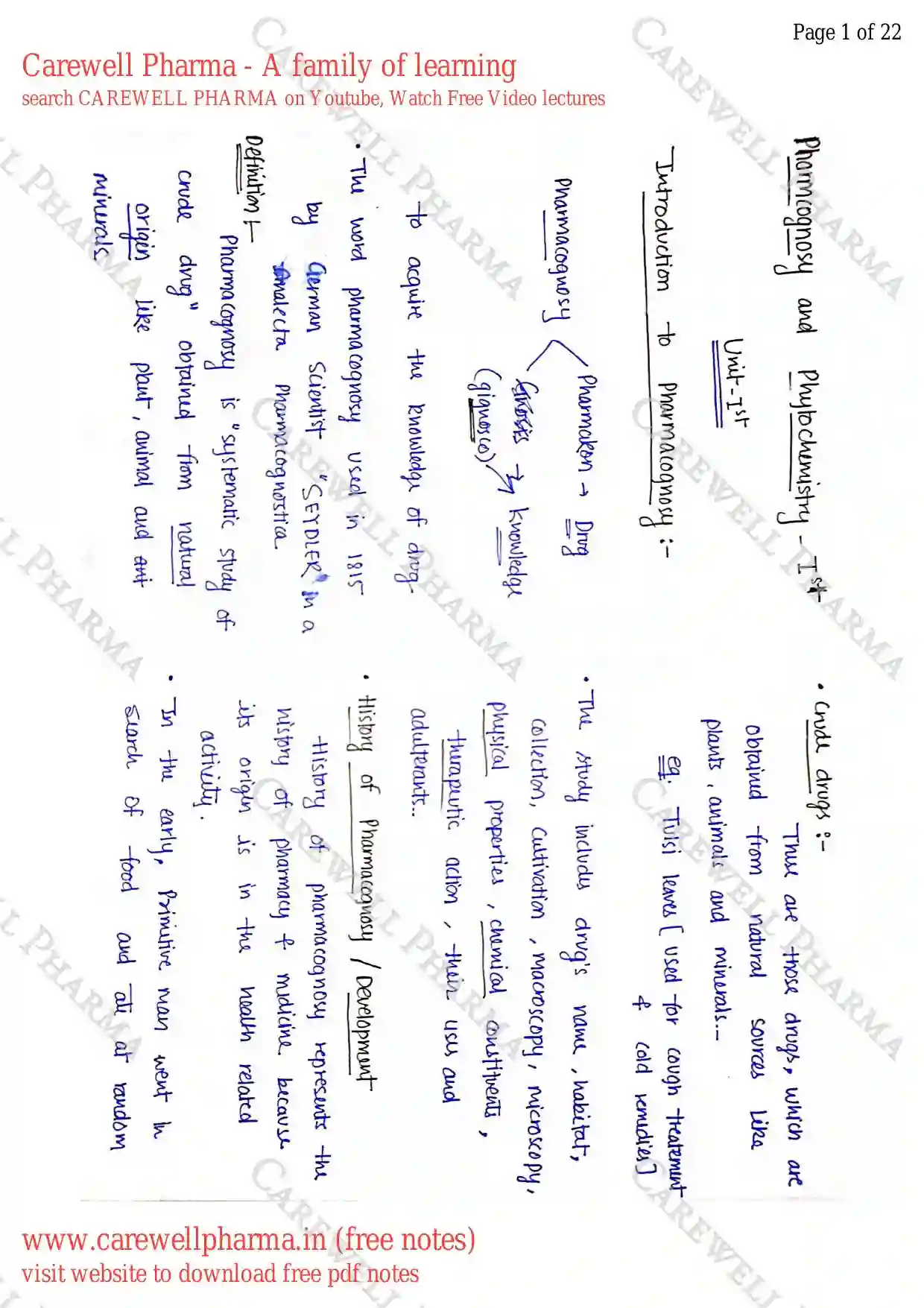
Introduction to Pharmacognosy
Pharmacognosy : The word Definition:
- Pharmakon Drug
- gignosco knowledge
to acquire the knowledge of drug.
- The Word pharmacognosy used in 1885 by German Scientist "SEYDLER" in 1815 in a Analecta Pharmacognostica.
Definition
Pharmacognosy is "systematic study of crude drug" obtained from natural origin like plant, animal and minerals.
Crude drugs
These are those drugs, which are Obtained from natural sources Like plants, animals and minerals.
eg. Tulsi leaves (used for cough treatement & cold remedies)
- The study includes Collection, Cultivation, drug's name, habitat, macroscopy, microscopy, physical properties, chemical constituents, uses and adulterants.
History of Pharmacognosy / Development
History of pharmacognosy represents the history of pharmacy & medicine, because its origen is in the health related activity.
- In the early, Primitive man went in search of food and ate at random plant parts, some animals etc.
- If no harmfull effect occurs they considered as edible.
- If any plant part cause vomiting, then use as emetic agents.
- If plant part cause diarrhea, then it use as purgative.
By obserbing animals recognise any plant for their medicinal use.
So, the use of plants for medicinal purpose started long before any form of record.
In Ancient era
- Shen Nung (2838-2698BC) : wrote oldest pharmacopoeia [china] 'Pen Ts'ao', consist of 365 drugs such as ginseng, Cinnamon bark etc.
- Hippocrates (460-377 BC) : father of Medicine. HAP (Human Anatomy & Physiology). His litrature consist of 360 medicinal plants, Like garlic etc.
- Theophrastus (370-287BC) : father of Botany (study of plant kingdom).
- Aristotle (384-322BC) : father of Biology. Study of animal kingdom (also plants).
- Dr. Chandra Raunt / C.A. Seydler referred as father of pharmacognosy.
- Galen (131-200) - Greek pharmacist, he worked on extraction of chemical constituent from the plants.
Ayurveda of India (1500 BC)
Herbs play an important role in Ayurveda.
- The basic Ayurveda writing are atleast 2000 year old.
- Caraka Samhita - oldest, describe about 582 herbs.
- Sushruta Samhita - (nearly 600 herbal remedies).
Modern Era (the era of pure compounds)
- Isolation of morphine from opium (1806)
- Strychnine (1817)
- Quinine and Caffeine (1820)
- Nicotine (1828)
- Cocaine (1855)
- In 19th century, many compound were isolated and determined.
- In 20th century, the drug were isolated from the animal kingdom, particulary hormones and vitamines.
- Isolation of penicillin In 1928 by william fleming.
- Steroid harmones like progestrone.
Scope of Pharmacognosy
It has a wide and broad scope in field of pharmacy.
It help in study of:
- Phyto chemistry
- Pharmaceutics
- Pharmacology
- Botany
- Quality Control
- Chemotaxonomy etc...
- Analysis/Isolation of Phyto chemicals.
- Morphine extracted from the plant opium, also studied on their clinical uses.
- Preparation of general tonic and stimulants.
- It helps to increase immunity such as Ashwagandha, Tulsi etc.
- Natural product act as a model for Synthesis of new drugs.
- eg morphine act as a model for large group of potent analgesic drugs.
- Structure Activity Relationship (SAR)
- Can be used to predict biological activity from molecular structure.
- Preparation of herbal formulation.
- Churnas, asavas, leha etc.
- Biosynthetic/Biogenetic pathway investigation.
- These are primary and secondary metabolites.
- Primary Carbohydrates, lipids, protein, Nucleic acid, amino acid. they involves in growth.
- Secondary Alkaloids, Phenolics, steroids, essential oil. produced for defence purposes.
- Cultivation and collection of medicinal plants. clove, cinchona, senna, opium etc.
Sources of Drugs
Plants, Animals, Marine & Tissue Culture
I) Plant sources
II) Animal sources
III) Marine Sources
IV) Tissue Culture
V) Mineral sources
I) Plant source
It is the oldest sources of drugs. Most of the drug is obtained from plants. Many plant/plant families contain biological active substance such as
Labiatae - Tulsi, Pudina etc
Rutaceae - lemon etc.
Almost all parts of the plant are used i.e. Leaves, stem, Bark, flowers, fruits and roots etc.
Leaves : Plants leave used as a source of drugs. eg. Tabacco leaves give Nicotine. Digitalis leaves give Digitoxin and Digoxin, which are cardiac glycocides.
Flowers : Plant's flower used as a source of drugs. eg. Cloves give Eugenol. Rose give rose water used as tonic etc.
Fruits : Sennapod give Anthracin, which is purgative and Laxative etc..
Seeds : Used as a source of drugs. Nux Vomica seeds give Strychnine, which is CNS stimulator.
Roots : eg. Rauwolfia serpentina gives reserpine, used for hypertension treatment.
Stem : eg. Chondrodendron tomentosum gives tubocurarine, which is skeletal muscle relaxant used as general anaesthesia.
II) Animal sources
Many parts of animals are a good sources of drug and also some tissue/cells of humans/animals are used in manufacturing of drug.
- Isolation of Insulin from a pancrease. Used in treatement of diabetetes.
- Blood of animals is used in preparation of vaccines.
- Sheep thyroid as a source of thyroxin, which is used in hypertension.
- Cod liver oil derived from a cod fish, Used as a source of vit. A & Vit. D.
III) Marine Sources
Ocean/Seas contain about 5 lach+ types of species, which termed as marine species.
- Many these species show biological activity and used as a sources of drugs.
eg Seaweeds contain iodine so it is used in treatment of iodine deficiency disease such as goitre.
IV) Mineral sources
Drugs from mineral sources include both metallic and non-metallic sources. Substances like talk, borax and their salts kaolin, chalk, bentonite and many more minerals.
- Ferrous sulphate in iron deficiency anemia
- magnesium sulphate as purgative
- Zinc oxide ointment as skin protectant (in wounds & eczema)
- Gold salt used in treatement of rheumatoid arthritis. etc.
V) Tissue Culture
Tissue culture is the process in which animal cells and plant cell cultivated in-vitro under aseptic and controlled environment condition.
Simple definition
- Tissue Culture is the growth of tissue or cells [plants or animals] in an artificial medium separate from parent organism.
- It is used for the production of primary and secondary metabolities to regenerate plants (plant tissue culture).
- Eg : By using tissue culture technique, following metabolites can be formed: Alkaloids, Tropane, Cocaine etc.
Classification of Drugs
Organized drugs, Unorganized drugs (dried latex, dried juice, dried extracts, gums and Mucilages, Oleoresins and oleo-gum-resins)
I) Organized drugs
Those drugs which are direct part of plant or animals such as Leaves, flowers, root etc.
- These are of plants or animal origin.
- They consists of organized cellular structure.
- These can be identified by morphological character.
- Parts of plants used as drugs:
I) flower - clove
II) leaves - Tulsi, Senna
III) Bark - Cinchona, Cinnamon
IV) fruits - fennel, coriander
V) Root - Ginger, Turmeric
VI) wood - Sandalwood
VII) Seed - Mustard
II) Unorganized drugs
Those drugs which are not a part of plant but derived from a plant/animals (natural products).
- These are from plants, animal or mineral origin.
- These derived substance can be obtained through a process of extraction, distillation, natural secretion etc.
- They do not have cellular structure.
- These can be identified by organoleptic properties.
- Acc. to their origen and nature:
1) Dried latex
Latex is white aqueous suspension type substance which is obtained from tree (stem).
eg. Opium, Papain.
2) Dried Juices
The Juice Obtained from fresh Leaves and stem of tree etc.
eg. Aloevera juice etc.
3) Dried extracts
Drugs obtained by treating the part of plant with water/distillation.
eg. Agar, Black Catechu etc..
4) Gums and Mucilages
Gums and mucilage have similar constituents and on hydrolysis yields a mixtures of sugar & uronic acids.
- Gums formed upon injury of plants. eg Acacia, tragacanth.
- Mucilages normal product and formed inside the cells.
eg. It is present in Agar, Senna etc.
5) Resins
Oleoresins Homogeneous mixture of volatile mixture and resins prepared from Cinnamon, Capsicum, Ginger etc.
Oleo-gum-resins Homogeneous mixture of volatile oil, gums and resins (A solid plant exudation). Indian Bdellium, Myrrh, Turmeric etc.
- There are also some fats & oils and waxe, fixed oil Used as drug (medicinal purpose).
eg: Castor oil, wool fat etc.
Classification Systems of Drugs
Crude drugs
Those drugs which Obtained from natural sources Like plants, animals, minerals, marine etc.
Because of their wide distribution the arrangement of classification in a definite sequence is necessary to understand easily.
They classified as follow:
- Alphabetical Classification
- Taxonomical Classification
- Morphological Classification
- Pharmacological Classification
- Chemical Classification
- Chemo-taxonomical Classification
- Sero-taxonomical Classificaltion
I) Alphabetical Classification
- It is the simplest way of classification.
- In which drugs are arranged in alphabetical order of their Latin & English names and some time for their local language name.
Merits : Easy & quick in use (effective). No repetition of drugs.
Demerits : Scientific nature of the drug cannot be identified. Orginal source is not clear.
eg: Acacia, Agar, Benzoin, Cinchona, Cinnamon, Digitalis, fennel, Ginger, Linseed, Mustard etc..
II) Taxonomical Classification
In which drugs are arranged according to their kingdom, phylum, order, family, genus and species.
Merits : Easy for study. helpful for studying evalutionary developments.
Demerits : This system failed to tell about chemical nature and therapeutic significance of crude drugs.
III) Morphological Classification
In which drugs are arranged according to their morphological characterics such as their Shape, Size, parts of plants/animals etc..
Organised (cellular) : Drugs obtained directly from part of plants.
eg. Leaves - Vasaka, Tulsi.. fruits - fennel, Coariender.. Seeds - Castor, Mustard.. Root - Rauwolfia, Ipecac... etc.Unorganised (non cellular) : Drugs derived from the parts of plants.
eg. Dried latex - opium, Gums - acacia, Dried Juice - Aloe, Dried extract - Agar, Resins - Oleoresins & Oleogum resins etc..Merits : Very useful in identifying the adulterants used. convenient for practical study.
Demerits : It does not give an idea about chemical constituents and uses.
IV) Pharmacological Classification
In which drugs are arranged according to their Pharmacological (therapeutic) action.
It is more relevant classification and widely used.
- Examples
- fever - Paracetamol, dolo 650
- Headache - Disprin
- Purgatives - Senna
- CNS stimulants - Coffee (caffein)
- Antihypertensive - Rauwolfia.
- Anticancer - Vinca, taxus
- Antimalarial - Cinchona etc..
- Emetics - Ipecac
- CNS depressants - opium
- Bronchodilators - Ephedra, Tea..
Merits
- They classified acc. to their therapeutic action. so they are easy in use, even their Chemical constituents are not known.
Demerits
- Regardless of morphology, taxonomical or chemical nature the drugs are grouped together due to their same pharmacological uses.
V) Chemical Classification
In which drugs are arranged in different groups according to their chemical nature of their most important constituent present in the drug (API) - actual pharmaceutical Ingredient.
- Vitamin & harmones - Insulin, Yeast
- Protein & Enzymes - Gelatin, Papain
- Lipids - Castor oil
- Alkaloids - Datura, Vasaka, Tropane
- Glycosides - Senna, Digitalis
Merits : chemical constituent and medicinal uses are known.
Demerits : Drugs of different origin are grouped together under similar chemical titles.
VI) Chemo-taxonomical Classification
In this classification, the equal importance is given for taxonomical status and chemical constituents.
eg. Tropane alkaloids generally occurs among the members of Solanaceae. Oleo-resin generally occurs among the Pinaceae family.
VII) Sero-taxonomical classification
Sero Serum, logy Study.
- The study of antigen-antibody reaction is called serology.
- The application of serology in solving taxonomic problems is called serotaxonomy.
- The classification of very similar plants by means of differences in the proteins they contain.
Quality control of drugs of Natural Origen
Quality control : It is necessary to maintain the quality of drug.
ADULTERATION
"The mixing or substituting orginal crude drug partially/whole with other similar looking substances and the defective orgenal substance"
- Adulterant : The adulterant must be some material which is both cheap and available in large amounts and substance is inferior, useless, sometime harmful and free from therapeutic properties. (no response).
- Adulteration is a latin word which means "Debase" reduce the quality of any products.
- In simple word "The debasement of an article".

Adulterated :
The adulterant must be some material which in both cheap and available in large amounts and used to adulterate the orginal drug/substance.
Reason for Adulteration
- Scarcity of the drug.
- Expensive drug (high price) eg. Clove, Cinnamon etc..
- Similarity in Morphology.
- With the Intention of enhancing profits. etc....
TYPES OF ADULTERATION
I) Direct (intentional) adulteration.
II) Indirect (unintentional) adulteration.
1) Intentional (Direct) adulteration:-
It is done intentionally which usually includes practices in which an herbal/crude drug is substituted partially or fully with other inferior products.
i) Adulteration by artificially manufactured Substitutes
- In this adulteration, artificially prepared substance resemble (substitute) the orginal drug.
- It is done for costlier drugs or for those which are not easily available.
eg. Yellow colored paraffin waxes bees wax. etc..
ii) Substitution with Inferior quality material
- In this adulteration, sub-standard substance with/without therapeutic effect Substitute orginal drugs.
- Due to their morphological characteristics similar to orginal drugs, inferior material used as adulterant.
eg. Indian senna is substituted with Arabian Senna. Medicinal ginger is substituted with Zingiber mioga. etc...
iii) Substituted with exhausted drugs
- In this adulteration, the exhausted material may be used partially/whole as a substituent for the genuine drugs.
eg. In case of volatile oil containing material like clove, fennel etc.
iv) Addition of synthetic chemicals
- In this adulteration, Sometimes chemicals (synthetic) are used to enhance the character of natural products.
eg. Benzyl benzoate to balsam of peru etc..
v) Addition of Heavy worthless material
- In this adulteration, some heavy worthless material added to orginal drugs.
eg. A large mass of liquorice root etc.
vi) Adulteration by harmful adulterants
- In this adulteration, the waste from the market are collected and admixed with the authentic drugs.
- Mostly seen in case of Liquids or unorganised drugs.
eg. Lead shot in opium, White oil in coconut oil etc..
2) Indirect (Unintentional) adulteration
Those adulteration which sometimes occurs without bad intention of the manufacturer or supplier. can be happened accidently.
I) faulty collection
Herbal adulteration sometimes occurs due to carelessness of collectors or suppliers.
- In this during collection, some other plants/material is collected due to similarity in the appearance, color, and lack of knowledge.
eg. Aconitum deinorhizum in place of Aconitum nepellus is collected. white oil in coconut oil etc.
II) Imperfect preparation (improper processing)
Sometimes neglected drying process may lead to unintentional adulteration, or any other process.
eg. Use of excessive heat in separating the cod liver oil from liver but the proportion of vitamin, odor, color etc are affected.
III) Incorrect storage
Deterioration, especially during storage, leads to the loss of active ingredients and production of non-active toxic metabolites.
Deterioration (impairment in the quality of drugs)
eg. Moisture or humidity can accelerate enzymatic activities, leading to decomposition of the herbs (crude drugs). etc..
Evaluations of drugs
It is defined as the determination of identity, purity and quality of drugs.
Identity : Identification of biological sources of the drug.
Purity : The range of foreign biological material present in a drug (Adulteration). Deterioration (impairment in the quality of drugs).
Quality : The amount of active ingredient present in crude drugs.
Method of Evaluations
I) Organoleptic (Morphological) evaluation
In which drugs are evaluated by means of organs of our sense OR
In which drugs are evaluated by means of their morphological character such as Size, shape etc.. and their sensory character such as color, odour, taste, texture, touch.
- Cinnamona - Brown color
- Liquorice - sweet taste
- Cinchona - fractured surface
Also with the help of gross Morphology, evaluated easily.
- leaves, flowers, fruits, seeds etc. all have different morphological character & sensory characters.
II) Microscopic evaluation
It dealt with the histological (tissue, cells) study of drugs. It is used for organised drugs, because these drugs contain cellular structure.
- trichomes (hair like structure) present in Dhatura.
III) Physical evaluation
In which drugs are evaluated by their physical properties such as moisture content, melting point, boiling point, viscocity, Solubility, refractive index, Optical rotation etc...
- Presence of moisture in a crude drug can lead to its deterioration. It can be determined by heating the drug at 150°C in an oven & calculate the loss of weight.
- M.P, B.P. eg. Coca butter (30°-33°) M.P.
- Ash content : The residue remaining after incineration (to be burnt) of a known quantity of the air crude drug, is know as the ash content of the drug. eg. Ashoka - 11.00, Ginger - 6.00 etc.-
IV) Chemical evaluation
In which drugs are evaluated with the help of chemical test. OR
Determination of the active constituent present in a drug by chemical test.
- Various methods
Instrumental (colorimetry, flourimetry etc...)
chemical constants (acid value, iodine value etc.).
Individual chemical test (used for identify particular drugs).
Microchemicals tests (carried on slides).
eg : Halpher's test for cotton seed oil [individual].Qualitative chemical test include identification of various phyto constituent like alkaloids, Glycosides, Tannins. Halphen's test for cotton seed oil.
V) Biological evaluation
It is the important, most reliable but costly evaluation of drugs.
- This method are perform on living experimental animals like rat, mice, rabbit, cat etc... and isolated organ, tissue.
- It is used, when chemical or physical evaluation are not satisfy.
- The response produced by the test drug on living being is compared with that of the Standard preparation.
- Cardiac glycoside (medicines for treating heart failure and certain irregular heartbeats) are evaluated by this method on cats, frogs or pigeons.
Quantitative microscopy
Leaf Constant
Stomatal no
It is the average no. of stomata present in 1 sq. mm of epidermis.
eg. Datura innoxia 141
Stomatal index
Percentage which the number of stomata form to the total no. of epidermal cells. (each stoma = 1 cell). $$S.I. = \frac{S}{E+S} \times 100$$ where, $S$ = No. of stomata per unit area $E$ = No. of epidermal cells in the same unit area
- Indian Senna: 17-20
- Alexandrian Senna: 10.8-12.6

Vein islet no
Islet is the area surrounded by vein. no. of vein Islets per sq.mm of leaf surface.
- Indian Senna: 19-23
- Alexandrian Senna: 25-30
Palisade Ratio
Average no. of palisade cells beneath (under) one epidermal cells.
- Digitalis purpurea 3.7-4.2
- Datura stramonium 4-7

Lycopodium spore method
It is an important analytical technique for powder drugs, especially when chemical and other method of evaluation fail as an accurate measure of quality.
- By lycopodium spore method, estimation of the percentage of foreign organic matter in powdered form drug is possible.
- Lycopodium spores are uniform in size ($25 \mu$) and have characterized shape & appearance.
- It has average 9400 spores/mg.
- Lycopodium spores are obtained from lycopodium clavatum.
- Appropriate for evaluation of drugs containing well defined particles, Single layer cells/tissue, uniform thickness.
Eg. powdered clove, ginger, etc--
Procedure
Take powdered material & lycopodium spores $\downarrow$
dry & remove moisture content
powdered material + lycopodium spores (weighed & mixed) $\downarrow$ mixture is suspended in a appropriate viscous liquid. $\downarrow$ Examined under microscope, counted in 25 fields $\downarrow$ repeated for and similar suspension. then put values in formulas -
- = No. of sample particles in arount 25 fields
- = weight of lycopodium in mg
- = No. of lycopodium spore in same field.
- = Sample weight
- = No. of characteristics particles present in 1 mg of drug sample
Camera lucida
- It is an optical instrument, when attached with a compound microscope help in drawing microscope images of objects on paper.
- It work on simple optical principle reflecting beam of Light through a prism on to the plane mirror and there from the Image is reflected one to the plane paper.
- The observer moves the pencil on the image and draws a correct and faithful figure of the object on the paper.

- Diagram three main parts:
- attachment ring
- prism
- mirror