Pharmaceutical Organic Chemistry 3 - Unit 4
Syllabus
Synthesis, reactions and medicinal uses of following compounds/derivatives
Pyrazole, Imidazole, Oxazole and Thiazole.
Pyridine, Quinoline, Isoquinoline, Acridine and Indole. Basicity of pyridine
Synthesis and medicinal uses of Pyrimidine, Purine, azepines and their derivatives
Scroll to Download
POC-III UNIT-4
Heterocyclic Compounds
IMPORTANT QUESTIONS
- Write synthesis, reactions and medicinal use of
- Pyridine, Basicity of pyridine
- Imidazole
- Pyrazole, Thiazole, Oxazole
- Quinoline + Isoquinoline
- Write Synthesis and Medicinal use of :-
- Pyrimidines
- Purines
- Their derivatives.
HETEROCYCLIC COMPOUNDS
- These are those organic cyclic compound which contain atleast one different atom than carbon in a ring.
- The atom present in cyclic ring other than 'carbon' is known as 'Heteroatom'.
- Examples: Nitrogen (N), Oxygen (O), Sulphur (S)

1. Write synthesis, reactions and Medicinal use of
PYRIDINE
- It is an unsaturated six membered heterocyclic ring consist of Nitrogen (N) as hetero atom. It is basic in nature.
- Chemical formula

SYNTHESIS (METHODS OF PREPARATION)
1. Hantzsch Pyridine Synthesis: This involve condensation of $\beta$-ketoesters with ammonia & aldehydes.

2. From Acetaldehyde : Pyridine is synthesized by reacting acetaldehyde with formaldehyde and ammonia.

3. From Pyrrole : Pyrrole when heated with methylene dichloride in presence of sodium ethoxide, it formed pyridine.

4. From Acetylene : Pyridine is formed when mixture of acetylene and hydrogen cyanide is passed through red hot tube.

5. From Picolines : Picoline on oxidation with gives $\beta$-picolinic acid, which on decarboxylation gives pyridine.

CHEMICAL REACTIONS OF PYRIDINE
1. Reaction with Acids : On protonation, it gives pyridine salts.

2. Electrophilic Substitution Reactions : Preferably substitution takes place at C-3 position, due to high stability of carbocations formed by the attack of electrophile at C-3 Carbon atom.
Nitration: Pyridine 3-Nitro pyridine
Sulphonation: Pyridine 3-Sulpho pyridine
Bromination: Pyridine 3-Bromo pyridine
3. Oxidation : Pyridine is oxidized by Hydrogen peroxide to form pyridine-N-Oxide. Pyridine + Pyridine N-Oxide +
4. Nucleophilic Substitution Reactions : Pyridine undergoes nucleophilic substitution reaction at C-2 position. attack on 2nd position gives more stable.
- Pyridine 2-amino pyridine
- Pyridine 2-hydroxy pyridine
- Pyridine 2-phenyl pyridine
5. Reduction :
- Pyridine Piperidine
- Pyridine 1,4-dihydro pyridine
- Pyridine 1,2-dihydro pyridine
Medicinal uses of Pyridine
Pyridine derivatives are used as a:
- Antiviral agents - Ritonavir (used to treat HIV infections)
- Anti-Inflammatory agents - Indomethacin
- Analgesics - Acetaminophen
- Cardiovascular agents - Nicotinic acid (Niacin)
BASICITY OF PYRIDINE
- Pyridine have molecular formula:
- It contain Nitrogen (N). Nitrogen have 5 valence electrons, which is available for protonation (N) and a lone pair.
- So, Pyridine behaves as a base, because it contain lone pair of electron, so it can donate lone pair.
- Acc. to lewis, Those substances which can donate lone pair of electrons are know as Bases.
- When pyridine is react with acid, it form salts. So it is basic in nature.
Resonance Structure of Pyridine

- Pyridine is weaker base, it has resonance structure which make it stable. So, it is weak basic in nature.
- Pyridine has a ($pK_b$) value of 8.77, which indicates its basic strength.
- It is weaker base than alkylamines but stronger than aniline ($pK_b=9.42$)
Pyridine is more basic than Pyrrole
- Pyridine is a stronger base than pyrrole (or aniline) in which the basicity is reduced by delocalization of N lone pair.
- In pyridine, N does not involved in the resonance and those lone pair of electrons are readily available for reactions.
- In pyrrole, N involved in the resonance (delocalisation) and those lone pair of electrons are not readily available for reactions.
Pyridine is less basic than aliphatic amines
- Pyridine is less basic than aliphatic amines, because pyridine has resonance structure which make it more stable. $\uparrow$ stability = Basicity.
- Aliphatic amines has no resonance, so it is less stable. Stability = Basicity.
- (Aliphatic amines) > Pyridine > Pyrrole
IMIDAZOLE
- Imidazole is a heterocyclic compound with the formula .
- It is a five-membered ring structure consisting of three carbon atoms and two nitrogen atoms at non-adjacent positions.

METHOD OF PREPARATION (SYNTHESIS)
1. Debus Method : In this synthesis, dicarbonyl compounds are condensed with aldehydes in presence of ammonia.
Benzil (dicarbonyl compound) + + 2,4,5-triphenyl-1H-Imidazole
2. Dehydrogenation of Imidazoline : Barium mangnate convert imidazolines into imidazole in the presence of sulphur.
Ethylenediamine + R-COOH 2-Alkyl-2-Imidazoline 2-alkyl imidazole
3. From $\alpha$-haloketones : $\alpha$-haloketones reacts with amidines to form imidazole.
+ 4-phenyl-1H-imidazole
4. From Aminonitrile : Mixture of aldehyde and aminonitrile on condensation gives imidazole.
+ Imidazole derivative
CHEMICAL REACTIONS
1. Electrophilic Substitution reactions : It occurs at C-2, C-4, C-5 position, but at C-4 is more favourable.
- Halogenation: Imidazole 2,4,5-tribromo imidazole.
- Iodination: Imidazole 4-Iodo imidazole
- Nitration: Imidazole 4-Nitro Imidazole
2. Oxidation : Oxidation of imidazole in presence of leads to ring opening i.e. Oxalamide.
Imidazole + Oxalamide + +
3. Reaction with KOH : When imidazole react with KOH, it gives potassium salt.
Imidazole Potassium salt of imidazole
MEDICINAL USES
Metronidazole, is an anti-amoebic agent used for the treatment of amoebic dysentry.
Methimazole & Carbimazole are used as anti-thyroid drugs which is used to control hyperthyroidism.
Pilocarpine - parasympathomimetic agent used to treat glaucoma.
Antifungal drugs - Miconazole, ketoconazole.
Write a short note on
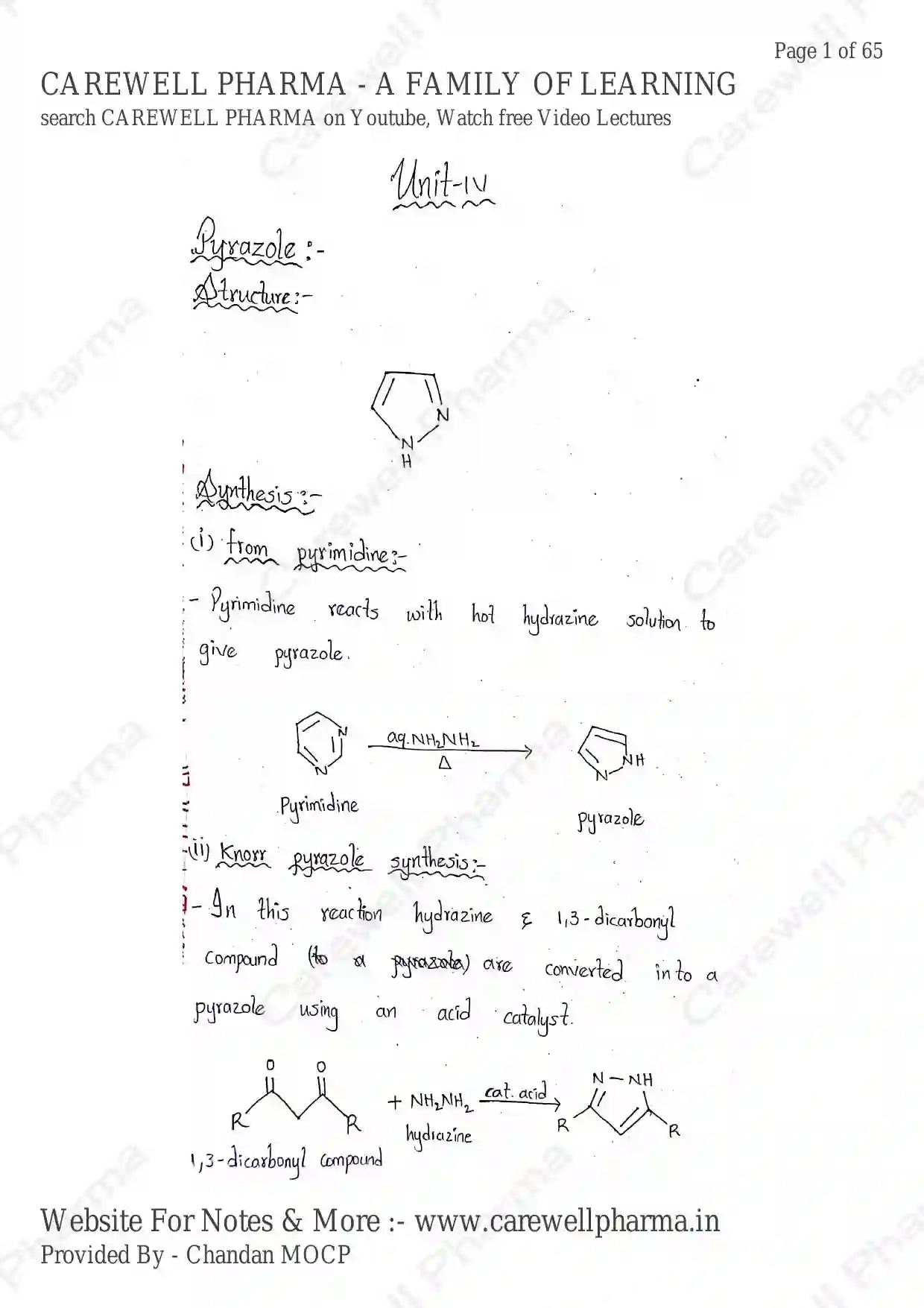
1. Pyrazole
- It is a heterocyclic compound with the formula .
- It is a five-membered ring structure consisting of three carbon atoms and two nitrogen atoms at adjacent position.

Medicinal Uses
- Used as analgesic (pain relievers) and antipyretic (fever reducers).
- Also used as anti-inflammatory (treat arthritis).
- Antiviral, Anti cancer.
2. Thiazole
- It is a heterocyclic compound with the formula , consisting of a five-membered ring containing both sulfur and Nitrogen atom.

Medicinal uses
- Used as antibacterial, antifungal, anti-inflammatory, antiviral etc.
3. Oxazole
- It is a heterocyclic compound with the formula consisting of a five membered ring containing both oxygen & Nitrogen atom.

- Also used as Antibacterial, antifungal, anti-inflammatory.
- Eg: Oxacillin, Oxazepam.
4. Quinoline
- It is a heterocyclic aromatic compound with the formula , consisting of a fused ring system containing a benzene ring and a pyridine ring.

- Chloroquine (Antimalarial)
- Mefloquine (Antimalarial)
- Ciprofloxacin (Antibacterial medication).
5. Isoquinoline
- It is a heterocyclic aromatic compound with the formula , consisting of a fused ring system containing a benzene ring and a pyridine ring, but with a different ring fusion position than quinoline.

- Papaverine Antispasmodic
- Drotaverine
PYRIMIDINE
- It is a heterocyclic aromatic compound with the formula , consisting of a six-membered ring containing two Nitrogen atoms.

SYNTHESIS
1. Gabriel Synthesis
- It Involves reactions between urea and malonic acid to give barbituric acid, which on reaction with and Zn dust gives pyrimidine.

2. Whittaker Synthesis
- Reduction of 2,6-dichloropyrimidines by using Pd catalyst.

3. From Alkyl Pyridines
- Methyl pyrimidine pyrimidine carboxylic acid pyrimidine
Medicinal Uses
- 5-fluorouracil - used as an anti-cancer agent.
- Sulfadoxine - Used as an bacterial agent.
- Barbital - used as sedative and Hypnotic.
PURINES
- These are a class of heterocyclic aromatic compounds. with the formula , consisting of a fused ring system containing a pyrimidine ring and an imidazole ring.

METHOD OF PREPARATION / SYNTHESIS
1. Fischer Method : It involves conversion of uric acid into 2,6,8-trichloropurine by reaction with . Excess of chlorine atoms are removed by reduction with HI to form purines.

2. Traube's Method : Heating of 4,5-diamino pyrimidines with formic acid to give purines.

3. From Formamide :

MEDICINAL USES
- Adenine a component of DNA/RNA
- Guanine a component of DNA/RNA
- Caffeine stimulant and vasodilator
- Mercaptopurines Anticancer medications
DERIVATIVES
- Hypoxanthine
- Xanthine
- Uric acid
- Caffeines etc..