Medicinal Chemistry 1 - Unit 4
Syllabus
Drugs acting on Central Nervous System
1. Sedatives and Hypnotics
Benzodiazepines:
SAR of Benzodiazepines, Chlordiazepoxide, Diazepam\*, Oxazepam, Chlorazepate, Lorazepam, Alprazolam, Zolpidem
Barbiturtes:
SAR of barbiturates, Barbital\*, Phenobarbital, Mephobarbital, Amobarbital, Butabarbital, Pentobarbital, Secobarbital
Miscelleneous:
Amides & imides: Glutethmide.
Alcohol & their carbamate derivatives: Meprobomate, Ethchlorvynol.
Aldehyde & their derivatives: Triclofos sodium, Paraldehyde.
2. B
Phenothiazeines:
SAR of Phenothiazeines - Promazine hydrochloride, Chlorpromazine hydrochloride\*,
Triflupromazine, Thioridazine hydrochloride, Piperacetazine hydrochloride,
Prochlorperazine maleate, Trifluoperazine hydrochloride.
Ring Analogues of Phenothiazeines:
Chlorprothixene, Thiothixene, Loxapine succinate, Clozapine.
Fluro buterophenones: Haloperidol, Droperidol, Risperidone.
Beta amino ketones: Molindone hydrochloride.
Benzamides: Sulpieride.
3. Anticonvulsants:
SAR of Anticonvulsants, mechanism of anticonvulsant action
Barbiturates: Phenobarbitone, Methabarbital.
Hydantoins: Phenytoin\*, Mephenytoin, Ethotoin
Oxazolidine diones: Trimethadione, Paramethadione
Succinimides: Phensuximide, Methsuximide, Ethosuximide*
Urea and monoacylureas: Phenacemide, Carbamazepine*
Benzodiazepines: Clonazepam
Miscellaneous: Primidone, Valproic acid , Gabapentin, Felbamate
Scroll to Download
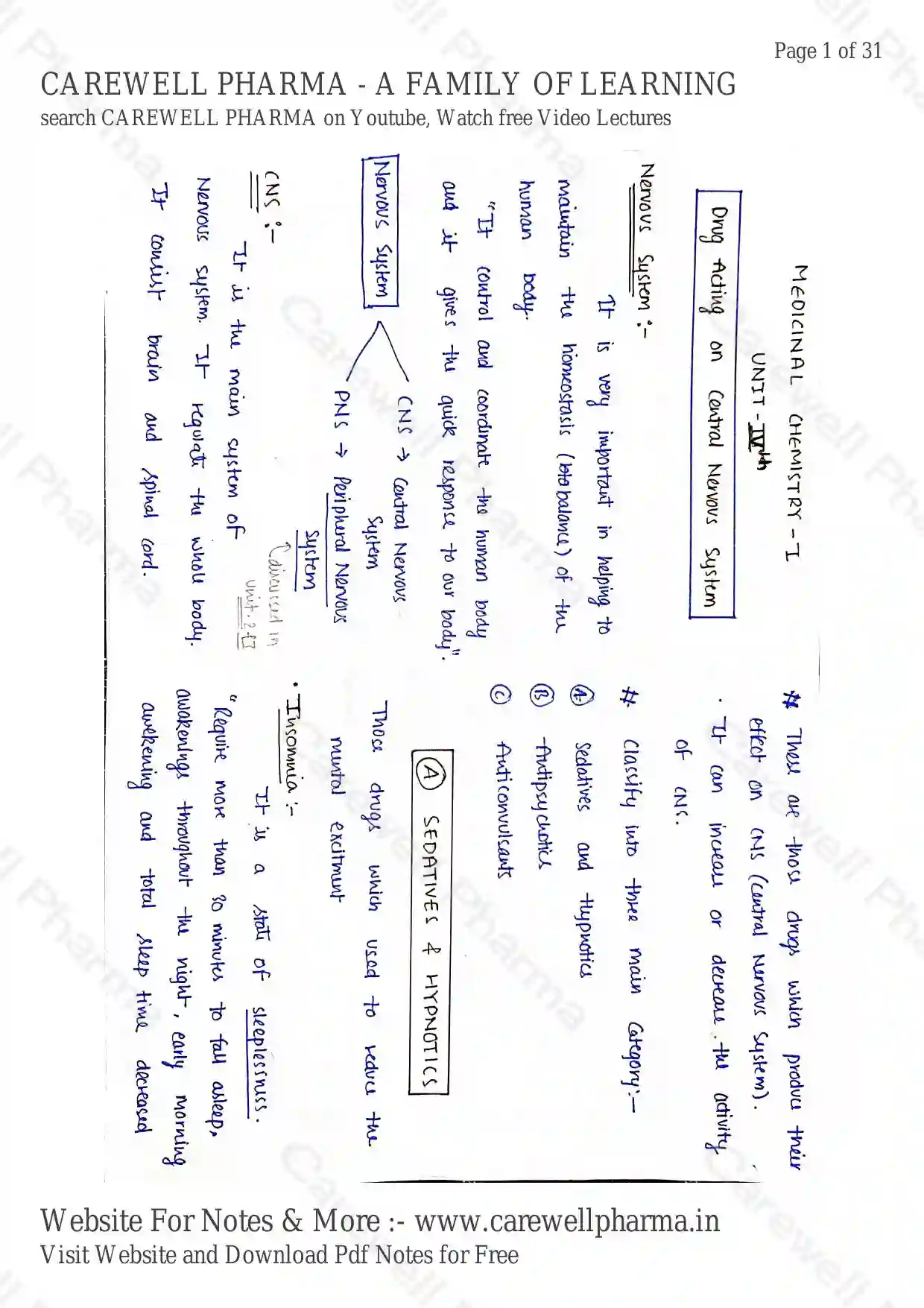
MEDICINAL CHEMISTRY-I UNIT-4
Drug Acting on Central Nervous System
Nervous System
It is very important in helping to maintain the homeostasis (bta balance) of the human body.
"It control and coordinate the human body and it gives the quick response to our body".
Nervous System
- CNS: Central Nervous System
- PNS: Peripheral Nervous System (Cairevised in Unit-2-13)
CNS
It is the main system of Nervous system.
It regulate the whole body.
It consist brain and spinal cord.
- These are those drugs which produce their effect on CNS (Central Nervous System). can increase or decrease the activity of CNS.
- Classify into three main Category
A) Sedatives and Hypnotics
B) Antipsychotics
C) Anticonvulsants
(A) SEDATIVES & HYPNOTICS
Those drugs which used to reduce the mental excitment.
Insomnia : It is a state of sleeplessness. "Require more than 30 minutes to fall asleep, awakenings throughout the night, early morning awekening and total sleep time decreased to less than 6 hours.
This is due to increased in mental excitment or emotional stress, any other factor such as hypertension etc...
Definetion : Sedative and Hypnotic are those drugs which act on CNS and reduce metal excitment and Cause CNS depression and produce mild sedation to sleep.
Small doses cause Sedation and higher doses Causes hypnosis and en exces amount Cause Surgical anaustheia.
Sedatives : those drugs which can decrease activity and moderate excitment to the patients and also calm the patients but does not produce natural sleep.
Sedation mild depression to CNS, used in emotional stress, hypertension, convulsions of prenasthesia ete...
Hypnotic : Those drug which decrease mental excitment, produce drowsiness and complete normal sleep.
Hypnosis: strong depression of CNS, cause sleep. used in insomnia.
Classification of Sedative and Hypnotics
- Sedatives & Hypnotics
- Benzodiazepines
- Chlordiazepoxide
- Diazepam*
- Oxazepam
- Chlorazepate
- Lorazepam
- Alprazolam
- Zolpidem
- Barbiturates
- Barbital*
- Phenobarbital
- Mephobarbital
- Amobarbital
- Butabarbital
- Pentobarbital
- secobarbital
- Miscelleneous
- Alcohol
- Meprobomate
- Ethchlorvynol
- Amides
- Glutethmide
- Aldehyde
- Paraldehyde
- Triclofos sodium
- Benzodiazepines
Mechanism of Sedative & Hypnotics
GABA receptor are present in our body in which GABA neurotransmitter bind and open channel.
- Receptor Ionotropic.
- Receptor GPCR.
Mechanism of Benzodiazepines bind with binding sites on open channel $\downarrow$ $Cl^-$ influx $\downarrow$ Hyperpolarisation $\downarrow$ Stop channel $\downarrow$ CNS activity
Mechanism of Barbiturates bind with their binding sites on increase the time of opening of channel $\downarrow$ $Cl^-$ influx $\downarrow$ Hyperpolarisation $\downarrow$ Stop channel $\downarrow$ CNS activity
Normally communication b/w cells are polarised. Whenever any stimulas generate it depolarised cell and activity occured.
- Now, there are increasement in the activity of CNS.
Benzodiazepines
- So, Benzodiazepines (Bzd, Bdz, BZs) Benzodiazepines was accidently synthesized in 1961.
- They have sedative, hyptonic, anti-anxiety, anti convulsant and muscle relaxant properties.
- Mainly used anxiolytic drugs used to treat anxiety, insomnia and a range of other several condition.
- Used in place of barbiturates for anxiety, because they are safer and more effective.
- Low doses Sedatives. High doses Hypnotics.
Mechanism : Benzodiazepines increase the effect of the neurotransmitter GABA (Gamma aminobutyric acid) which reduce the activity of neurons (that cause stress and anxiety).
SAR of Benzodiazepines
The basic structure of benzodiazepines
- Structurally, Substitution (modification) is possible on
- Ring A - Aryl group
- Ring B - 1,4-Diazepine ring
- Ring C - Phenyl substitution
- Ring A
- In ring A, attachement of an electron withdrawing group like , , or at 7th position will increase the activity. eg. flurazepam.
- If we add any substitute at position 6, 8th & 9th in ring A, the activity decreases .
- Ring B
- In Ring B, substitution of alkyl group like or at position 1st on Nitrogen will increase activity (essential). eg. flurazepam.
- Carbonyl group ($C=O$) present at position 2nd is essential & good for activity. Replacement of this carbonyl function with two hydrogen atom gives Medazepam, which is less effective (activity decreases $\downarrow$).
- By replacing one of the hydrogen with group at position 3rd lowers the activity & facilitates elimination.
- Attachment of carbonyl group at position 3rd increase duration of action & forms water soluble salts.
- At position 4th & 5th double bond is good for activity, saturation of this reduce potency.
- Ring C
- Phenyl substitution at position 5th is increase activity.
- Attachement of an electronegative substitution like and at ortho and di-ortho position will increases activity .
- By replacing this benzene ring with aromatic heterocyclic ring (eg. pyrazole) increase anxiolytic properties eg Ripazepam etc..
Drugs
1) Chlordiazepoxide
Mechanism
- Increase the activity of GABA in the brain.
Uses
- Used in treatment of anxiety & insomnia.
- Used in treatment of withdrawl symptoms from alcohol (Nausia, muscle spasm) etc..
2) Diazepam
Most prescribed drug as a benzodiapepines.
Yellowish white crystalline powder.
Most prescribed drug as a benzodiazepines.
Metabolized in liver & give oxazepam and temazepam as metabolites.
Mechanism
- Bind with GABA Receptor
- Increase the activity of GABA
- Decrease CNS
Uses
- Used in the treatment of anxiety and insomnia.
- Treat symptoms of alcohol withdrawal.
- Used to treat muscle spasm, seizures and restless legs syndrome.
Synthesis
3) Oxazepam
It is a white crystalline powder, practically insoluble in water.
Mechanism
- Mechanism same as diazepam.
- Produce anxiolytic effects.
Uses
- Used in treatment of insomnia.
- Used for anxiety disorder.
- Control the symptoms of alcohol withdrawl syndrome.
4) Chlorazepate
Clorazepate long acting benzo-diazepines
Mechanism
- Bind on Open channel CNS
Uses
- Used in treatment of insomnia & anxiety. Used as muscle relaxant.
5) Lorazepam
It is readily absorbed and exerted in urine as its inactive glucuronide.
Mechanism
- Same (common mechanism)
Uses
- Short acting benzodiazepines.
- Used as hypnotics in treatment of anxiety disorder.
- Used as anticonvulsant.
6) Alprazolam
- Mechanism
- Same
- Uses
- Short acting.
- Used as antianxiety, sedative, hypnotic.
- Used as skeletal muscle relaxant, anticonvulsant & antidepressant.
7) Zolpidem
Mechanism
- It have high affinity toward subunit of GABA than same mechanism.
Uses
- Used in the treatment of insomnia.
Barbiturates
- They are the potent CNS depressants.
- They have sedative, hypnotics, anaesthetic and anticonvulsant activity.
- Before benzodiazepines they are the most used drugs as a sedative & hypnotics.
- They are the derivatives of 2,4,6-trioxohexahydropyrimidine.
- These are acidic in nature.
SAR of barbiturates
- The main drug in barbiturates is barbituric acid 2,4,6-trioxo hexahydropyrimidine.
- It has less CNS depressant but substitution at various position give many compounds with sedative and hypnotic activity.
- Substitution has been done at 1st & 5th position.
At 5th position
- Replacement of 'H' atom by alkyl group at 5th position increase the ability of drug to cross BBB (blood brain barrier) & activity increases. eg. Phenobarbitone.
- Now, further increase in the branching of this alkyl chain at position 5th increase lipophilicity potency duration of action eg Pentobarbitone.
- Higher the branching greater will be its potency. but, more than 8-9 (approx.) branching, CNS depressant action decreases.
At 1st position
- Substitution of group at position 1st on nitrogen increase lipophilicity (lipid solubility) which increase activity but decrease duration of action. eg Methyl phenobarbitone.
- At position 1st and 3rd on nitrogen, Replacement of 'H' atom by alkyl group at only one 'N' increase activity . But, replacement of 'H' at both 1st & 3rd position decrease activity .
Mechanism
Barbiturates promote binding of GABA bind on their binding site (on & \beta$) $\rightarrow increase the time of opening of channel influx Hyper-polarisation CNS depress .
All drugs have almost same mechanism
1) Barbital
Also known as "Barbitone".
5,5-diethyl barbituric acid.
MOA
- Stimulate GABA neurotransmitter and depress CNS.
Uses
- Used in the treatment of epileptic seizures.
- Used as sedative and hypnotic in the treatment of insomnia.
- Synthesis of Barbital
2) Phenobarbital
Mechanism
- Stimulate GABA receptor Cause depression of CNS.
Uses
- Used both as sedative and hypnotic.
- Also has anticonvulsant effect.
3) Mephobarbital
Also known as Methyl phenobarbital.
Mechanism
- Non-selective CNS depressant.
- Same.
Uses
- Used as sedative & Hypnotics.
- Used to treat anxiety, excitment & also anticonvulsant agent.
4) Amobarbital
Intermediate acting barbiturates duration of action (3-6 hours).
Mechanism
- Bind on & subunit of GABA receptor increase duration and conductance of channel Influx of CNS depress.
Uses
- Used as a sedative & hypnotic for the treatment of insomnia.
- Used to treat anxiety, epilepsy (used as anticonvulsant).
5) Butabarbital
Mechanism
- Same as other.
Uses
- Used to treat severe insomnia due to fast onset effect & short duration of action. also used to relieve anxiety before surgical procedure.
6) Pentobarbital
Short acting drug.
Mechanism
- Stimulate GABA receptor (Same).
Uses
- Used as sedative and hypnotic for short term preanesthetic procedure.
- Used as anticonvulsant in emergency condition.
- Used to reduce intracranial pressure in Reye's syndrome.
7) Secobarbital
White hygroscopic powder. tendency to absorb moisture.
Mechanism
- same.
Uses
- Used as sedative and hypnotics in severe insomnia.
- Used as anticonvulsant.
- Also used as anesthetic and anxiolytic.
Miscellaneous
Amides & Imides - Heterocyclic compound which have amide linkage.
1) Glutethimide
Mechanism
- GABA agonist induced sedation.
Uses
- Used in treatment of insomnia.
Alcohol & their carbamate derivatives -
1) Meprobamate
Mechaism
- Not exactly, but bind with GABA receptor & cause sedation.
Uses
- Used as hypnotic, sedative, anti-anxiety, muscle relaxant and anticonvulsant.
2) Ethchlorvynol
Mechanism
- Bind at GABA benzodiazepine receptor & depress CNS.
Uses
- Used as sedative & hypnotic in treatment of short term insomnia.
Aldehyde & their derivatives -
1) Triclofos sodium
Mechanism
- It rapidly hydrolysed to trichloroethanol which act on brain & produce sleep.
Uses
- Used as a sedative & hypnotic to treat insomnia.
2) Paraldehyde
Mechanism
- Reduced the release of acetylcholine.
Uses
- Used as hypnotic and sedative.
- Used as anticonvulsants.
- Used as expectorant in some cough medicines.
- Manufacturing in resin & also as a preservative.
(B) ANTI PSYCHOTICS
Also known as "Neuroleptic".
- Anti Oppose
- Psychotics psychoses
"These are those drugs which are used to reduce the symptoms of psychosis".
Psychosis : A mental disorder characterized by disconnection from reality.
It may occurs due to or as a result of -
- Schizophrenia (most common) - In this condition patient's mind is always in excitment state.
- Mania Euphoria, पागलपन.
- Bipolar Disorder - manic depression.
- Sometime mentally excited
- Sometime mentally depressed mood swings.
Sleep deprivation (loss of sleep).
Substance use such as alcohol, some drugs etc..
Stress.
- Symptoms
- Hallucination
- Delusions
- talking incoherently
- Aggression & anxiety
- Abnormal behaviour
- Confusion
- Nightmares & thoughts of suicide etc..
- Antipsychotic drugs are not curative, they do not eliminate this disorder, they only decrease the symptoms & make person comfortable to function in a supportive environment.
Mechanism
Dopamine which belong to the class of catecholamine is responsible for these activity in brain.
- Dopamine bind with its receptor ($D_1, D_2, D_3$) and cause activity but when it's concentration is increases then it increases the activity of CNS (brain) multiple time, which cause psychoses & others.
- Anti-psychotic drugs competitively bind, with dopamine receptor, and block, the action of dopamine on the corresponding receptor sites and hence lowers the psychotic activity.
Classification of Antipsychotics
- Phenothiazines
- Promazine hydrochloride
- Chlorpromazine hydrochloride*
- Triflupromazine
- Thioridazine hydrochloride
- Piperacetazine
- Prochlorperazine maleate
- Trifluoperazine hydrochloride
- Ring Analogues of Phenothiazines
- Chlorprothixene
- Thioxene
- Loxapine succinate
- Clozapine
- Fluro butyrophenones
- Haloperidol
- Droperidol
- Risperidone
- Beta amino ketones
- Molindone hydrochloride
- Benzamide
- Sulpiride
Phenothiazines
- Tricyclic antipsychotics.
- These are used for treating severe mental and emotional disorder such as schizophrenia and other psychotic disorders. (all symptoms included).
- These are non-selective and competitive antagonists of and receptor and blocks the dopamine activity.
- Sometimes used to relieve anxiety, control nausea, diarrhoea and cause muscle relaxation.
SAR of Phenothiazines
- Basic structure of Phenothiazines
- Structurally, Substitution (modification) is possible on:-
- Position
- Position .
- Unsubstituted phenothiazines has no activity so, substitution at & is essential for activity.
- Also 'N' and 'S' is essential for activity.
Position
- At position , addition of withdrawing group such as will increases the activity.
- Activity increases in the following order at position : $-OH < -H < -CH_3 < -C_2H_5 < -COCH_3 < -COCl < -SCH_3 < -Cl < -CF_3$
Position
- At position 10, aliphatic chain (terminal amino substituent) is essential for activity. there are three methylene unit i.e. . Reduction in these carbon number reduces the activity.
- By branching the $\beta$-position of the side chain (aliphatic chain) with small methyl group, decrease in antipsychotic activity but increase in antihistamine activity.
- The position can be replaced isosterically by ethylidene group to form various thioxanthenes (ring analogues). These are more potent than the parent drugs eg Chlorprothixene and thiothixene etc.
- If we increase the chain length at 'N' on aliphatic chain (at last), then Lipophilicity & their duration of action increases.
Drugs
1) Promazine hydrochloride
Mechanism
- Act as antagonist at dopamine receptor, 5HT receptor, muscarinic receptor and also histamine receptor.
Uses
- Used for short term treatment of distributed and agitated behaviour.
- It has weak antipsychotic activity.
- Used as antiemetic. prevent vomiting.
2) Chlorpromazine hydrochloride
Mechanism
- Act as antagonist of Dopamine, serotonin, Histamine, adrenergic & muscarinic receptor.
Uses
- Used in the treatment of schizophrenia.
- Used in treatment of nausea & vomiting.
- Used in porphyria & as a part of tetanus treatment.
- Synthesis
3) Triflupromazine
Mechanism Same as chlorpromazine.
Uses
- Used in treatment of psychotic disorder.
- Also used to control nausea & vomiting.
4) Thioridazine hydrochloride
Mechanism
- Act as antagonist for dopamine and adrenergic receptors.
Uses
- Treatment of psychosis.
- Used to control disturbed & agitated behaviours.
- Antiemetic.
5) Piperacetazine hydrochloride
Mechanism
- Block $D_2$-dopamine receptor (antagonist).
Uses
- Used as tranquilizer
- Used in treatment of psychosis.
6) Prochlorperazine maleate
Mechanism
- Block $D_2$-dopamine receptor (antagonist).
- Also block anticholinergic and alpha adrenergic receptors.
Uses
- Used as antipsychotic drugs & antiemetic.
- Used in treatment of migraine headaches.
7) Trifluoperazine hydrochloride*
Mechanism
- Act as antagonist for dopamine receptor.
Uses
- Used in the treatment of schizophrenia and acute mania disorder.
- Antiemetic.
- Treat anxiety.
Ring Analogues of Phenothiazines
Those drugs which have same ring as phenothiazine.
1) Chlorprothixene
- Mechanism
- Act as antagonist of Dopamine, muscarinic, adrenergic and histamine receptor.
- Uses
- Used in treatment of schizophrenia & acute mania disorder (bipolar disorder).
- Used to treat anxiety and insomnia.
2) Thiothixene
Mechanism
Highly potent antagonist of dopamine receptor. and weak affinity for histamine, $\alpha$-adrenergic and serotonin 5-HT receptor.
Uses
- Used to treat schizophrenia and bipolar mania.
- Reduce aggression and the desire to hurt yourself and others.
- Help to decrease hallucinations.
3) Loxapine succinate
Mechanism
- Antagonist for Dopamine or Serotonin 5HT receptor.
Uses
- Used for managing the symptoms of psychotic disorder like schizophrenia.
4) Clozapine
Mechanism
- Antagonist of dopamine and serotonin receptor.
Uses
- Antipsychotic used in treatment of schizophrenia.
- Used for those patient who are un-responsive and intolerant to other anti-psychotic drugs.
Fluoro Butyrophenone
1) Haloperidol
More potent than chlorpromazine
- Mechanism (not accurate)
- It completely blocks dopamine receptor.
- Uses
- Used as antipsychotic and antiemetic.
- Used as sedative in intensive care treatment (it depress CNS).
2) Droperidol
Mechanism
- Similar as other drugs.
Uses
- Used in the treatment of schizophrenia and other psychotic disorder.
- Also used in management of severe anxiety & also used as antiemetic.
3) Risperidone
Mechanism
- It act as antagonist of dopamine, serotonin, $\alpha_1$-adrenergic and histamine receptor.
Uses
- Used in treatment of schizophrenia and other psychotic disorders. used to treat mood disorder (bipolar disorder and mood swings).
Beta Amino ketones
Also used as a antipsychotics.
1) Molindone hydrochloride
Mechanism
- Act on $D_2$-dopamine receptor and decrease their activity.
Uses
- Effective in treatment of schzophrenia & others.
Benzamides
1) Sulpiride
Mechanism
- selective and act as a $D_2$-dopamine receptor antagonist.
Uses
- Mainly used in treatment of schizophrenia. Also used as a antipsychotics
(C) ANTICONVULSANTS
- It is also known as Anti-seizure OR Anti-Epileptics.
- These are those drugs which are used to treat epilepsy and convulsion (involuntary muscle contraction).
Epilepsy : It is a brain disorder in which the normal pattern of neuronal activity become disturbed. (abnormal neurohumoral transmission). - Neurological disorder.
Epilepsy cause (symptoms)
- Seizures
- Strange sensation, emotions and behaviours
- Convulsions (involve shaking & involuntary contraction of body muscles).
- Muscle spasm
- Loss of consciousness.
- Proxymal attacks.
Mechanism
- These are all due to excitation of cerebral neurons in the brain.
- Seizures are generated in the epileptogenic center of the brain.
- Occurs due to any toxins, trauma, hyperthermia (abnormally high body temp), Medical overdose or discontinuous of medication.
- Electroencephalogram (EEG) recording of brain activity.
- We can diagnose epilepsy in it. (In epilepsy, occurs abnormal and excessive discharges).
Types of Epilepsy (Epileptic seizures)
a) Generalised seizures
b) Partial (Local) seizures
a) Generalised seizures
It affects both sides of brains.
- Absence seizures (petit mal seizures)
- Mostly in childrens.
- Loss of consciousness.
- Blinking of eyelid & jerking of the entire body.
- asts for 30 sec.
- Tonic-clonic (Grand mal) seizures
- Sequence of tonic spasm (muscle become stiff) and clonic jerking of all muscles.
- Loss of consciousness.
- Fall to the ground.
- Lasts for 2-5 minutes.
- Call 911 if seizure lasts more than 5 Min.
b) Local seizures (Partial) : In which neuronal abnormal discharge are localised to a particular area in the brain.
It last for a 20-60 seconds.
Simple : Small part of the brain.
- Cause twitching or a change in sensation,
Complex Confused, unable to respond for up to minutes. last for 2 minutes.
Secondary generalised spread one part of brain to the whole brain. (local to general).
Mechanism of Anticonvulsant
- Anticonvulsant used to treat epilepsy & seizures.
- Drugs used in major attack Phenytoin, mephobarbital, Carbamazepine.
- Drugs used in minor attack Clonazepam, valproic acid etc..
- Mechanism
Drugs bind GABA receptor open channel influx CNS activity decreases. eg. Barbiturates, Benzodiazepines etc..
There are also some drugs which block neuronal discharge by blocking the channel. (ion channels). channel. eg. Hydantoins, Succinimides etc..
Classification of Anticonvulsants
- Barbiturates - Phenobarbitone, Methabarbital
- Hydantoins - Phenytoin, Mephenytoin, Ethotoin
- Oxazolidine diones - Trimethadione, Paramethadione
- Succinimide - Phensuximide, Methsuximide, Ethosuximide*
- Urea and monoacylureas - Phenacemide, Carbamazepine*
- Benzodiazepines - Clonazepam
- Miscellaneous - Primidone, Valproic acid, Gabapentin, felbamate.
SAR of Anticonvulsants
Basic structure of anticonvulsants
Substitution at position 1st yield the various classes of anticonvulsants.
- Substitution of yield barbiturates.
- Substitution of yield hydantoins.
- Mostly substitution occurs at position 5th.
SAR of barbiturates already discussed in Sedative & Hypnotics.
Carbonyl group present at position 2nd & 4th is essential for activity. So, detachment of this group decrease activity.
Substitution of phenyl or other aromatic ring at position 5 increases its activity eg Phenytoin.
Substitution of alkyl & phenyl produce sedation. eg mephenytoin.
- Substitution of by yield oxazolidine.
- Methyl group at position 3rd in place of & increases the activity. (essential).
- Alkyl group at position 5th in place of & increases the activity. (essential). eg Trimethadione, Paramethadione. Oxazolidine dione are useful in the treatment of grand-mal epilepsy.
- Substitution of by yield succinimide.
- Substitution at by aryl group formed active form eg phensuximide.
- Alkyl chain form active form eg Ethosuximide.
- Substitution at position 1st in place of 'H' is also formed active form. eg. methsuximide.
- Benzodiazepines (discussed in Sedatives & hypnotics).
- Valproic acid increase chain length increases the anticonvulsant activity. introduction of a double bond decrease the activity.
1) Barbiturates
The main antiepileptic drug is Phenobarbitone.
i) Phenobarbitone
Mechanism
- It may block channel. Increases GABA function.
Uses
- Used in the treatment of grand mal epilepsy.
- Used as anticonvulsants, sedative, hypnotics.
ii) Methabarbital
Mechanis
- Bind with GABA receptor increase the activity of GABA receptor increase neuron.
Uses It is used in the treatment of generalized tonic-clonic seizures.
2) Hydantoins
i) Phenytoin
Mechanism
- It blocks the voltage gated Sodium channel.
Uses
- Useful in the treatment of tonic-clonic and partial seizures but not effective in absence seizures.
- Used in case of trigeminal neuralgia.
Synthesis
- Rearrangement on the reaction of urea and benzil.
ii) Mephenytoin
Mechanism
- Promote sodium efflux from neurons (outside) move and reduce the activity of brain stem centre.
Uses
- Used in the treatment of tonic-clonic seizures.
- Also used to control partial seizures.
- Suitable for those, who are not responding to other agents.
iii) Ethotoin
Mechanism
- Same as phenytoin.
Uses
- It is mostly used in combination with other anticonvulsants.
- Used in tonic-clonic and partial seizures.
3) Oxazolidine diones
i) Trimethadione
Mechanism
- It reduce T-type Calcium current and increases the threshold for repititive activity (seizures), and stabilizes the neuronal membranes.
Uses
- Used in the treatment of absence seizures, when other drugs not work.
- Used as anticonvulsants.
ii) Paramethadione
Mechanism
- Same as trimethadione.
Uses
- Same as trimethadione.
4) Succinimides
Also used in the treatment of absence seizures (less toxic than oxazolidines).
i) Phensuximide
Mechanism
- Suppress the proxymel cycle and wave EEG patter in case of absence seizure.
- Inhibit accumulation of cAMP and cGMP in the brain.
Uses
- Used in the treatment of absence seizures.
- Reduce the frequency of attack.
- Used as an anticonvulsant.
ii) Methsuximide
Mechanism
- Increase threshold of seizures & also suppress the proxymal cycle.
Uses
- Prevent seizures.
- Treatment of absence seizures.
iii) Ethosuximide
Mechanism
- Blockage of T-type Calcium channel.
- same as methsuximide.
Uses
- Used in the treatment of petitmal epilepsy.
- Used in combination with phenytoin & phenobarbitone in the treatment of grand mal.
Synthesis
5) Urea and monoacylureas
Used as anticonvulsants.
i) Phenacemide
Mechanism
- Blocks neuronal sodium channel or voltage sensitive Calcium channel which suppress neuronal depolarisation.
- Increase threshold for eletroshock convulsions.
Uses
- Used in the treatment of generalised tonic-clonic, absence & mixed seizures.
ii) Carbamazepine
Mechanism
- Blocks channel.
- Prevent repetitive firing of action potential.
Synthesis Reaction of 5H-dibenz[b,f]azepine with potassium cyanate to get Carbamazepine.
Uses
- Providing relieve from certain nerve pains.
- Used in the treatment of grandmal epilepsy.
6) Benzodiazepines
Discussed in Sedatives & Hypnotics.
i) Clonazepam
Mechanism
- Stimulate GABA.
Uses
- Used in treatment of all types of epilepsy. Used as sedatives & Hypnotics.
7). Miscellaneous
i) Primidone
Mechanism
- Block channel.
- Stimulate GABA receptor.
Uses
- Used in the treatment of generalized tonic-clonic and partial seizures.
- Management of psychosis.
ii) Valproic acid
Mechanism
- It inhibit the GABA transaminase enzyme which degrade the GABA (major Inhibitor).
- So, increase the action of GABA.
Uses
- Used in treatment of absence and tonic-clonic seizures.
iii) Gabapentin
Mechanism
- Analogue of GABA.
- Inhibit excitatory neuron activity.
Uses
- Used in the treatment of epilepsy.
- Used as analgesic, anti-anxiety, anti manic and anti-parkinson.
- Also used to treate neuralgia.
iv) Felbamate
Mechanism
- Antagonist of NMDA (N-methyl-D-aspartate) receptor ionophore complex and block seizure activity.
Uses
- Used as anticonvulsant/antiepileptic.
- Used in the treatment of partial seizure, when not treated by other drugs.