Medicinal Chemistry 1 - Unit 3
Syllabus
Cholinergic neurotransmitters:
Biosynthesis and catabolism of acetylcholine.
Cholinergic receptors (Muscarinic & Nicotinic) and their distribution.
Parasympathomimetic agents: SAR of Parasympathomimetic agents
Direct acting agents:
Acetylcholine, Carbachol\*, Bethanechol, Methacholine, Pilocarpine.
Indirect acting/ Cholinesterase inhibitors (Reversible & Irreversible):
Physostigmine, Neostigmine\*, Pyridostigmine, Edrophonium chloride, Tacrine hydrochloride, Ambenonium chloride, Isofluorphate, Echothiophate iodide, Parathione, Malathion.
Cholinesterase reactivator:
Pralidoxime chloride.
Cholinergic Blocking agents: SAR of cholinolytic agents
Synthetic cholinergic blocking agents:
Atropine sulphate, Hyoscyamine sulphate, Scopolamine hydrobromide, Homatropine hydrobromide, Ipratropium bromide*.
Synthetic cholinergic blocking agents:
Tropicamide, Cyclopentolate hydrochloride, Clidinium bromide, Dicyclomine hydrochloride\*, Glycopyrrolate, Methantheline bromide, Propantheline bromide, Benztropine mesylate, Orphenadrine citrate, Biperidine hydrochloride, Procyclidine hydrochloride\*, Tridihexethyl chloride, Isopropamide iodide, Ethopropazine hydrochloride.
Scroll to Download
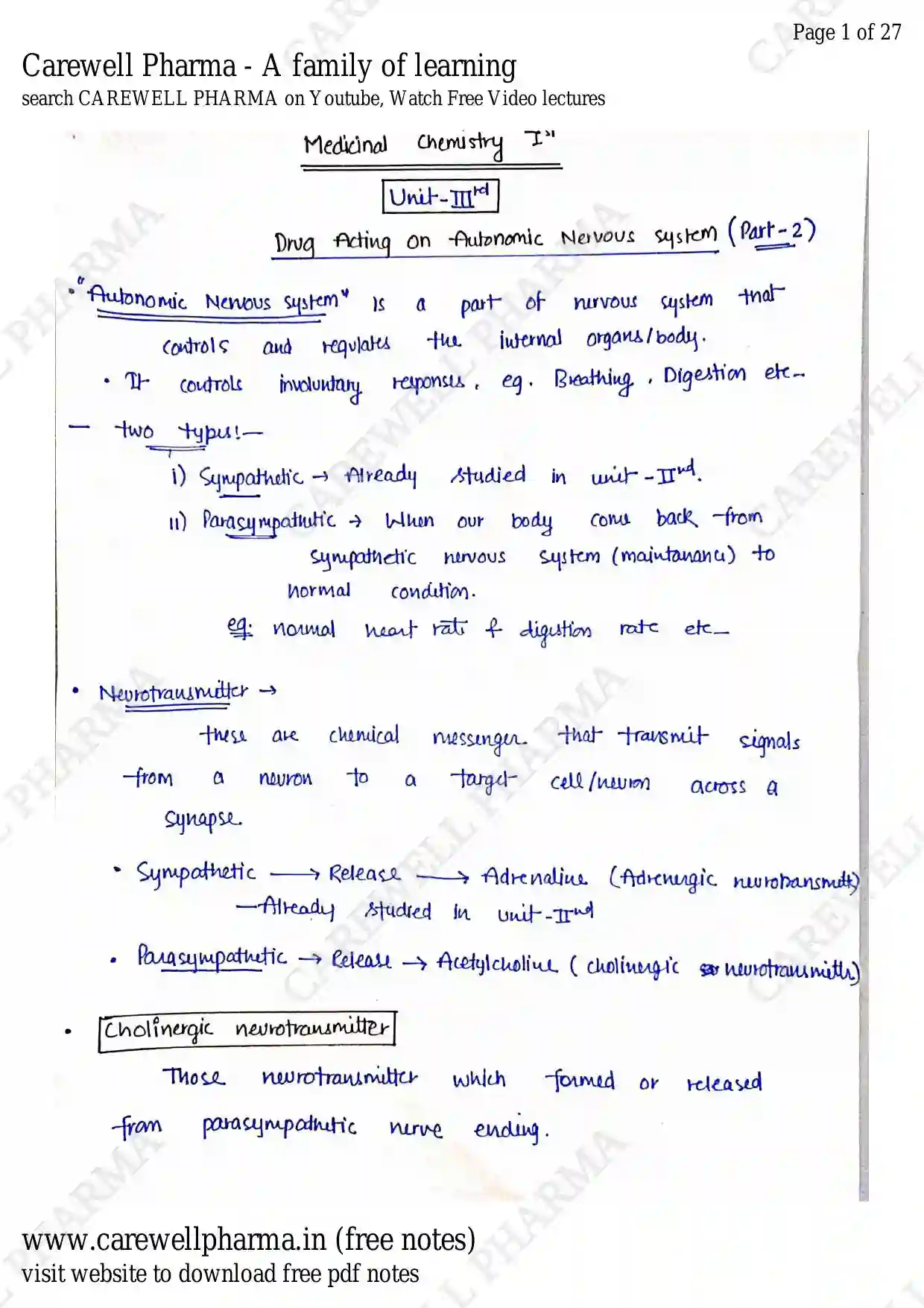
Medicinal Chemistry I"
Unit- III
Drug Acting on Autonomic Nervous system (Part-2)
Autonomic Nervous system
It is a part of nervous system that Controls and regulates the internal organs/body.
It controls involuntary responses eg. Breathing, Digestion etc-
It controls two types
i) Sympathetic - Already studied in unit-IInd. ii) Parasympathetic - When our body come back from Sympathetic condition (nervous) to normal condition. System (maintenance) to normal.
eg: Normal heart rate & digestion rate etc
Neurotransmitter
These are chemical messenger that transmit signals from a neuron to a traget cell/neuron across a synapse.
- Sympathetic neuron Release a chemical messenger. A target cell/neuron signals across a synapse. Adrenaline (Adrenergic neurotransmitter) -Already studied in unit-IInd
- Parasympathetic Release Acetylcholine (cholinergic neurotransmitter) from parasympathetic nerve ending.
Cholinergic neurotransmitter
Those neurotransmitter which formed or released from parasympathetic nerve ending.
Acetylcholine [Ach]
- It is the major neurotransmitter at post ganglionic synapses of cholinergic or parasympathetic nerve ending.
- It is a chemical substance which acts in the brain and body as a neurotransmitter to maintain it.
Biosynthesis, Storag & Release of Ach
Biosynthesis of Acetylcholine
- It is the acetic acid ester of choline. Synthesis of acetylcholine (ach) is done by cholinergic neurons.
- Firstly choline is synthesized in the liver by the reaction between serin and ethanolamine, which is taken up into the nerve terminal by choline transport system (CTS).
- Acetylcholine is synthesized by choline and Acetyl coenzyme A with the help of enzyme Acetyl choline transferase.
(serine) (ethanol amine)
(ethanol amine) (choline)
(Acetyl Co-A) + (Choline) Acetyl Choline [Ach]
Storage
The newly formed Ach is stored into the storage vesicles by the vesicular Ach transporter (VAChT). Each vesicle contain about 1000-50,000 molecules of Ach.
- Within the vesicle Ach is protected from hydrolysis.
Release
Ach is release from the granules (vesicles) under the influence of action potential (opening of ion channel (voltage gated channel)).
Stimulation Activation of nerve membrane ion enter through voltage gated channel Activate protein kinase that phosphorylate synapse. Vesicle fuse with pre-synaptic membrane Vesicle discharge their content (Ach). Ach bind with Receptors (N & M) and give their action (responses).
Catabolism of Acetylcholine
After the release and action of acetylcholine, the function and effects of Ach can be terminated with the help of enzyme hydrolysis.
Acetylcholine Choline + Acetic acid
- Cholinesterases enzyme also known as acetylcholine esterases (ACHE) hydrolyses Acetylcholine (Ach) into the inactive metabolites choline and acetic acid.
Release of Ach is inhibited by Botulinum toxin.
Cholinergic Receptor and their distribution
Cholinergic receptor are those receptor in which cholinergic neurotransmitter/drugs bind directly to induce various action or responses.
These are classified into two types
I) Muscarinic (M) , , , ,
II) Nicotonic (N) ,
1) Muscarinic (M) receptors
- It belongs to the G-protein couple receptors family. It is known as muscarinic receptor, because when cholinergic drugs/neurotransmitter bind with it, it give response like muscarinic.
Muscarinic
It is a water soluble toxin derived from the Mushroom Amanita muscaria which cause activation of parasympathetic nervous system. (effects such as slowed heart rate and increased activity of smooth muscles).
Mechanism
Acetylcholine (other drug same as Ach) Binds to muscarinic Receptors Conformational change in Receptor Activation of G-protein Response/Action
Types
- Present in autonomic ganglia, gastric gland, CNS.
- Function Histamine Release, Acid secretion, Affects memory, learning & motor functions.
- Present in heart.
- Function Decrease velocity of heart conduction.
- Present in smooth muscles of the blood vessels and of the lungs.
- Function Cause contraction of smooth muscles (bronchoconstriction). Release NO (nitrous oxide) to produce vasodilation.
- Present in the CNS and heart.
- function Activation of receptor inhibits acetylcholine release.
- Present in the CNS.
- function It may regulate dopamine release.
Eg Acetylcholine, Methacholine, Bethanechol (M's) drugs which bind.
2) Nicotonic (N) receptors
- It is an ionotropic receptor (Ion channel receptor).
- It is known as nicotonic receptor, because when cholinergic drugs or neurotransmitter bind with it, it give response like nicotine.
- Nicotine
- It stimulates the pleasure centre of the brains.
- It is a drug (highly addictive). the nicotine in cigarettes changes your brain."
- Mechanism
Acetylcholine (other drugs) Binds to nicotonic receptors opening of ion channel Rapid flow of cations Activation
Types
- (Muscle type nicotonic receptor)
- Present in skeletal neuromuscular junction.
- Function - Skeletal muscle contraction, increase cation permeability ($Na^+, K^+$). eg Ach, Nicotine, Phenyl Dimethyl ether etc...
- (Neuronal type nicotonic receptor)
- Present in adrenal medullary cells, spinal cord, ganglionic cells, brain (certain areas).
- Function Depolarization, secretion of catecholamines. eg. Ach, nicotine, piperazine etc.
Parasympathomimetic Agents:
- Also known as cholinergic agonists or cholinergic drugs.
- Parasympathomimetic parasympatho (parasympathetic Nervous System) + mimetic (mimic [copy the action]).
- Parasympathomimetic agents are those chemical agents/drug which copy the action of parasympathetic nervous system.
- These agents or drugs bind with cholinergic receptor (N & M) and give their action. (they act as a cholinergic neurotransmitter)
SAR of Parasympathomimetic agents
SAR - Structure Activity Relationship
- It is defined as the relationship between the chemical structure of a molecules and its biological activity.
- This allow modification of the effect or potency of a substance by changing its chemical structure.
- Parasympathomimetic Agent/drugs
Structurally, modification is possible on
- Acetyl group
- Ethylene chain ( & Carbon)
- Quaternary ammonium compounds
Substitution on acetyl group
Replacement of acetate group, increase activity by more stable Carbamate group.
[Carbachol]
- More active & stable than acetylcholine.
Replacement of ester group by ether & ketone group give chemically stable and potent compounds and have some cholinergic activity.
eg, $\beta$-methylcholine Ethyl ether.
Substitution on ethylene chain ( & carbon)
- Increase in the chain length decrease the activity.
- Branching there are also change in their activity.
- Branching on $\alpha$-carbon increase activity for nicotinic (N) & decrease activity for Muscarinic. (M).
- Branching on $\beta$-carbon increase activity for Muscarinic (M) & decrease activity for Nicotinic (N).
Replacement of Quaternary Ammonium Compounds
- Replacement of quaternary ammonium group by other group (bio-isoster) like sulphonium, phosphonium etc.. leads to loss of activity.
- Replacement of more than one methyl group of quaternary ammonium cause loss of activity.
Classification of Parasympathomimetic agents.
- Direct acting agents
- Indirect acting agents (cholinesterase inhibitors)
- Cholinesterase reactivator
Parasympathomimetic Agents
- Direct acting agents
- Acetylcholine
- Carbachol*
- Bethanechol
- Methacholine
- Pilocarpine
- Indirect acting agents / cholinesterase inhibitors
- REVERSIBLE
- Physostigmine
- Neostigmine*
- Pyridostigmine
- Edrophonium chloride
- Tacrine hydrochloride
- Ambenonium chloride
- IRREVERSIBLE
- Isofluorphate
- Echothiophate Iodide
- Parathione
- Malathion
- REVERSIBLE
- Cholinesterase reactivator
- Pralidoxime Chloride
Direct acting Agents
These are those drugs which directly bind with cholinergic receptor (N & M) and give its action.
i) Acetylcholine
Mechanism of Action
- It is direct acting cholinergic drug.
- It is powerful but its action is destructed by cholinesterase.
Uses
Widely used as eyedrop to cause miosis during surgery & recovery. used as vasodilator & cardiac depressent etc..
ii) Carbachol
Synthesis
(choline chloride) + (Phosgene) (Carbachol)
It is prepared by reacting choline chloride with phosgene in chloroform solution followed by treatment of the product with ammonium hydroxide give Carbachol.
Mechanism of Action
- Bind with both muscarinic and nicotinic receptors.
- It is not inactivated by cholinesterase so its action are more prolonged than acetylcholine.
Uses
- Used in case of severe chronic glaucoma.
- Give intra-ocularly to produce miosis in ocular surgery and to reduce Post operative risk.
iii) Bethanechol
- Mechanism of action
- More selective on the muscarinic receptors.
- It is more stable than carbachol due to presence of methyl group on $\beta$-Carbon.
- Uses
- Used to stimulate GI tract and urinary bladder after surgery.
iv) Methacholine
- Mechanism of Action
- It has muscarinic actions of acetylcholine.
- Prolonged action than acetylcholine.
- Uses
- Used in the treatment of reynaud's syndrome and glaucoma.
- Used in case of tachycardia.
v) Pilocarpine
- Mechanism of Action
- Direct acting cholinergic drug that has muscarinic effect of acetylcholine.
- Uses
- Used in treatment of glaucoma or dry eye, dry mouth.
- Used before acute surgery and in treatment of as part of emergency treatment of attacks of angle-closure glaucoma.
Indirect acting Agents OR Cholinesterase inhibitors
- Also known as anticholinesterases.
- These are those drug which does not directly act on receptors but inhibit the hydrolysis of acetylcholine by acetyl cholinesterases and hence increase the Life of acetylcholine, so acetylcholine give their action.
These are of two types
- Reversible inhibitors
- Irreversible Inhibitors
1) Reversible Inhibitors
- These are those drugs which binds reversibally to the acetyl cholinesterases enzyme.
- These agents form an ester Like carbonate or phosphate and bind with active site of enzyme.
- Now, this enzyme does not hydrolyzed acetylcholine so increases in the concentration of acetylcholine.
i) Physostigmine
Mechanism of Action
- Reversible cholinesterase inhibitors.
- It indirectly stimulate both muscarinic and Nicotinic receptors.
Uses
- Used as a miotic.
- Used to decrease intraocular pressure in glaucoma.
ii) Neostigmine
Synthesis
3-dimethyl aminophenol + Chlorodimethyl carbamoyl chloride [intermediate] Neostigmine bromide
Mechanism of Action
- It indirectly stimulates both muscarinic and nicotonic receptors.
- It bind to the anionic and esteric site of cholinesterase and block the activity of acetylcholinesterase.
Uses
- Used in the treatment of myasthenia gravis.
- Also used in glaucoma (lower Intraocular pressure).
iii) Pyridostigmine
Mechanism of Action
- Block acetyl cholinesterase enzyme and inhibit the destruction of released acetylcholine.
Uses
- Used in the treatment of myasthenia gravis.
- Also helpful in nerve gas poisoning.
iv) Edrophonium Chloride
Mechanism of Action
- Reversible cholinergic Inhibitor.
- Short duration of action than neostigmine and pyridostigmine.
Uses
- Useful for the treatment of myasthenia gravis (not regular).
- Used in the treatment of snake bite.
v) Tacrine hydrochloride
Mechanism of Action
- Centrally acting anticholinesterases.
Uses
- Used for the treatment of Alzheimer's disease.
vi) Ambenonium Chloride
Mechanism of Action
- Reversibly inhibit acetylcholinesterase enzyme.
Uses
- Used in the treatment/management of myasthenia gravis.
2) Irreversible Inhibitors
- These are those drug which produces Irreversible inactivation of acetylcholinesterase enzyme.
- These drugs bind irreversibly by covalent bond to the active site of enzyme and cause inactivation of enzyme.
- This category include various Organophosphorous compounds.
i) Isoflurophate
Mechanism of Action
- Irreversible inactivation of the acetyl cholinesterase.
Uses
- Used as miotic agent in treatment of glaucoma.
2) Ecothiophati Iodide (Echothiophate Iodide)
Mechanism of Action
- Irreversible acetyl cholinesterase inhibitor.
- Permanently inactive the enzyme.
Uses
- Used as an ocular antihypertensive in the treatment of chronic glaucoma.
3) Parathione
Mechanism of Action
- Indirectly inhibitor.
Uses
- Used as insecticide in agriculture.
4) Malathion
MOA
- Binding serine residue on cholinesterase enzyme & inactive it.
Uses
- Used for treatment of scabies. Used as insecticide.
Cholinesterase reactivators
- These are those drugs which cause reactivation of cholinesterase enzyme. these are mainly used in the treatment of poisoning by organophosphates, sulfonates and acetylcholinesterase inhibitors.
Pralidoxime chloride
Mechanism of Action
- It reactivate the enzyme by binding to the anionic site of enzyme and displaces the phosphate from the serine residue.
Uses
- Used for the treatment of poisoning by organophosphorous compounds.
CHOLINERGIC BLOCKING AGENTS: SAR of Cholinolytic agents
- Also known as:
- Cholinergic blocking agents
- Cholinolytic agents
- Anticholinergic agents/drugs
- Cholinergic antagonist
- Parasympatholytic agents
- Antimuscarinic agents
- These are those agents or drugs which inhibit the effect of acetylcholine or parasympathomimetic agents by blocking the cholinergic receptors.
Why??
- Sometime naturally or due to any reason, release of acetylcholine increases and due to excessive release it gives response (which our body does not want).
- Such as Increase in Saliva, In condition of cholinergic poisoning, contraction.
- So, Anticholinergic agents reduce the over-response of acetylcholine.
- Ex: Atropine, Dicyclomine hydrochloride, Ipratropium bromide etc.
SAR of anticholinergic Agents or Cholinolytic agents.
Structure Activity Relationship
General structure of anticholinergic compounds
- A, B = Cyclic substitution
- C = H/OH substitution
- chain
- N = amine group (Cationic head)
Structurally
Modification is possible on:-
- Amine group (Cationic head)
- Chain
- Cyclic substitution
- Hydroxyl group substitution.
Modification in Cationic head (ammonium compounds)
- Quaternary ammonium compounds possess most potent anticholinergic activity.
- So, Replacement of quaternary to the tertiary, secondary or primary cause decreases in activity.
activity
Modification in Chain
- The substitution may be ester, ether, alcohol or amine.
- But, Ester group provides the most potent anticholinergic activity. eg. Atropine etc-
- Sometimes substitution is absent.
Modification in A and B Substitution
- Substitution Could be cycloalkyl, aromatic rings or hetrocyclic rings. Carbocyclic and heterocyclic rings give maximum antagonist activity.
- Replacement of heterocyclic rings to aromatic decrease activity.
- The rings could be identical but the more potent compounds are found to have different ring substitution. Dicyclomine etc-
Substitution in C or Hydroxyl group substitution
- Substitution can be hydrogen (H) or hydroxyl (OH) or hydroxymethyl group.
- In H & OH, OH attached antagonist are more potent (activity $\uparrow$).
- OH Action (activity \uparrow$), duration of action $\uparrow
- H Action (Activity \downarrow$), duration of action $\downarrow
CLASSIFICATION OF ANTICHOLINERGIC AGENTS
Solanaceous alkaloids and analogues
- Atropine sulphate
- Hyoscyamine sulphate
- Scopolamine hydrobromide
- Homatropine hydrobromide
- Ipratropium bromide*
- Tropicamide
- Cyclopentolate
Synthetic cholinergic blocking agents
- Clidinium bromide
- Propantheline bromide
- Benztropine mesylate
- Orphenadrine citrate
- Dicyclomine hydrochloride
- Biperiden hydrochloride
- Procyclidine hydrochloride
- Glycopyrrolate
- Tridihexethyl chloride
- Methantheline bromide
- Isopropamide iodide
- Ethopropazine hydrochloride.
Solanaceous alkaloids and Analogues
- Solanaceous alkaloids are the ester of the tropine, these alkaloids are obtained from plants such as Atropa belladona, Hyoscyamus niger, Datura stramonium etc.
- These all alkaloids called as Solanaceous alkaloids as these plants belongs to the family solanaceae.
- These alkaloids inhibit the effects of parasympathomimetic agents. eg- Hyoscyamine, Atropine, Hyoscine etc-
1) Atropine Sulphate
- It is a racemic mixture of hyoscyamine obtained from root of belladona.
Mechanism of Action
- It has both central and peripheral action. It first stimulates and then depresses the CNS.
Uses
- Used in the treatment of gastric and duodenal ulcers.
2) Hyoscyamine sulphate
Mechanism of Action
- Similar to atropine. more potent than atropine.
Uses
- Treatment of gastric and duodenal ulcers.
- Also used in treatment of parkinsonism,
- Prevent motion sickness.
3) Scopolamine hydrobromide. (Hyoscine)
Mechanism of Action
- It has more rapid onset but shorter duration of action than atropine.
- More potent than atropine.
- More toxic.
Uses
- Used in the treatment of motion sickness.
- Sometimes used before surgery to decrease saliva.
4) Homatropine Hydrobromide
Mechanism of Action
- It is a competitive inhibitor of acetylcholine at the muscarinic receptor, blocks parasympathetic stimulation.
Uses
- It is used to dilate or enlarge pupils in eyes.
5) Ipratropium bromide
Synthesis
Atropine is react with Isopropyl bromide and give ipratropium bromide.
Mechanism of Action
- It is quaternary ammonium compound which blocks muscarinic acetylcholine receptors.
- It is non-selective Muscarinic antagonist.
- Uses
- Used in the treatment of Asthma.
- Treatment of chronic obstructive pulmonary disease (COPD).
SYNTHETIC CHOLINERGIC BLOCKING AGENTS
- Solanaceous alkaloids have lack selectivity and also have side effects this lead to the development of synthetic anticholinergic agents.
- Various modification have been made in the structure of atropine to give various cholinergic antagonist.
1) Tropicamide
M.O.A
- Act as a competitive antagonist for Ach.
Uses
- Used for dilation of pupil (before & after eyes surgery).
2) Cyclopentolate hydrochloride
M.O.A
- Act as a compititive antagonist for Ach. act more quickly than atropine.
Uses
- Used in a eye drop for mydriasis (dilation of pupil).
3) Clidinium bromide
M.O.A
- Bind with muscarinic receptor on smooth muscles and secretory gland & inhibit receptor.
Uses
- It relaxes smooth muscles and decrease biliary tract secretion. used in treatment of irritable bowel syndrome.
4) Dicyclomine hydrochloride
M.O.A
- Acts as non selective smooth muscle relaxant.
- It has specific anticholinergic effect at muscarinic receptor and has direct effect on smooth muscles.
Uses
- Used in the treatment of irritable bowel syndrome. also used in the treatment of gastric and dudonel ulcer.
Synthesis of Dicyclomine hydrochloride
5) Glycopyrrolate
M.O.A
- Blocks muscarinic receptor thus inhibiting cholinergic transmission.
Uses
- Used to treat gastric ulcer by reducing acidic secretion.
- Used before surgery to reduce salivary, bronchial and gastric secretions.
6) Methantheline bromide
M.O.A
- Bind muscarinic receptor & block the action of Ach.
Uses
- It is given in the combination of antacids to treat peptic ulcer.
7) Propantheline bromide
M.O.A
- It blocks the action of acetylcholine by binding to Muscarinic receptor present in various smooth muscle like gut, bladder and eye.
Uses
- Used in the treatment of excessive sweating.
- Used in combination with antacid to treat gastric ulcers.
- Treatment of spasm of the stomach, intestine & bladder.
8) Benztropine mesylate
M.O.A
- Centrally acting anticholinergic or antihistamine agent.
- It is selective Muscarinic antagonist.
Uses used in treatment of parkinsonism. antihistamine and local anaesthetic activity.
9) Orphenadrine citrate
M.O.A
- It is well known non selective acetylcholine receptor antagonist and also antihistamine.
Uses
- It is used to relieve pain due to spasm of voluntary muscle.
- Also used in treatment of parkinson's disease.
10) Biperiden Hydrochloride
MOA
- Acts as a centrally blocking agent and block muscarinic receptors.
Uses
- Used in treatment of parkinson's disease.
- Reduce muscle rigidity.
- Reduce abnormal sweating and salivation.
11) Procyclidine hydrochloride
MOA
- Block muscarinic receptor.
Uses
- Used for treatment of drug induced parkinsonism.
- Used in treatment of Akathisia (movement disorder) and acute dystonia (Neurological movement disorder).
Synthesis
12) Tridihexethyl chloride
MOA
- Bind & block muscarinic receptor.
Uses
- Used as antispasmodic & antiulcer.
13) Isopropamide Iodide
MOA
- Bind & block muscarinic receptor.
Uses
- Used in peptic ulcer, gastritis and hyperchlorhydria.
- Used for treatment of muscular contraction that cause pain, cold.
14) Ethopropazine hydrochloride
MOA
- Partially block central cholinergic receptor and helps to balance cholinergic and dopaminergic activity.
Uses
- Used in the treatment of parkinsonism.
- It have anaesthetic, ganglionic blocking, antihistaminic properties.