Medicinal Chemistry 1 - Unit 2
Syllabus
Drugs acting on Autonomic Nervous System
Adrenergic Neurotransmitters:
Biosynthesis and catabolism of catecholamine.
Adrenergic receptors (Alpha & Beta) and their distribution.
Sympathomimetic agents: SAR of Sympathomimetic agents
- Direct acting: Nor-epinephrine, Epinephrine, Phenylephrine\*, Dopamine, Methyldopa, Clonidine, Dobutamine, Isoproterenol, Terbutaline, Salbutamol\*, Bitolterol, Naphazoline, Oxymetazoline and Xylometazoline.
- Indirect acting agents: Hydroxyamphetamine, Pseudoephedrine, Propylhexedrine.
- Agents with mixed mechanism: Ephedrine, Metaraminol.
Scroll to Download
Medicinal Chemisty-Ist
Unit-IInd
Drugs - acting on Autonomic
Nervous System
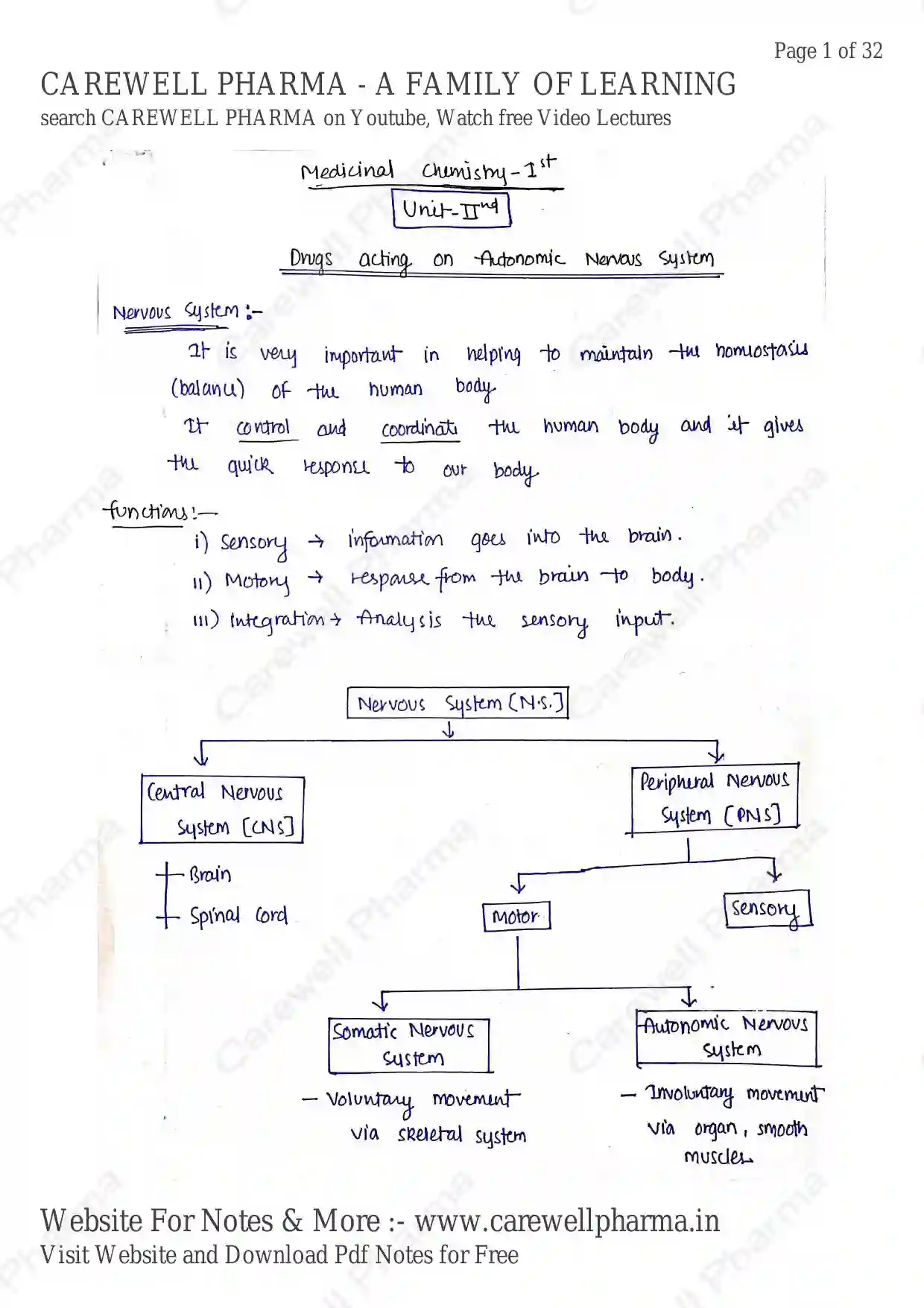
It is very important in helping to maintain the homeostasis (balance) of the human body It control and coordinate the human body and it gives the quick response to our body.
Functions
i) Sensory information goes into the brain.
ii) Motory response from the brain to body.
iii) Integration Analysis the sensory input
Nervous System (N.S.)
- Central Nervous System [CNS]
- Brain
- Spinal Cord
- Peripheral Nervous System (PNS)
- Motor
- Somatic Nervous System - Voluntary movement via skeletal system
- Autonomic Nervous System - Involuntary movement via organ, smooth muscles
- Sensory
- Motor
Autonomic Nervous System [ANS]
Autonomic nervous system part of nervous system that regulates the internal organs / body.
- It control involuntary responses eg. Breathing, digestion etc.
Two types:
Sympathetic : Flight or fight response. when our body is in abnormal sitution et works. (fight or flight sitution) (emergency condition et helps) work such as - increase heart rate, decease digestion rate.
Parasympathetic : When our body come back from sympathetic to normal condition. nervous system (to maintenance) work such as - normal heart rate & digestion rate.
Neuro : It is the basic element of the nervous system. It transmit information to the other nerve cells (neuron), muscle, glands etc...
Neurotransmitters are chemical messengers that transmit signals from a neuron to a target cell/neurons across a synapse.
- Sympathetic = Adrenergic
- Parasympathetic = Cholinergic
Both Adrenergic-Cholinergic division work antagonistically to maintain homeostasis.
Adrenergic system produces Adrenergic neurotransmitter (Catacholamines)
- Dopamine
- Epinephrine (adrenaline)
- Nor-epinephrine
- Dopamine (pleasure) : Feeling of pleasure, also addiction, movement and motivation. people repeat behaviours that lead to dopamine release.
- Nor epinephrine (Nor adrenaline) : Concentration affect attention and responding action in the brain. contract blood vessels, increasing blood flow.
- Epinephrine (Adrenaline) : Fight/Flight It produced in stressful sitution. increase heart rate & blood flow. leading to physical boost & heightened awareness.
Catacholamines
It is mono amino neurotransmitter, in which amine side chain present with a side chain amine.
Biosynthesis of Catacholamine
The biosynthesis takes place in dopaminergic neurons in the CNS and in sympathetic neurons in the ANS, in adrenergic and adrenal medulla.
- I) Phenylalanine get hydrolyzed into tryosine in liver.
- II) Tyrosine get hydrolyzed into DOPA by the enzyme tyrosine hydroxylase. (in cytoplasm of neurons).
- III) DOPA convert into Dopamine with the help of enzyme Dopa decarboxylase, in which is removed. (in cytoplasm of neurons). - Dopamine (first catacholamine formed).
- IV) Dopamine is converted into nor-adrenaline with the help of enzyme dopamine $\beta$-hydroxylase (nor-epinephrine -formed).
- V) Nor-adrenaline get converted into adrenaline with the help of enzyme phenylethanolamine-N methyl transferase (PNMT). (in the adrenal medulla).
Synthesis and release of neurotransmitter
- The Nor-adrenaline formed in the nerve ending remain stored in vesicles in the form of ATP complex.
- Now, nor-adrenaline diffuses out in cytoplasm and get methylated into adrenaline.
- Adrenaline then enter into chromaffin granules and get stored.
- Now, neurotransmitter release from vesicles.
- Then neurotransmitter bind with receptor and give action/response.
Catacholamines (catabolism of Catacholamines)
It is the removal of Catacholamines and also termination of action of catacholamines.
In this process, structure of catacholamines change with the help of enzymes (MAO, COMT) so they do not interact with adrenergic receptor to produce effects.
ENZYMES!
I) MAO Monoamine oxidase (deamination).
II) COMT Catechol-O-Methyl transferase (methylation in ring).
Adrenergic receptor and their distribution.
- Adrenergic receptor are those receptor in which adrenergic drugs/neurotransmitter will bind directly to induce various action/responses.
- Adrenergic receptors are G-protein Coupled receptors, membrane bound.
These are classified into two types
I) receptor .
II) receptor
Distribution of adrenergic receptor with their action
I) receptor
- Present on post synaptic receptor sites.
- Smooth muscles of blood vessels (vasoconstriction)
- Gland cells (Gland secretion)
- Glycogenolysis in liver (glucose synthesis).
- Also these are presents in iris (eye), bladder, uterus etc...
- These are mainly excitatory ($\uparrow$) in nature.
II) receptor
- Present on pre and post-synaptic receptor sites.
- Presents in CNS, pancrease.
Funtion
- Inhibit neurotransmitter release
- Decrease insulin release
- Platelet aggregation
- These are mainly inhibitory ($\downarrow$) in nature.
III) receptor
- Present in cardiac tissue (myocardium) ie Heart and in kidney.
Function
- Contraction and heart rate increases
- Release Renin from Kidney results increases BP.
- Excitatory ($\uparrow$) in nature
IV) receptor
- Present in smooth muscles and gland cells, i.e. Bronchi, blood vessels, uterus, liver, git.
Function
- Relaxation, Bronchodilation, Vasodilation, relaxation.
- inhibitory ($\downarrow$) in nature.
V) receptor
- Present in adipose tissue and urinary bladder
Function
Lipolysis , Relaxation
Sympathomimetics agents
- Also known as Adrenergic agonist.
- Sympatho Sympathetic nervous system
- Mimetic mimic (copy)
- Sympathomimetic agents/drugs are those chemical agents/drugs which copy the action of Sympathetic Nervous system.
- These agents/drugs bind with adrenergic receptor and act as adrenergic neurotransmitter to produce effects or action.
SAR of sympathomimetic agents.
SAR Structure Activity Relationship
- It is defined as the relationship between the chemical structure of a molecules and its biological activity.
- This allows modification of the effect or potency of a substance by changing its chemical structure.
NOR-EPINEPHRINE
Structurally, Substitution (modification) is possible on:-
- Catechol [aromatic ring]
- $\beta$-Carbon
- $\alpha$-Carbon
- amino group
- Substitution on aromatic ring
I) Presence of -OH group at alternate (3,4 position) gives maximum activity. Absence of these group decrease activity (also their potency).
Epinephrine (Adrenaline) More potent. Phenylephrine Less potent.
II) But unsubstituted (without -OH group) aromatic ring, easily cross blood brain barrier [BBB] and have CNS activity.
eg: Amphetamine.
- Substitution on $\beta$-Carbon
- attachment of -OH group on $\beta$-Carbon lower the Lipid solubility of the drug.
- But increase & receptor activity. decrease CNS activity. eg. Ephedrine
- Substitution on $\alpha$-Carbon
- Drugs having substitution on $\alpha$-carbon block the metabolism (activity of MAO) due to which longer duration of action. Eg. Amphetamine
- Substitution on amino group
- The amino group is essential (primary or secondary) but tertiary are poor direct agonists.
- and amino group high selectivity (activity) eg. Epinephrine (adrenaline)
- More the size of alkyl substituent, higher will be $\beta$-selective action, and lower $\alpha$-selectivity. eg. Isoprenaline, salbutamol etc.
Classification of Sympathomimetics Agents/drugs
- Direct acting
- Indirect acting
- Mixed acting
- Direct acting Drugs
- Nor-epinephrine
- Epinephrine
- Phenylephrine*
- Dopamine
- Methyldopa
- Clonidine
- Dobutamine
- Isoproterenol
- Terbutaline
- Salbutamol*
- Bitolterol
- Naphazoline
- Oxymetazoline
- Xylometazoline
- Indirect acting Drugs
- Hydroxy amphetamine
- Pseudoephedrine
- Propylhexedrine
- Mixed action (Mechanism)
- Ephedrine
- Metaraminol
1) Direct acting Drugs
- These are those drugs/agents which directly bind with adrenergic receptors (Both $\alpha, \beta$) and give its pharmacological action.
- The action produced are of rapid onset and of short duration.
I) Nor-epinephrine
Mechanism of action
- Potent at $\alpha$-receptor [less potent than adrenaline.]
- Also effect on $\beta_1$-receptor but no effect on $\beta_2$-receptor.
Uses
- Strong vasoconstriction properties.
- Reduced the absorption and to localise the effects of local anesthetic.
- Intravenous infusion for the treatment of hypotension.
II) Epinephrine
Mechanism of action
- Directly bind with and receptors (potent for all).
- For oral route it is given in the form of prodrug (pivalic acid) to prevent from first pass metabolism.
Uses
- Act subcutaneously to produce vasoconstriction.
- Relaxes bronchial muscles.
- Used in treatment of asthma. used in emergency treatment of anaphylaxis and shock in the cardiopulmonary disease.
III) Phenylephrine
1-(3-hydroxyphenyl)-2-(methylamino) ethanone
Synthesis
Mechanism of action
- Bind at receptors.
- No action on $\beta$-receptors.
Uses
- Vasoconstriction of arterioles, iris and contraction of uterus.
- Increase blood pressure in acute hypotension.
- Used as mydriatic agent using eye surgery.
IV) Dopamine
It is a neurotransmitter that helps to regulate movement and emotional responses. Also for feeling of pleasure.
Mechanism of action
- Directly bind with $\beta_1$-receptor.
- Indirectly on $\alpha$-receptor.
Uses
- Used in patient of shock.
- Also used in trauma, septic shock etc.
- Used in congestive heart failure where it increase BP and urine outflow.
V) Methyldopa
It is yellowish white fine powder, slightly soluble in water and stored in well closed Light resistant container.
M.O.A
- Methyldopa is converted into \alpha$-methyl norepinephrine by enzyme dopamine beta hydroxylase and bind with $\alpha_2 receptor.
Uses
- Used as antihypertensive (lower blood pressure $\downarrow$).
- Helps to prevent heart attack's and kidney problem by reducing the high blood pressure.
VI) Clonidine
M.O.A
- It is centrally acting on receptor.
Uses
- Used to treat hypertension.
- Used as a mild sedative.
VII) Dobutamine
It is a white crystalline powder, soluble in water.
M.O.A
- It is directly stimulate & receptor. (dual acting drugs).
Uses
- It is used to treat heart failure occuring during cardiac surgery.
- Treatment of congestive heart failure.
VIII) Isoproterenol (Isoprenaline)
White, odourless powder with bitter taste.
M.O.A
- Act on both & receptors.
(increase cardiac output).
(increase bronchodilation).Uses
- Used for treatment of bronchial asthma.
- Used in treatment of bradycardia.
IX) Terbutaline
It is grey white, odourless, crystalline powder having bitter taste.
M.O.A
- Bind with $\beta_2$-receptor.
- Better than isoprenaline.
Uses
- Given orally for the treatment of asthma.
- Also used as an aerosol/inhalation.
X) Salbutamol
A white crystalline powder, kept in well closed container and protected from light.
M.O.A
- Directly bind with $\beta_2$-receptor.
Uses
- Used to relax uterine smooth muscles and to delay premature labour.
- Orally for relief of bronchospasm. (narrowing of bronchi).
Synthesis of Salbutamol
XI) Bitolterol
M.O.A
- Bind with receptor. prodrug of colterol.
Uses
- Bronchodilator (used to treat Asthma).
XII) Naphazoline
M.O.A
- Powerful $\alpha$-receptor stimulant. Used ($\alpha_1 + \alpha_2$)
Uses
- Used as a vasoconstrictor.
- Reduced swelling.
- Relief of rhinitis and sinusitis.
XIII) Oxymetazoline
- M.O.A
- Partially agonist at and selective agonist at receptor.
- Uses
- Due to their vasoconstriction properties, it is used to treat nose bleeding and redness of eye due to irritation.
XIV) Xylometazoline
- M.O.A
- Bind with both & receptors.
- Uses
- Produces constriction of large veins in the nose.
- Treat symptoms of nasal congestion, allergies. NASAL DROPS.
2) Indirect acting drugs
- These are those drugs which act indirectly to produce their effects mainly by causing release.
- These drug produce their effects mainly by releasing nor-adrenaline from storage sites.
- These drugs do not themselves react with the receptors but interacts with the neurotransmitter from storage sites which then interacts with the receptors to produce effects.
I) Hydroxy amphetamine
It is a white powder, freely soluble in water.
M.O.A
- Cause release of nor-adrenaline from nerve synapse and Causes dilation of pupil
- Indirectly acting drugs.
Uses
- Used as eye drop to dilate the pupil.
- Used as a diagnostic agents for testing Horner's syndrome (damage of nerves of eyes).
II) Pseudoephedrine
It is an optically active isomer of Ephedrine.
M.O.A
- It stimulate both & receptors.
- It stimulates central nervous system.
Uses
- It increase the blood pressure (Hypertension) by increasing cardiac output and by causing vasoconstriction.
III) Propylhexedrine
M.O.A
- Indirectly active drugs.
- Activates $\alpha$-receptor in the mucosa of respiratory tract.
- Same action as norepinephrine and epinephrine.
Uses
- Used for relief of congestion due to cold, allergies, rhinitis. (inflammation of the mucous membrane of nose due to any virus infection (common cold) or any allergic reaction).
3) Agents with mixed mechanism
- These are those drugs which directly act on adrenergic receptors and also effect the release of noradrenaline.
- Act both as direct acting and indirect acting.
I) Ephedrine
- It occurs naturally in Ephedra [medicinal plant].
- Ephedrine has two asymmetric carbons and exists in four optical isomers
i.e. (-) Ephedrine, (+) Ephedrine, (-) Pseudoephedrine and (+) Pseudoephedrine.
M.O.A
- Acts both directly & indirectly.
- Stimulates both and $\beta$-receptors.
- High stimulates effect on the CNS.
Uses
- Used as nasal decongestant in the form of nasal drops & nasal spray.
- Used in various allergic disease like hay fever and urticaria.
*II) Metaraminol
White crystalline powder and freely soluble in water.
M.O.A
- Act on both & receptors. stimulates noradrenaline.
Uses
- Used in treatment of hypotension.
Adrenergic Antagonist
- These are those drugs which inhibit the effect of sympathomimetic agents by blocking the receptor.
- Antagonist which oppose the agonist. `
- Alpha ($\alpha$) Adrenergic antagonists.
- Beta ($\beta$) Adrenergic antagonists.
Alpha ($\alpha$) adrenergic antagonists (blockers)
These are those drugs which blocks the $\alpha$-receptor and antagonises the effects produced by the drugs acting on $\alpha$-receptors.
- Alpha adrenergic blockers
- i) Tolazoline
- ii) Phentolamine
- iii) Phenoxybenzamine
- iv) Prazosin
- v) Dihydroergotamine
- vi) Methysergide.
I) Tolazoline
- It is a white crystalline powder, which is freely soluble in water.
- It belong to non-selective $\alpha$-adrenergic blockers.
- It is competitive inhibitor of $\alpha$-receptor.
Synthesis
- When 1 mole of benzyl cyanide is react with 1 mole of ethylene diamine in the presence of Carbon disulphide ($CS_2$) it gives Tolazoline.
Mechanism of Action
- It is structurally similar as $\alpha$-agonists, so they bind to $\alpha$-receptor and stop $\alpha$-agonists to produce effects (Reversible).
Uses
- Used as vasodilators.
- It causes stimulation of gastric acid secretion.
- Also used to antagonize the overdose of clonidine.
II) Phentolamine
It is a white crystalline powder, slightly hygroscopic, freely soluble in water.
- Non-Selective.
M.O.A
- It blocks the both & receptor (affinity for both).
Uses
- Used as a vasodilators, inhibit Catecholamines effects (vasoconstriction).
- Used to control hypertensive conditions.
III) Phenoxybenzamine
- It is colourless crystalline compounds, soluble in alcohol, water and chloroform.
- Non-selective $\alpha$-receptor antagonists (blocker).
M.O.A
- Irreversible $\alpha$-blocker.
- Blocks both & receptors.
Uses
- Used in treatment of urinary retention.
- Used in treatment of hypertension caused by pheochromocytoma.
IV) Prazosin
- It is white powder and freely soluble in water.
- It is Selective $\alpha_1$-adrenergic antagonist (blocker).
Structure
M.O.A
- It has affinity for $\alpha_1$-receptor, so it blocks $\alpha_1$-receptors.
Uses
- Used in treatment of heart failure, Raynaud's syndrome.
V) Dihydroergotamine
Structure
M.O.A
- It is an antagonist of $\alpha$-adrenergic receptors.
Uses
- Treatment of migraine.
- Used as vasoconstrictor.
- Treatment of medication overdose headache.
VI) Methysergide
Structure
M.O.A
- It is an antagonist of $\alpha$-adrenergic receptors.
- potent serotonin antagonist.
Uses$
- Used as prophylactic in the treatment of severe recurrent migraine.
Beta adrenergic Blockers
These are those drugs which blocks the $\beta$-receptor and antagonises the effects produced by the drugs (catecholamines) acting on $\beta$-receptor.
- These drugs mostly used as a antihypertensive agents.
Beta ($\beta$) adrenergic blockers
- i) Propranolol
- ii) Metibranolol
- iii) Atenolol
- iv) Betaxolol
- v) Bisoprolol
- vi) Esmolol
- vii) Metoprolol
- viii) Labetalol
- ix) Carvedilol
It can be classified as
- i) Selective
- ii) Selective
- iii) Non Selective (blocks both and $\beta_2$)
I) Selective
- Cardioselective \beta$-blockers drugs have affinity for $\beta_1$-receptors. $\beta_1 blockers are mainly present in the heart.
- So, used in the treatment of hypertension.
II) selective
- receptors are present in lungs and bronchial muscles.
- So, blockers causes contraction of bronchial muscles.
III) Non selective Non-selective blocker act on both and receptor. used in treatment of ocular hypertension and glaucoma.
SAR of $\beta$-blockers
S STRUCTURE
A ACTIVITY
R RELATIONSHIP
PROPRANOLOL - It is a potent $\beta$-antagonist.
Structurally, substitution (modification) is possible on!-
- aromatic ring (phenyl ring)
- Carbon chain
- amino group.
Aromatic ring (phenyl ring)
Most of the derivatives have substituted naphthalene / naphthyl ring in place of phenyl ring.
I) Alkenyl and Alkanyloxy group when present in ortho position on phenyl ring, give good $\beta$-antagonist activity.
II) Addition of -OH group in phenyl ring lead to antagonist activity.
III) If phenyl ring is replaced by naphthyl or substituted naphthyl, than they are non-selective.
Eg:
propranolol non selective.
Atenolol, Betaxolol, Bisoprolol etc.. selective.
Carbon chain
I) The group is placed between the aromatic ring and the ethanolamino side chain, increase activity or essential for activity (Aryloxy propanolamines).
II) If there in place of then compound known as Aryl ethanolamines (non-selective).
Amino group
- If isopropyl, and t-butyl group present on amino group, then it provides nucleophilicity to the amino group. (increase activity) affinity.
Eg: Atenolol and Timolol.
I) Propranolol
It is a white powder.
It is Non Selective $\beta$-blocker.
Mechanism
- It is a non-cardioselective $\beta$-adrenergic blocker.
- Its mechanism of action may be due to
i) Decreased renin release
ii) Reduced cardiac output.
Uses
- Used in the treatment of hypertension.
- Used in the treatment of cardiac arrhythmia. (irregular heart beat).
Synthesis of propranolol
When $\alpha$-naphthol is treated with epichlorohydrin in the presence of base, the intermediate formed is then treated with isopropylamine gives propranolol.
II) Metibranolol
It is a white crystalline powder, insoluble in water. Must be stored in well closed container (protect from light).
Mechanism
- Non-selective beta blocker.
Uses
- Used in eye drops in the treatment of glaucoma.
III) Atenolol
Mechanism
- selective antagonist.
Uses
- Used as antihypertensive.
- Used in emergency treatment of cardiac arrhythmia.
IV) Betaxolol
Mechanism
- selective blocker.
Uses
- Used as antihypertensive.
- Used as antiglaucoma (eye drop in treatment of glaucoma).
V) Bisoprolol
Mechanism
- selective blockers.
Uses
- Used as antihypertensive.
- Used in treatment of arrhythmias, myocardial infarction, heart disease.
VI) Esmolol
Mechanism
- Selective blocker.
Uses
- It is short acting. antihypertensive.
- Used in the early treatment of myocardial infarction.
VII) Metoprolol
Mechanism
- Selective blocker.
Uses
- Used orally in treatment of hypertension (antihypertension)
- Helpful in treatment of heart failure.
VIII) Labetalol
Mechanism
- Non selective Beta blocker.
- Acts as a competitive blocker on both and $\beta$-receptor.
Uses
- Used as antihypertensive agents. (orally).
- Given intravenously in severe hypertension.
IX) Carvedilol
Mechanism
- Non-selective \beta$-blocker. It acts on both $\alpha_1 and $\beta$-blockers.
- Due to $\alpha_1$-blockage it relaxes blood vessels, dilates them and lowers blood pressure.
Uses
- Antihypertensive drugs.
- Helpful in congestive heart failure..