Medicinal Chemistry 1 - Unit 1
Syllabus
Introduction to Medicinal Chemistry
History and development of medicinal chemistry
Physicochemical properties in relation to biological action
Ionization, Solubility, Partition Coefficient, Hydrogen bonding, Protein binding, Chelation, Bioisosterism, Optical and Geometrical isomerism
Drug metabolism
Drug metabolism principles- Phase I and Phase II
Factors affecting drug metabolism including stereo chemical aspects.
Scroll to Download
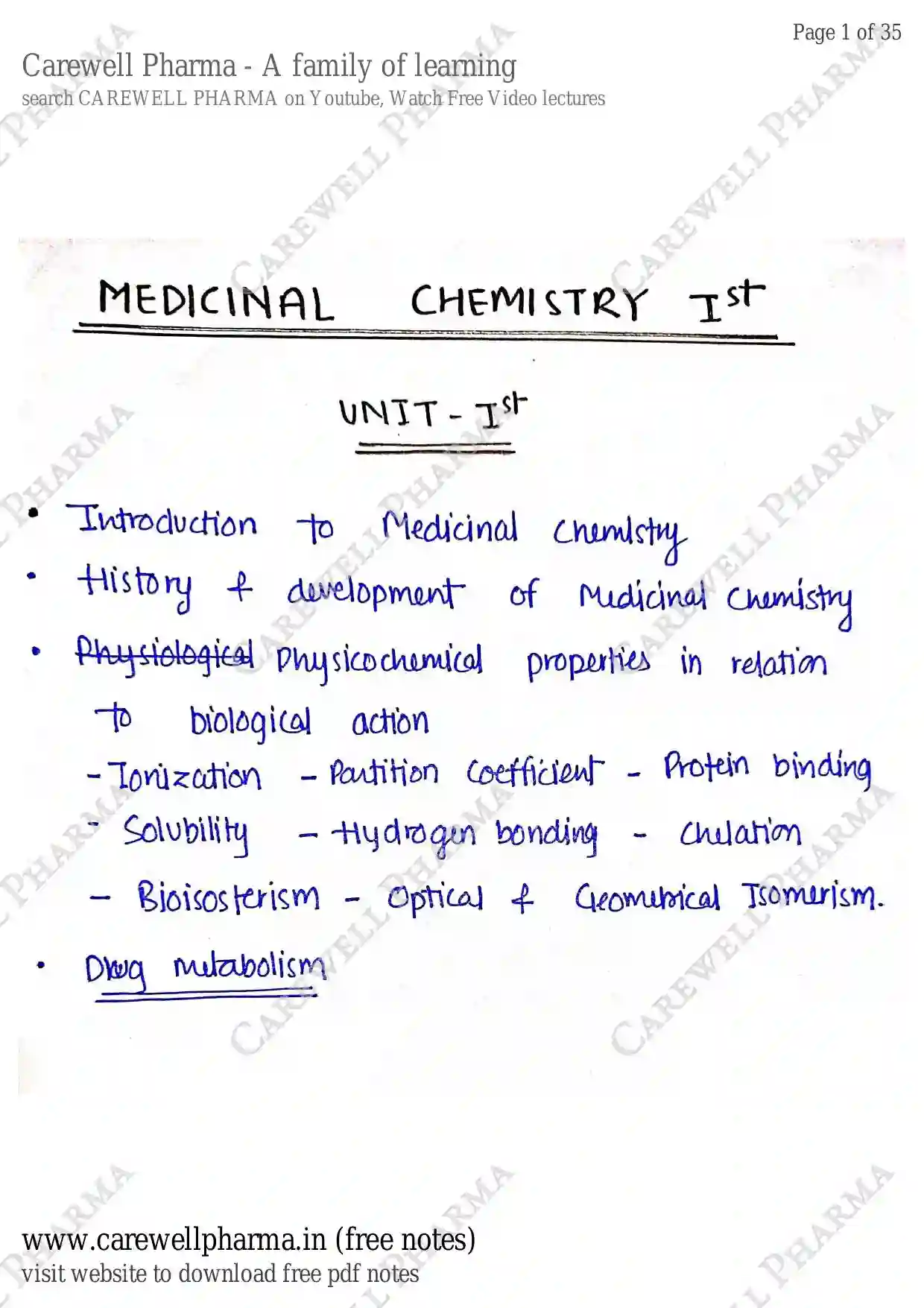
MEDICINAL CHEMISTRY IST
UNIT - Ist**
- Introduction to Medicinal Chemistry History & development of Medicinal Chemistry
- Physicochemical properties in relation to biological action**
- Ionization
- Partition coefficient
- Solubility
- Hydrogen bonding
- Protein binding
- Chelation
- Bioisosterism
- Optical & Geometrical Isomerism
- Drug metabolism
Introduction to Medicinal Chemistry
It is a branch of chemistry, that is intersection of organic chemistry, pharmacology and various other biological specialities.
It is a discipline that enclose the design, development and synthesis of pharmaceutical drugs.
It also involves the studying of existing drugs and their biological activity (properties) and their structure activity relationship
- Mechanism of action
- Uses of drugs
- Synthesis of drugs
- SAR [STRUCTURE ACTIVITY RELATIONSHIP]
CHEMISTRY BEHIND DRUGS.
History and Development of Medicinal Chemistry
- The ancient civilizations of the chinese, the Hindus, found to be therapeutic plants and used minerals for the treatement.
- They also chewed Coca Leaves (containing cocaine) and used mushrooms as hallucinogens.
- Some natural products used in history Such as Opium, Cinchona Bark.
- In 19th century (known as age of innovation and chemistry).
- In 1853 Henry How isolated morphine and mated with methyl iodide and make a new substance of quaternary salt of morphine (modified).
- Morphine derivative was introduced as cough Sedhative in 1898.
- During 1840 the first use of synthetic chemicals were introduced for anaesthesia during a tooth removed like nitrous oxide, ether and chloroform.
- 1864- barbituric acid synthesized as a useful hypnotic.
- 1875- Aspirin was introduced.
- 1899- salicylic acid for typhoid fever marketed as antipyretic without unpleasent side effects.
- After 1930's the development of new drug was speeded greatly by combination of medicinal chemistry & experimental pharmacology.
- Discovery of penicillin in 1928, which is first Antibiotics was an greatest achievement (Discover by Alexander fleming).
- 1940- first drug used for treating Cancer nitrogen mustard was a alkylating agent.
- In the 20th century, John langley and Paul Ehrlich come up with the receptor theory that make understand this based on drug composition their chemical structure bind to receptor.
Physicochemical properties in relation to Biological action.
In which we know the "role" of some physical and chemical properties of our body in the action.
- Ionization
- Solubility
- Partition coefficient
- Hydrogen bonding
- Protein Binding
- Chelation
- Bioisosterism
- Optical and Geometrical isomerism.
1. Ionisation
It is a process in which an atom/molecules acquire negative or positive charge by gaining or losing electrons. The resulting charged atom/molecules called an ion.
Unionized (non-ionic) Ionization (ionized) ionic.
eg:
release [Cation] $e^-$ accept (take) [Anion] etc etc-
Relation to Biological action
Role of ionization in Biological action (activity) in humans (animals).
- It play an Important role in pharmacokinetics.
- Pharmacokinetics involves The movement of drugs in Body. ADME (Absorption, distribution, metabolism and Excretion).
- A Good balance of "Ionized-Unionized" form is better for pharmacokinetics.
- Unionized form of drug [Lipophilic nature]
- Ionized form of drug [Hydrophilic nature]
- Ionized form impart good water solubility to the drug, which is essential for good binding of drug with its receptor.
- While unionized form helps the drug to cross cell membrane.
Eg:
The drug must be weakly acidic or weakly basic.
The degree of dissociation (ionization) can be calculated Using henderson hasselbalch equation.
- for an acid.
- for Base.
eg. Acetic acid $CH_3COOH \rightleftharpoons CH_3COO^- + H^+$ (Unionized/non-ionized) acid conjugated base (Ionized) + proton.
2. Solubility
The maximum amount of solute particles which can be dissolved in per 100ml/gm of solvent is called the "solubility" of the drug at given temperature.

- It depends on the "nature" of solute and solvent as well as "temperature", "pH" & "pressure" [Hydrophilic & Lipophilic].
- The atoms and molecules of all organic substance are held together by various types of "bonds" (eg. Hydrogen bond, dipole-dipole, Ionic bond etc-).
- method to improve solubility of drugs
- Alter the structure of molecules
- Use of co-solvents (ethanol, etc--)
- Addition of surfactants
- Complexation.
Important (Relation to biological Action)
- Bioavailibity of drugs mainly depends on their solubility in the given solvent system.
- Drug (solute) must be in "solution" before it can be absorbed by biological membrane and show its activity.
- Drugs must be in solution to interact with receptors.
3. Partition Coefficient
It is the ratio of concentration of a (drug) in the two phases at equilibrium. Compounds Lipophilic [organic] / Hydrophilic [water]
Where, $K = \frac{C_o}{C_w}$ where, K = partition coefficient $C_o =$ Concentration of drug in lipophilic (organic) phase $C_w =$ Concentration of drug in hydrophilic (aqueous) phase
Importance (Relation to biological activity)
It affect drug absorption and distribution.
It is generally used in combination with the pKa to predict the "distribution of drug" in biological system.
Since, Biological membrane are "lipophilic" in nature. So, the rate of drug transfer is directly related to the Lipophilicity of the molecules.
Help's to know the Hydrophilic or Lipophilic nature of drug for its solubility (bioavailibity) that is measured through Separation method.
If the Value of , then drug is Lipophilic. If , then drug is hydrophilic.
eg.
Barbitol partition coefficient (K) 0.7
Phenobarbitol partition coefficient (K) 4.8
4. Hydrogen Bonding
The hydrogen bond is a special dipole-dipole interaction between the hydrogen atom in a polar bond such as N-H, O-H or F-H and electronegative atom O, N, F atom.

When hydrogen atom is attached with any highly electronegative atom [F, O, N], then hydrogen become electron deficient and they make a weak attraction force/bond with another electro rich molecules and this is called "Hydrogen bonding" and it is represented by the dotted line.
It is of two types
I) Intermolecular
II) Intramolecular
I) Intermolecular
When H-bonding is formed between two or more molecules. This gives associations of molecules and forms dimers, trimers etc..
eg : $H-O-H \cdots O-H \cdots O-H$ (Water)
(Ammonia)
II) Intramolecular hydrogen bonding When H-bonding is formed between two atoms within a molecules.
This result in formation of Ring (chelate ring).

Importance (Relation to biological Action)
- Many physical properties are affected by hydrogen bonding.
- Intramolecular H-bonding generally decrease melting point, boiling point and solubility.
- Intermolecular H-bonding generally increase melting point, boiling point and solubility.
- It is very important in chemistry of genetic code.
- Important in drug receptor interaction as well as their biological activity.
- It will also increase the water solubility.
5. Protein Binding
It is the process in which drug molecules bind with protein, it form a complex type molecules and this phenomena is known as Protein Binding. (Protein drug binding).

- In Blood
- After the absorption of drug when drug reaches into systematic circulation, it bind with some proteins which is already present in blood and form a "plasma protein drug complex".
- Some proteins which present in blood-
- Albumin (Mostly attached) drug also attached with some
- $\alpha$-acid glycoprotein
- Lipoprotein
- Globulins
- Drug also attached with some blood cells & protein of extravascular tissue.
- When drug is combined with the protein they form two types:
I) Reversible
II) Irreversible
I) Reversible : In this, The drug is bind with protein with very weak attraction forces like vanderwalls forces and hydrogen bonding, So they can easily detache, and drug become free. and then this drug bind with receptor and give its pharmacological action.
II) Irreversible : In this, The drug bind with the protein with strong bond like covalent bond, so they can not easily detached. so, drug do not become free and it does not bind with receptor and not give any pharmacological action.
Importance (Relation to biological action)

- It influence the bioavailability and distribution of active compounds (drugs).
- Both [complex & free drug] form are important for complete pharmacological action.
6. Chelation
This is a one form of complexation.
It is a type of bonding of ions/molecules to metal ion.
- A substance containing two or more ligands (which has lone pair) (donor) group may combine with a metal ion to form a complex known as chelates and the process is known as chelation.
eg. EDTA, Ethylenediamine etc-
Importance (Relation to biological action)
- When metals like lead, mercury, iron and Arsenic build up in our body, they can be toxic. In this, EDTA is used to treate this.
- In chelation therapy EDTA is injected into the blood and then this bind with heavy metal/minerals from body & make a chelates and then remove From the body.
- Used in heavy metal poisoning.
7. Bioisosterism
In medicinal Chemistry, Bioisosteres are group of chemical substituents which have similar physical or chemical properties with Similar biological activity.
(Isosteres [configuration])
eg: & , & etc-).
Friedman gave a definition of bioisosterism "the phenomena by which compounds usually similar functional group (isosteres) and possess the same type of Biological activity".
(Replacement may increase biological activity or sometime decrease biological activity).
Types of Bioisosterism
I) Classical
II) Non-Classical
I) Classical Bioisosteres
They have similar shape and e- configuration [valency electron same].
When one bioisosteres exchange with another, it give Similar/desired biological response.
- They further classified as:- One valency left for attached.

II) Non-Classical Bioisosterism : They do not have same steric or e- configuration [not fit in definition] But they have same properties due to this they give similar biological properties (activity).

Importance (Relation to Biological Action)
- Bioisosterism are broadly used in pharmaceutical sciences.
- It is used to reduce toxicity, change bioavailability.
- In drug design, the purpose of exchanging one bioisosteres for another is to enhance the desired biological or physical properties without change in their structure (safe & more effective).
- Help in production of drugs.
- Bioisosterism solved many biological problems in several animal species.
8. Optical and Geometric isomerism [stereochemistry]
1) Optical isomerism :
Those molecules, which have same molecular, structural formula and also have same properties, but they differ in their behaviour towards Light.
- Those molecules which rotates plane polarised Light (PPL) is known as optical active compound.
- They contain chiral Carbon (four different group/atom).
eg Lactic acid ($C_3H_6O_3$) $COOH-CH(OH)-CH_3$
- Enantiomers: Non-super imposable mirror images
- Diastereoisomers: Non-Super imposable & non-mirror images.
Drug/substance rotates Light
- Clockwise Dextrorotatory (+)
- Anticlockwise Levorotatory (-)
Role in biological action
Various example are there where both the enantiomers (+) and (-) have different biological activities.
- (-) adrenaline is more active than (+) adrenaline.
- In some cases, one enantiomers is active while other isomers is toxic.
In this, D-penicillamine is used in the treatment of arthritis while L-Penicillamine is highly toxic.
This is occured due to change in structure of drugs, so can not bind with receptors.
2) Geometrical isomerism : Also known as Cis-trans isomerism.
- Those molecules which have same number & types of atom and bonds,
- "Which have different spatial arrangement of the atoms."
Role in biological action :
- It also affects the biological activity of molecules.
- It is due to the difference in inter atomic gap b/w group required for activity.
eg. Trans diethyl stilbestrol is more potent than Cis-isomer.
One cis-drug, has anticancer activity.
- Cisplatin (Anticancer activity)
- Transplatin (no anticancer activity)
Three point attachment with the receptor

- Due to change in structure of drug, it can not bind with receptor so not give pharmacological action or any side effects.
Drug Metabolism
Also know as biotransformation.
The conversion of drug from one chemical form to another.
Aim : To convert Lipid soluble (non-polar) drug to water soluble (polar) drug to avoid reabsorption in renal tubules and help in excretion. (remove the drug from body).
Lipid soluble (lipophilic) (increase polarity) Water soluble (hydrophilic).
Active drug (which gives pharmacological response) Inactive form of drug (does not give any pharmacological response).
Some drugs: Inactive drug (pro drug) Active form. eg Morphine morphine-6-glucuronide (active Metabolite).
- Most of the drug are lipid soluble (lipophilic) so it can be easily excreted out through metabolism. But some drug are hydrophilic (eq. Streptomycin, neostigmine etc-) are less bio-transformed and excreted unchanged.
Metabolites The drug which convert after metabolism. Drug (hydrophilic) Phase-I (Oxidation, Hydrolysis, Reduction) Metabolites-A excrete through kidney Metabolites-A Phase-II conjugation Metabolites - B Excretion through Urine (kidney) & Bile.
- The primary site for drug absorption metabolism is liver and others are kidney, intestine, lungs and plasma.
- There are different kinds of enzyme system which biotransform the drug molecules.
- Enzymes located in smooth endoplasmic reticulum of the liver (highest) and also in other organs such as kidney, lungs etc... but in smaller conc.
- Mostly biotransformation are done by microsomal enzymes such as Cytochrome P-450, glucuronyl transferase.
Phase-I reaction
In this the drugs can be metabolized by Oxidation, reduction, and hydrolysis so drug can increase polarity of drugs and easily excrete from kidney.
- These are non-synthetic reaction.
- It is a functionalization reaction.
i) Oxidation (oxidative biotransformation)
These are the most common and important reactions among various phase-I reactions.
The enzymes involved in this reaction are microsomal monooxygenase in liver (Cytochrome P450/CYP) and also these enzyme are non-microsomal enzymes, monoamino Oxidase.
- In this reaction CYP(450)s required NADPH & . addition of oxygen/removal of hydrogen take place.
a) Aromatic hydroxylation
eg. Phenytoin Hydroxylated Phenytoin derivative Propranolol 4-hydroxy propranolol
b) Dealkylation
Phenacetin to Paracetamol.
Nitrogen atom $RNHCH_3 \rightarrow RNH_2 + CH_2O$ Amitriptyline to Nortriptyline.
c) N-oxidation
ii) Reduction : Addition of hydrogen/removal of Oxygen. Drugs containing carbonyl, nitro, and azo group are biotransformed by reductive processes.
Such reduction generate amino & alcohol moieties in the metabolism.
a) Nitro reduction
eg. Chloramphenicol to aryl amine metabolite.
b) keto reduction
eg. Cortisone to Hydrocortisone
c) Azo reduction
eg. Prontosil to Sulfanilamide.
iii) Hydrolysis In combining water. drug is metabolise with combining water. Ester or amide Esterases, alcohol/amide eg Aspirin Salicylic acid + Acetic acid. also some CYP.
Other reaction Such as alicyclic oxidation and decyclization open ring structure.
II) Phase-II reaction
- It is faster than phase-1 and also those not excreted after phase-I can excreted through phase-II.
- Involves conjugation with an endogenous substance such as glucuronic acid, sulfate, glycine.
- These reaction are more polar, so drug can easily excreted by the kidney & liver (bile).
1) Glucuronic acid
Enzyme used UDP glucuronyl transferase
-OH group conjugated with glucuronic acid. eg. Salicylic acid + UDPGA Salicylic acid glucuronide + UDP. more drugs Aspirin, Paracetamol, Morphine, PABA, etc...
ii) Sulfate
The phenolic compounds, steroids are sulfated by sulfotransferase.
eg Methyl dopa, Chloramphenicol etc..
iii) Glycine conjugation
In which carboxylic acid (COOH) group conjugated with the help of enzyme.
eg Salicylates, nicotinic acid etc-
iv) Acetylation
Compounds having amino or hydrazine are conjugated with the Acetyl coenzyme A.
eg Sulfonamides, hydralazine, PAS etc-.
some others reactions of phase-II are:
Methylation, Glutathione conjugation, nucleotide synthesis.
Factor affecting drug metabolism
I) chemical factor
a) Enzyme induction
b) Enzyme inhibition
II) Biological factor
a) Age
b) Diet
c) Sex difference
III) Physicochemical properties of the drug
IV) Stereochemical aspects
I) Chemical aspects
a) Enzyme induction
The phenomena of increased drug metabolizing ability of enzymes by several drugs & chemicals known as enzyme induction & agents called enzyme inducers.
It is due to
- increase in both liver size & liver blood flow.
- increase stability of cytochrome P-450 enzymes.
Rifampin Induction of CYP3A4 Oral Contraceptic steroids Inactive, Eliminated.
b) Enzyme inhibition
A decrease in the drug metabolizing ability of an enzyme is called as enzyme inhibition.
direct interaction at the enzyme site & change enzyme activity [comp. & non-comp.]. Indirect due to fall in rate of enzyme synthesis (repression) or due to nutritional deficiency/hormonal imbalance (altered physiology). Erythromycin, Ketoconazole Inhibition of CYP3A4 Terfenadine Active antihistamine.
II) Biological factor
a) Age
The drug metabolic rate is different in different age groups.
- neonates (upto 2 month) & infants (2m-1year) metabolism - slowly due to less development of microsomal enzyme.
- children compared to adult metabolism - rapid.
- elderly person metabolism - slowly.
b) Diet
The enzyme content and activity is altered (affected) by dietary components.
Eg:
low protein diet slowly metabolism.
high protein diet rapid metabolism
because protein diet increase enzyme synthesis.
c) Sex difference :
It also affect drug metabolism.
Eg:
Benzodiazepines are metabolize slow in women than men. metabolize rapid in men than women.
- There may be some factor which affect metabolism such as hormonal imbalance, Pregnancy, diseases etc.-
III) Physicochemical properties
pKa, solubility, polarity, size, shape etc.- also affect the drug metabolism by Interaction with the active sites of enzymes.
IV) Stereochemical aspects
It also affect drug metabolism, because some metabolizing enzyme often display a preference for one enantiomer of a drug over the other. (enantioselectivity). It is due to differ in their action.
eg: D(+) glucose easily metabolised than L(-) glucose (not metabolised).