Physical Pharmaceutics 1 - Unit 3
Syllabus
Surface and interfacial phenomenon:
Liquid interface, surface & interfacial tensions, surface free energy, measurement of surface & interfacial tensions, spreading coefficient, adsorption at liquid interfaces, surface active agents, HLB Scale, solubilisation, detergency, adsorption at solid interface.
Scroll to Download
PHYSICAL PHARMACEUTICS UNIT-3rd
SURFACE & INTERFACIAL PHENOMENA
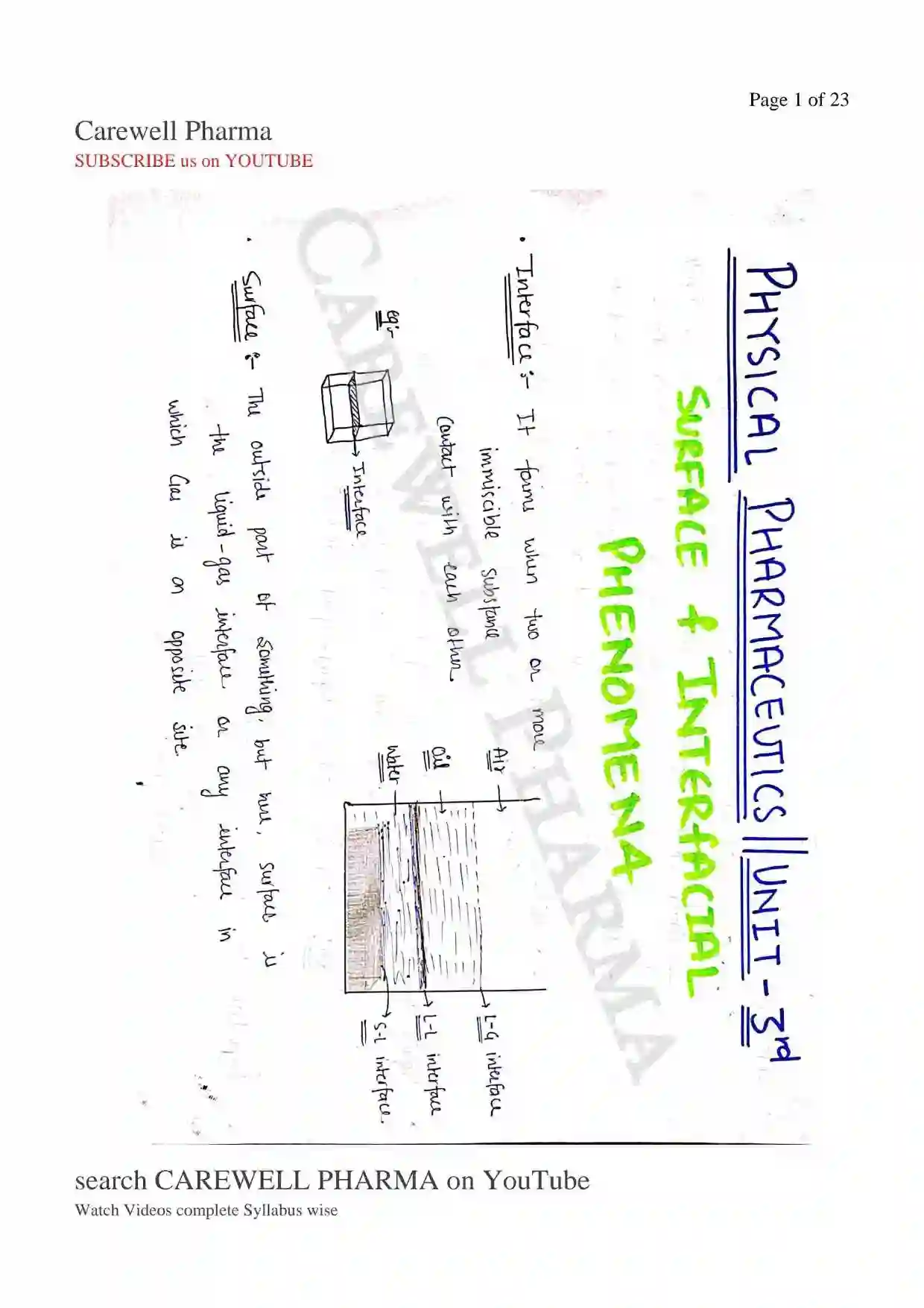
Interface
It forms when two or more immiscible substance Contact with each other.


Surface
The outside part of something, but truly, surface is the liquid-gas interface. any interface in which Gas is on Opposite site.
Interfaces
- Solid-Liquid interface: It forms b/w solid and Liquid.
- Liquid - Liquid interface: It forms b/w liquid and liquid, but liquids does not miscible with each other.
- Liquid - Gas interface (Surface): It form b/w liquid and gas (air) and it is called as Surface.
- Solid-Gas interface (Surface): It form b/w solid and gas and it is also called surface.
Liquid interface: when Liquid is contact or mix with other states of matter (solid and gas). foam, eg Oil in water (liquid-Liquid interface) etc.
Importance
- Emulsion formation and stability.
- Adsorptions of drugs onto solid adjuncts in dosage forms.
Surface and Interfacial Tensions
In Liquid, state, Liquid molecules are attached or attracted with each other through cohesive force. (vanderwaals forces)

Surface Tension → It is the force per unit Length that must be applied parallel to the surface. $\gamma \text{ (Gama)} = \text{force} / \text{Length}$ Unit, N/m
Interfacial Tension → Same as surface tension, but it is happened between two immiscible liquid.
SURFACE & INTERFACIAL PHENOMENON
SURFACE FREE ENERGY
- Measurement of surface and Interfacial tensions.
- Capillary Rise method
- Drop count method
- Drop weight method
- Wilhelmy plate method
- Ring detachement method
1. Surface Free Energy
Those energy which want to increase our surface.
The molecules near the surface of liquid have more potential energy as compared to the molecules in the bulk of the liquid, this means that as surface area of liquid increase, the more molecules have this excessive potential energy. This energy is proportional to the size of the free surface, it is called a surface free energy.

where = surface tension.
[ = Area of change of surface]
where,
Surface free energy (work done)
Surface tension, Increase in area.
Measurement of Surface and Interfacial Tension.
i) Capillary Rise Method
It is used to measure surface tension.

Principle
- When a thin glass tube (capillary) is placed in b/w liquid, liquid rises up in the capillary tube upto certain height.
- It is because adhesive force between capillary and liquid is more than the cohesive force b/w intermolecular molecules of liquid.
- Due to surface tension Liquid rises but some gravitational force is also apply on Liquid which pull downward liquid.
- When both forces are equal Liquid is an equilibrium and stable in that sitution.
Derivation
Upward Force →
where,
Circumference of that capillary.
Surface tension
angle of contact
Downward Force →
potential energy with respect to gravitational force
weight of liquid.
where,
Put, equ (iii) value in equ (ii) $f = \rho\pi r^2h \cdot g + w$
Now,
Liquid is in equilibrium, means both forces are equal.
So,
for water,
( for water) $$\gamma = \frac{1}{2} (\rho gh r + w)$$
where,
surface tension
density
gravitation
height of rising liquid
radius of that liquid
weight.
11) Drop Count Method
It is used to measure the surface tension of Liquid.

In this method, we find out surface tension through comparing.
- Firstly take known liquid, which we know the surface tension.
- Then fill stalagmometer with that liquid at point A. then stalagmometer closed from upper side with the help of finger.
- Now, Release liquid slowly-slowly dropwise from capillary untill Liquid reached at point B. and continously count no. of drop, then note it.
- Now, Do same with other liquid, which we have to find surface tension.
- So, on comparing both, by using formula we find out surface tension ($\gamma$). Let's see how??
Derivation & Formula
we know that
where,
circumference of capillary
1st case when we take water (known surface tension) $w_1 = \gamma_1 2\pi r$
2nd case when we take unknown S.T. $w_2 = \gamma_2 2\pi r$
[where $r = \text{radius is same for both liquid}$]
[where $n = \text{no. of drop}$]
Now,
we know that
density
where,
density of liquid
volume of liquid
gravitational force
- Put these value in main eqn.
On Comparing both
So,
where,
surface tension
density of liquid
no. of drop count
So, in this we know , , , and , so we can easily find out the surface tension, by putting these value.
iii) Drop Weight Method
It is same as drop count method, in which we use same capillary or stalagmometer.
Difference is that,
In which we weight the drop (one drop), firstly those liquid which we know surface tension, then weight the other liquid's drop which we have to find out the surface tension.
1st case know Liquid
2nd Case unknown Liquid
On Comparing both,
[ $r = \text{radius is same due to Same capillary}$]
where,
surface tension
weight of the drop
iv) Wilhelmy Plate Method
It is used to measure surface tension.

Firstly we put the rectangular plate in that liquid, which we have to find out the surface tension.
Now, Surface tension is applied on plate which pulled downward in the liquid.
And we pulled rectangular plate upward with some force and surface tension is also oppose this.
Now, that condition, when we pulled (detached) out plate from liquid, that time the force we applied is same as the surface tension of liquid.
where,
surface tension of liquid
force applied
length of plate (perimeter)
angle of contact,[ for water]
v) Ring Detachement Method
It is used for measure both surface and Interfacial tension.
- It is also known as du nuoy method.
- In this method, A slowly lifting ring, often made up of platinium it attached from the surface of liquid.
- The force , required to raise the ring from the liquid's surface is measured and related to the liquid's surface tension.

where,
Surface tension
force applied
radius of outer surface
radius of inner surface
Spreading Coefficient
Adsorption of Liquid interface
1) Spreading Coefficient
In two immiscible liquid, when we placed first's liquid drop on the surface of other different nature's Liquid it will spread as a film. And the ability of one liquid to spread over another liquid is calculated as Spreading coefficient.
Eg - Emulsion, oil in water etc

And it occurs, when adhesive force is more than cohesive force.
(i)
where,
spreading coefficient
Work done of adhesive force.
Work done of cohesive force.
1st case for Cohesive force
Cohesive force It applied on the same nature's Liquid.
If , then
(ii)
Surface tension of Liquid
Area of drop
2nd Case for different nature's Liquid (Adhesive force)
If
(iii)
Now,
put value of equ (ii) & (iii) into (i)
If, , then is positive Spreading occurs.
If, , then is negative No spreading occurs.
Adsorption of Liquid surfaces
Adsorption is defined as the deposition of some molecules or ions [moleculer species] onto the surface of liquid.
- Positive Adsorption
molecules deposite on the surface of Liquid.
Surface free energy & surface tension decreased.

molecules settle down on surface.
- Negative Adsorption (Absorption)
Molecules does not deposite on surface, it mix with the liquid.
Surface free energy & surface tension increase.

molecules mixed with liquid.

Surface Active agents (Surfactants)
These are those agents (substances) which reduced the surface tension and interfacial tension b/w two liquids.
eg - Detergents, Soaps, emulsifier etc.
It helps in mixing of oil into water...

(head) Hydrophilic Nature
(tail) Lipophilic nature
If we add oil & water in any container, then it is immiscible, so we used surfactants to reduced interfacial tension and helps to mix them.

(Micelle)
oil (lipophilic), so attached with lyophilic part of surfactant.
Water (hydrophilic), so attached with hydrophilic part of surfactants.
And on which temperature micelle formed is called kraft temperature.
Types of Surfactants
- Anionic
- Cationic
- Ampholytic 1v) Non-ionic
i) Anionic Surfactants
It contain organic tail with negative charge head and small positive Molecules like ammonia. $\rightarrow$ these are unpleasant taste. so not suitable for internal use.
eg:- Alkali metals and ammonium soaps (sodium stearate). (o/w)
ii) Cationic Surfactants
It contain organic tail with positive charge head and small negative molecules like chloride.
these are sometimes used on the skin for cleansing of wounds.
eg:- Benzalkonium chloride
iii) Amphoteric Surfactants
Ampholytic and Amphoteric surfactants sometimes reffered to as Zwitter ionic molecules.
Surfactants that possess both cationic and anionic group in the same molecules.
- They depends on the pH of the systems.
- They mostly used as co-surfactants that boosts the detergency and the foaming power of anionic surfactants.
eg:- Lecithin, Amino acetic acid etc-
iv) Non-ionic Surfactants
They are non-ionic, so they does not ionize in water, because their hydrophilic part consist of non-dissociable molecules.
these are mostly used in pharmaceutical industry.
they are resistant to pH change.
eg Glycerol
HLB System : (Hydrophilic - Lipophilic Balance System)
These system consist of an arbitrary scale in which values are assigned to different surfactants according to their nature.
HLB SCALE

HLB value of 1 indicates Surfactants is lipophilic & Soluble in oil.
HLB value of 20 indicates Surfactants is hydrophilic & Soluble in water.
HLB = Hydrophilic Lipophilic Balance.
Solubilization
It is the process in which, Solubility of organic compound is increased in aqueous medium with the help of surface active agents (surfactants), this phenomena is known as solubilization. It is used in many industries for the mixing of two immiscible liquid & help in making of drugs.Detergency
It is the process or phenomenon in which dirt (oil and solid objects) remove from the surface with the help of surface detergent. And these detergent are basically made up with Surfactants or itself surfactants. It work that, it reduce the adhesive force, so dirt particles easily remove from the surface.
Adsorption at Solid Interface
- When substance (material) deposite on the surface of solid is called the adsorption at solid interfaces.
- The material (substance) which deposite on the surface of solid is called adsorbate.
- The material (substance) on whose surface the process takes place is called adsorbent.

Now, adsorbent and adsorbate are attached with each other with some attraction forces.
- On the basis of attraction forces adsorption divided into two.
i) Physisorption (Physical adsorption)
ii) Chemisorption (chemical adsorption)
i) Physisorption - When adsorbent and adsorbate is attached with each other with some weak bonds like as, Vanderwaals forces.
- These are reversible.
- And these have weak force of attraction.
- It is less energy consuming as compared to chemisorption.
ii) Chemisorption - When adsorbate and adsorbent are attached with each other with some strong chemical bond. as like as, covalent bond, ionic bond.
- They are irreversible.
- They have strong force of attraction b/w adsorbent and adsorbate.
- It is more energy consuming as compared to physisorption.
Adsorption Isotherm
At constant temperature, graph b/w pressure & concen of adsorbate.

- Freundlich theorem
- Langmuir theorem
i) Freundlich Theorem
Let, when adsorbate is attached on the adsorbent.

That time, (let)
mass of adsorbate
mass of adsorbent
and their fraction of adsorption =
and on increasing amount of adsorbate, fraction of adsorption increase and on increasing pressure, fraction of adsorption increased.
So
Acc. to freudlich
ii) Langmuir Theorem
It is based on Chemisorption.
It is based on physisorption.
In this case, we let their are some vacant site on which particles attached.

Active site on which particles attached
Vacant site when particles detached from active site after adsorption

Rate of adsorption is depend on vacant site, the more vacant site, the more particles attached.
So,
where,
rate of adsorption [attachement of particles on surface]
let, filled site
Vacant site $r_2 =$ rate of desorption [detachement of particles from surface]
Rate of desorption is depend on active site, because the more particle attached get more detached.
At equilibrium,
this is Langmuir equation.
Constant for adsorption
Constant for detachement
pressure which help in adsorption
So, [pressure is not required for desorption].