Physical Pharmaceutics 1 - Unit 2
Syllabus
States of Matter and properties of matter:
State of matter, changes in the state of matter, latent heats, vapour pressure, sublimation critical point, eutectic mixtures, gases, aerosols - inhalers, relative humidity, liquid complexes, liquid crystals, glassy states, solidcrystalline, amorphous & polymorphism.
Physicochemical properties of drug molecules:
Refractive index, optical rotation, dielectric constant, dipole moment, dissociation constant, determinations and applications
Scroll to Download
PHYSICAL PHARMACEUTICS 1 UNIT-2
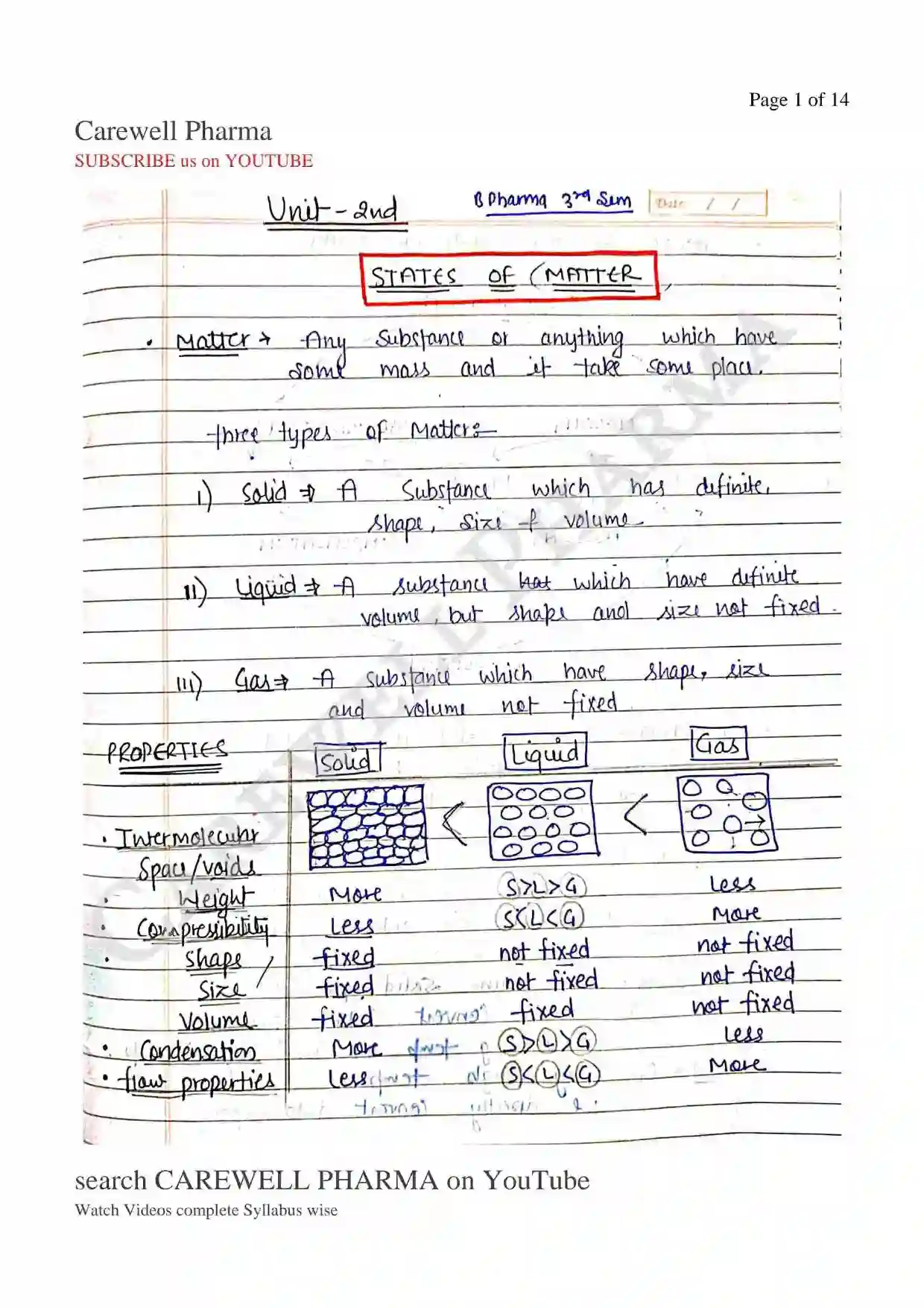
STATES OF MATTER
Matter
Any Substance or anything which have some mass and it take some place.
three types of Matter:
- Solid → A Substance which has definite, Shape, Size & volume
- Liquid → A substance which have definite volume, but shape and size not fixed
- Gas → A Substance which have shape, size and volume not fixed
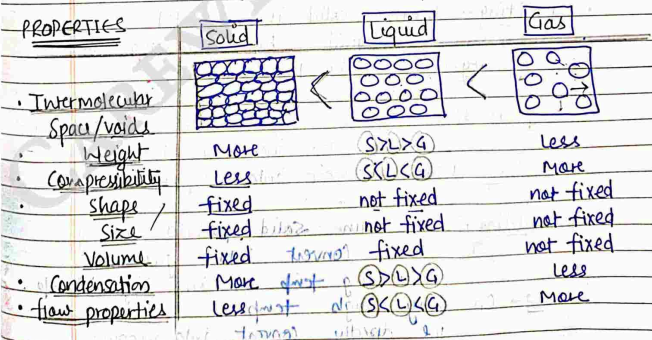
| PROPERTIES | Solid | Liquid | Gas |
|---|---|---|---|
| • Intermolecular Space/voids | Less | More | Very More |
| • Weight | More | Less | Less |
| • Compressibility | Less | More | More |
| • Shape/Size | fixed | not fixed | not fixed |
| • Volume | fixed | fixed | not fixed |
| • Condensation | No | Yes | Yes |
| • flow properties | Less | More | More |
Changes in the State of Matter
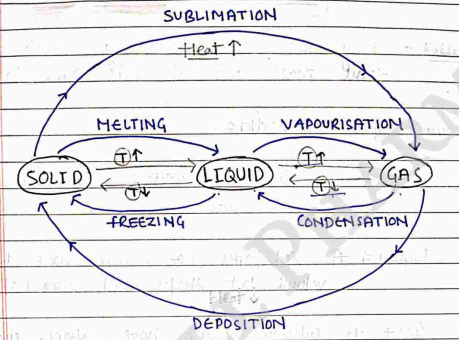
Melting → When solid is converted into Liquid by increasing heat.
eg Ice cube to water.
Vapourisation → When Liquid is converted into Vapours. by increasing temp.
eg Water convert into vapours.
Sublimation → When Solid particles directly convert into gas. by increasing temp.
eg On very high temp., ice directly convert into vapours.
Condensation → When gas converted into Liquid by decreasing temp.
eg Water vapour in the air turn into Liquid on Colder Surface.
Freezing → When Liquid is converted into Solid state by decreasing temp.
eg Water convert into ice cube in refrigerator.
Deposition → When gas state particles (or vapours) directly convert into solid state without first becoming a Liquid.
eg At very cold place, water vapour directly converted into ice.
Latent heat
That heat which changes Liquid into a vapour, (phase change) without change of temperature.
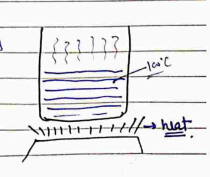
- After temp will not increase it remains same, and the heat used to convert phase by liquid.
Vapour pressure
The pressure of a vapour in contact with its solid or liquid form.
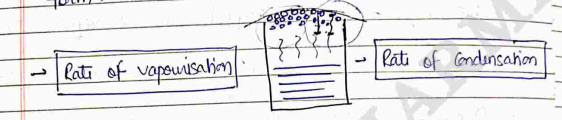
When Rate of Condensation = Rate of vaporisation, both is equal or gas is in equilibrium that time, the pressure exerted by vapour on any surface is called vapour pressure.
Factors that affect vapour pressure
Temperature → As the temperature of a Liquid or solid increases its vapour pressure also increases.
Intermolecular Forces → Those liquid in which the intermolecular forces are weak shows high vapour pressure.
Surface Area → Vapour pressure is independent of Surface area.
Sublimation Critical Point
It is an equilibrium Constant (maximum or minimum temp. & pressure) at which the state of matter Cannot be changed.
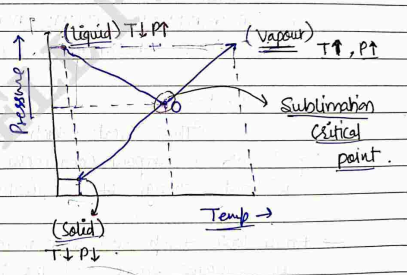
- Which point when is an equilibrium and change their phase easily by changing T or P.
Eutectic Mixture
It is a mixture in which two solid particles mix together and reduced Their melting point and converted into liquid at normal (room) temperature.
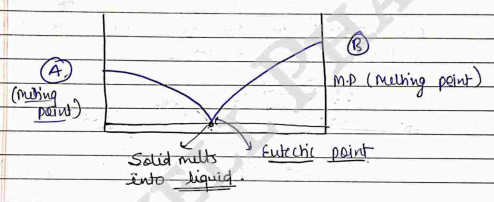
eg - Menthol-thymol powder, when these powder mixed it Convert into a liquid by reducing their melting point.
Gases
Shape, Size and Volume are not fixed.
Aerosol → An aerosol is a Suspension of fine solid particles or liquid droplet in air or another gas.
Eg. Natural aerosol are fog, mist, geyser steam.Inhaler → An inhaler is a device that gets medicine directly into a person's lungs. medicine inhaled in mouth through inhaler.
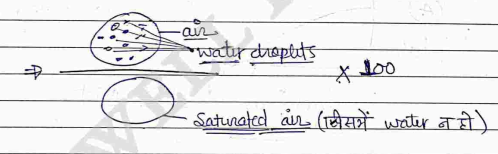
Eg. Asthma pump.Relative Humidity → It is the ratio of water vapor present in the air drop to the saturated air * 100.
Liquid Complexes
These are binary mixtures that have a coexistence b/w two phases.
Solid-Liquid (suspension etc.)
Solid-gas (Solid granular etc.)
Liquid-gas (foams)
Liquid-liquid (emulsions)
Liquid Crystal → They are matter in a State That has properties b/w those of conventional Liquid and those of solid crystal.
- A liquid crystal may flow like a Liquid.
eq Cholesteryl Benzoate ($145-178^\circ C$) Solid Liquid Crystal (Semi solid/Semi liquid) Liquid
Glassy State → A state occurs b/w a solid and a liquid). (Super Cooled Liquid.
Glass is a non-equilibrium, non-Crystalline state of matter that appears solid on a short time Scale but Continuously relaxes towards the Liquid state.
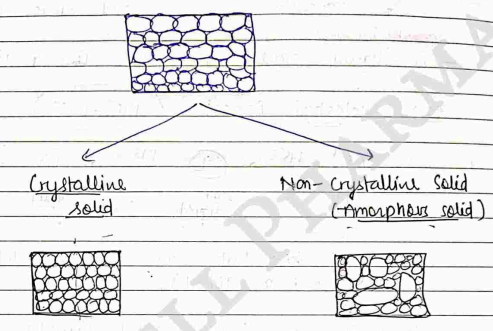
| Crystalline solid | Non-Crystalline Solid (Amorphous solid) | |
|---|---|---|
| • | A substance that has definite, Shape size & volume. | Any non-crystalline solid in which the atom & molecules are not arranged in a definite lattice pattern. |
| • | which have shape & size fixed and pattern of intermolecular are fixed. | eg Glass, plastic etc- |
| • | eg Metal, Rocks, ice etc- | On cutting edge Rough. |
| • | On Cutting, edge plane/smooth | M.P. & B.P are in wide range. |
| • | Melting point & Boiling point sharp | 100-110, 104-106 |
Polymorphism → These are those solid which has ability to change their form according to situation.
Eg. Carbon: diamond in a cubic (tetrahedral lattice arrangements).
Physiochemical Properties of Drug Molecules
- Refractive index
- Optical rotation
- Dielectric Constant
- Dipole moment
- Dissociation Constant
Refractive Index → It is the ratio of speed of light b/w any two medium.
- Speed of light is different in different Medium. So we take ratio of any two medium.
- Optical Rotation (activity) → When we pass light through any medium, if light turn or rotate then it is optical activate if light not rotate then light is optically inactive.
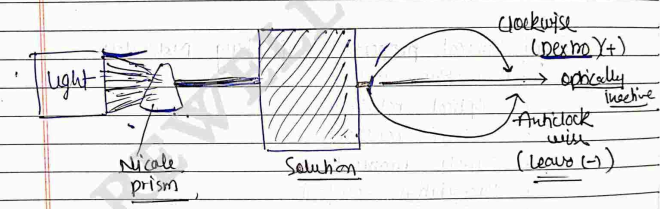
- Light rotate optical activate
- clockwise Dextro-rotatory (+)
- anticlockwise Levo-rotatory (-)
- Light not rotate Optically inactivate.
Dielectric Constant → It is the ratio of permitivity of medium ($\epsilon$) upon permitivity of free space ($\epsilon_0$).
Dielectric constant =
Measurement of Dielectric constant
- Co-axial probe method
- free space method
- cavity method iv) Resonant capacitor method v) Parallel plate method
Applications
- Dielectrics are used to manufacture Capacitor.
- Used to manufacture transformer.
- They are used in measuring and heating processes.
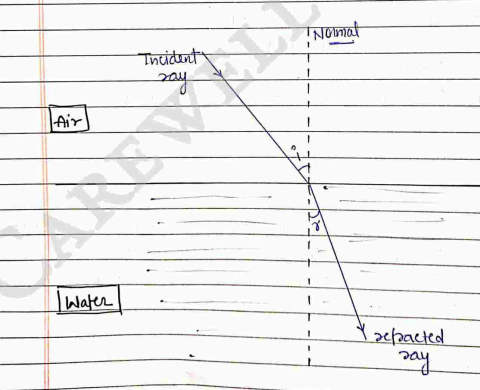
Snell's law
It gives the relation between the angle of incidence and angle of refraction.
Where,
Angle of incidence
Angle of refraction
Dissociation Constant
Acc. to Law of mass action
Rate of dissociation
The dissociation constant is usually written as a quotient of the equilibrium concentration. (in Mol/L).
Dipole moment → A mathematical product of the charge into distance. $\mu = q \cdot d$
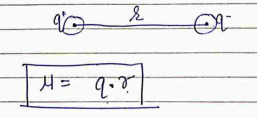
Where, dipole moment, charges product, distance