Pharmaceutical Organic Chemistry 2 - Unit 1
Syllabus
Benzene and its derivatives
- Analytical, synthetic and other evidences in the derivation of structure of benzene, Orbital picture, resonance in benzene, aromatic characters, Huckel’s rule
- Reactions of benzene - nitration, sulphonation, halogenationreactivity, Friedelcrafts alkylation- reactivity, limitations, Friedelcrafts acylation.
- Substituents, effect of substituents on reactivity and orientation of mono substituted benzene compounds towards electrophilic substitution reaction
- Structure and uses of DDT, Saccharin, BHC and Chloramine
Scroll to Download
PHARMACEUTICAL ORGANIC CHEMISTRY 2 UNIT-1
Benzene and its derivatives
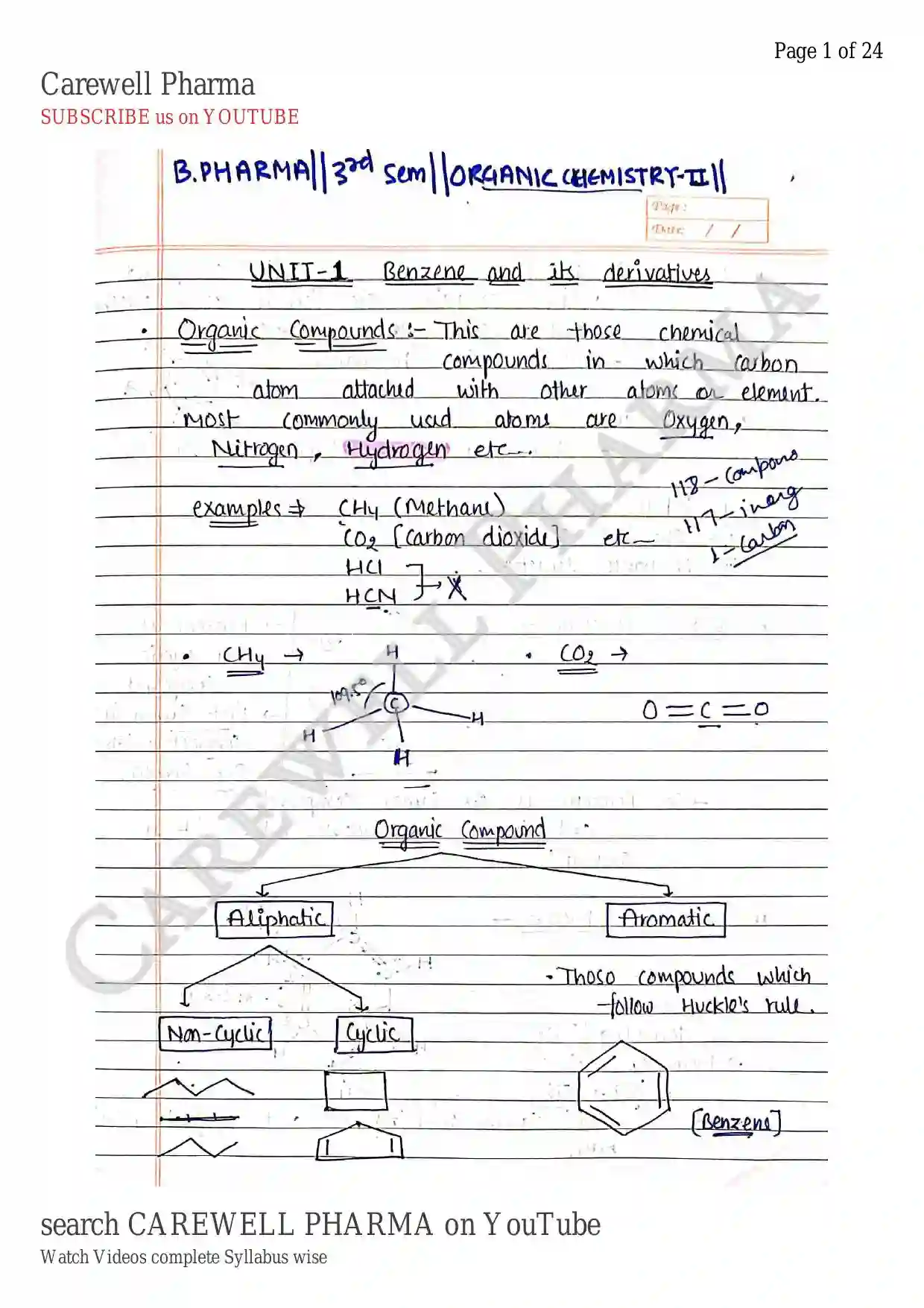
Organic Compounds
This are those chemical compounds in which carbon atom commonly used with other atoms or element. Most attached Nitrogen, Hydrogen, Oxygen, etc..
Examples
- (Methane)
- (Carbon dioxide) X (inorganic)
- HCN X (inorganic)
Organic Compound
- Aliphatic
- Non-Cyclic
- Cyclic
- Aromatic
- Those compounds which follow Huckle's rule.
- (Benzene)
Benzene
Benzene is an organic compound which contain six carbon atom attached with six hydrogen atom. It is aromatic compound and also contain resonance structure.
- Molecular formula -
Evidences
Analytic → The molecular formula of benzene is . This indicate the presence of unsaturation in benzene ring as compared to n-hexane ($C_6H_{14}$).
Synthetic → Benzene have unsaturation (double or triple bond), so it could be constructed as straight chain compounds.
But it did not behave like alkene or alkyne as it did not colonize bromine in etc.. So it can not be formed as straight chain formed. Benzene + NO REACTION Benzene + dil. Acid NO REACTION Benzene + NO REACTION
Other Evidence : (Cyclic Structure)
Addition of Hydrogen → Benzene added three moles of hydrogen in the presence of nickel (Ni) catalyst to give cyclohexane.
(cyclohexane).
This confirm cyclic structure and three (Carbon-Carbon) double bond.
Describe in Details the Structure of Benzene ??
There are three types of structure:
I) Kekule Structure.
II) Chemical Structure.
III) Resonance Structure
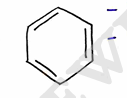
I) Kekule Structure → Kekule was first to suggest the structure of benzene -
- Benzene is a cyclic compound.
- In Benzene, first Carbon is connect with six Carbon.
- It is six Carbon Compound and it follow huckle's rule so benzene is aromatic compound.
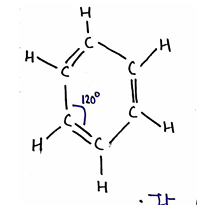
II) Chemical Structure → In this structure, structure with its in chemical form and with its chemical properties.
- Molecular formula
- Molecular weight
- Bond angle
- Bond length \rightarrow 1.40 \text{ \AA } (C-C \text{ & } C=C)
- It contain double bond and single bond both, which are in resonance. C have hybridization.
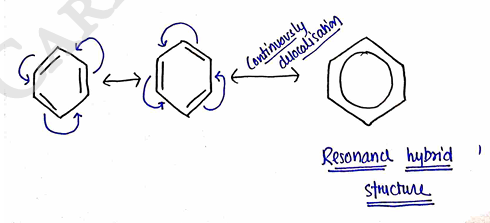
III) Resonance structure :- In benzene, their are continuously delocalisation of bond, so it form resonance and also show resonance hybrid structure. Continuously delocalisation Resonance hybrid structure
Draw Molecular orbital structure of benzene
- In benzene, All Carbon molecules undergoes hybridization, which produce three hybrid orbital and one unhybrid orbital (It bond overlapping).
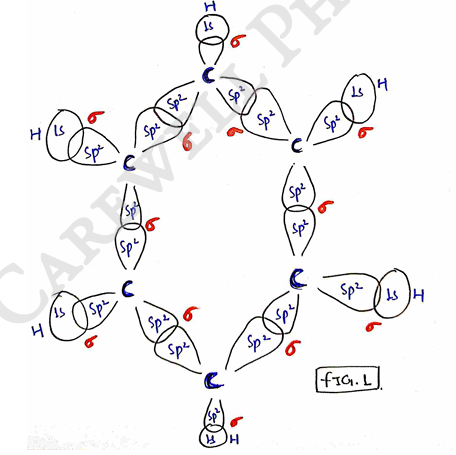
- hybrid orbital overlap with hybrid orbital of adjacent atom to form bond (sigma) and remaining one hybrid orbital of each carbon atom are overlap with is atomic orbital of H-bond to for (-H bond (sigma)).
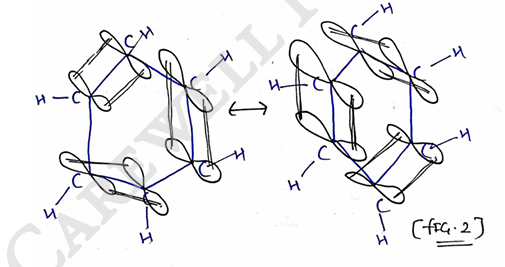
The following table:
| Orbital of C atom | adjacent to | form |
|---|---|---|
| hybrid orbital | each Carbon atom are overlap with | bond (sigma) |
| remaining one hybrid orbital | 1s atomic orbital of H-atom | bond (sigma) (C-H) (See in fig. 1) |
Each Carbon atom containing one unhybrid orbital, which overlap with unhybrid orbital of adjacent Carbon atom (sideways overlapping) to form $\pi$-bond (fig. 2).
Enlist the Rule of Aromaticity??
Their are three rules for Check the aromaticity.
I) Compound should be Cyclic.
II) Compound should be fully Conjugation (Resonance).
III) It must be follow Huckel rule (it is important and must follow this rule for aromaticity)., where, ($\pi \text{ bond} = 2e^-$) ($n=1,2,3... \text{ integers number}$)
Eg. Benzene (aromatic compound) because it follow all rules...
Give the Physical Properties of Benzene??
- Benzene is a Colourless liquid.
- It is insoluble in water.
- It is soluble in organic solvents.
- It has an aromatic odour.
- It shows resonance.
- Boiling point , Melting point .
- Its vapour is highly toxic.
- It burns with a luminous, sooty flame.
Derivatives of Benzene
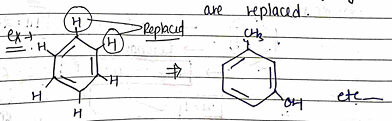
- Replace hydrogen with any other atom or group.
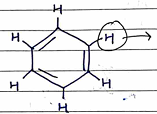
It is of three types:
I) Monosubstitution Derivatives
- When one hydrogen atom is replaced.
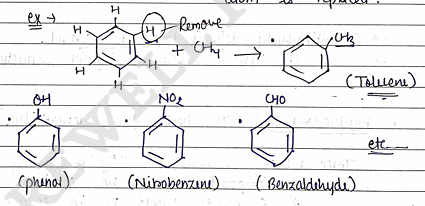
- (Toluene)
Other examples:
- Phenol (with -OH group)
- Nitrobenzene (with group)
- Benzaldehyde (with -CHO group) etc
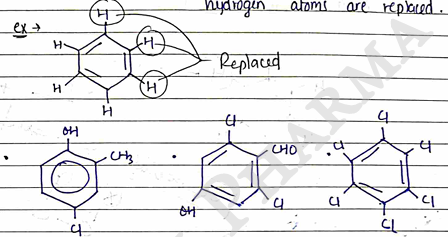
II) Disubstitution Derivatives
- When two hydrogen atom are replaced.
III) Polysubstitution Derivatives When more than two hydrogen atoms are replaced.
Concept of Ortho, Meta, Para key Carbon (where X is attached) Ortho Meta Para
Priority order: Salts > Carboxylic Acid > Anhydride > Ester > Acid chloride > Amide > Nitrile > Aldehyde > ketone > Alcohols > Amine > Ether.
CHEMICAL REACTIONS OF BENZENE
It gives electrophilic substitution...
a) Nitration
b) Chlorination
c) Sulphonation
d) Friedal craft alkylation
e) Friedal craft Acylation
a) Nitration
- When benzene is heated with nitric acid it formed Nitrobenzene [Nitration of Benzene].
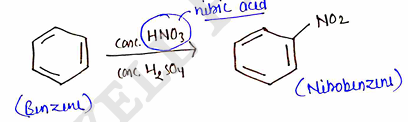
Benzene + Nitrobenzene +
b) Chlorination
- When benzene is heated with chlorine it formed chlorobenzene [Chlorination of benzene].
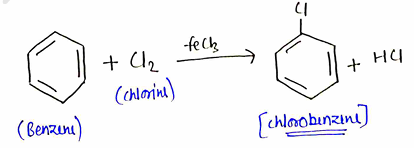
Benzene + Chlorobenzene +
c) Sulphonation of Benzene
It belong to electrophilic substitution of benzene.
In which benzene react with (Sulphuric acid) in the presence of conc. , it formed benzenesulfonic acid.
Benzene + Benzenesulfonic acid ($Ph-SO_3H$) +
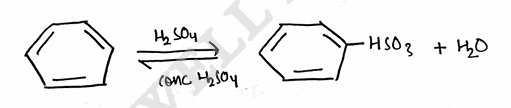
- It is a reversible reaction, it forms when benzene is heated with fuming Sulphuric acid or concentrated sulphuric acid, it yield benzenesulphonic acid.
Mechanism
(Step 1)
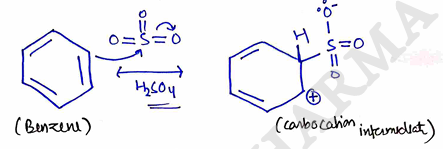
- acts as an electrophile.
- In which, Carbocation formed in benzene, and attached with benzene.
(Step 2)
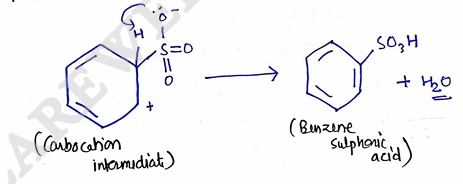
Benzene + (Carbocation intermediate)
- Resonance stablized carbocation intermediate..
- The lone pairs form a bond with hydrogen atom, releasing the electron in the hydrogen to ring bond for re-establish the electron.
- Required product obtained.
d) Friedal-Craft Alkylation
- It involves the addition of alkyl group to an aromatic ring by replacing aromatic proton. In which benzene react with alkyl halides and form alkylbenzenes in presence of Lewis acid catalyst (Aluminium chloride) .
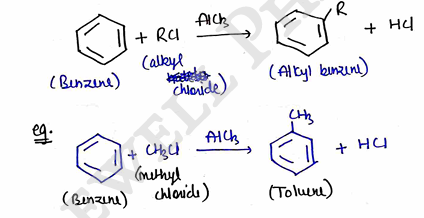
Benzene + (alkyl chloride) Alkyl benzene +
Eg. Benzene + (methyl chloride) Toluene +
Mechanism : (Three Step Mechanism)
Step 1
- react with alkyl chloride, resulting formation of an electrophilic carbocation.
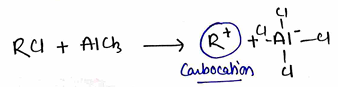
Step 2
- Carbocation attack on aromatic ring, forming cyclohexadienyl cation intermediate complex. (temporary lost aromaticity).
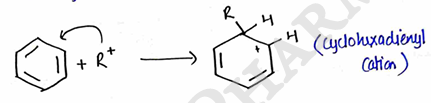
Step 3
- The complex deprotonated for restoring aromaticity. Proton goes on to form hydrochloric acid, regenerating the catalyst.
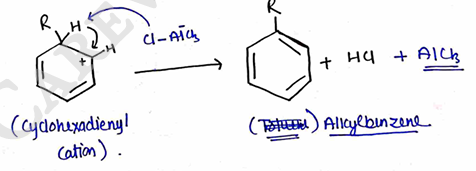
- Alkylbenzene +
- Required Alkylbenzene (toluene) product obtained and & formed.
e) Friedal Craft Acylation
- It involves the addition of an acyl group to an aromatic ring.
- In which benzene react with acetyl chloride in the presence of lewis acid catalyst ($AlCl_3$) anhydrous aluminium chloride which further formed Acetophenone.
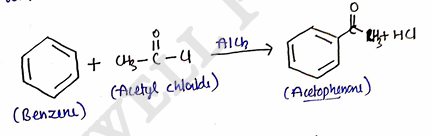
- Benzene + (Acetyl chloride) Acetophenone (Ph-CO-CH_3$) + $HCl
Mechanism : (Four Step Mechanism)
Step 1
- Reaction occur between and . Complex is formed and Acetyl chloride loses its one chloride ion.
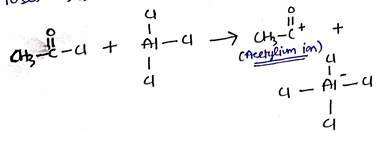
Step 2
- Now, Acylium ion ($RCO^+$) or Acetylium ion ($CH_3CO^+$) goes on to execute an electrophilic attack on an aromatic ring, complex formed.
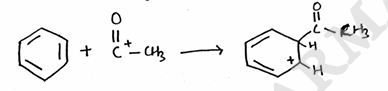
Step 3
- Now, Complex is deprotonated for restoring aromaticity. Proton attached with chloride ion (from complex) form and again regenerated.
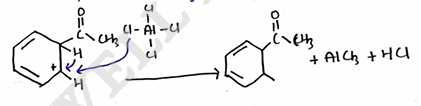
- Acetophenone +
Step 4
- Now, regenerated catalyst attack on carbonyl oxygen, which further liberated by adding water in excess amount.
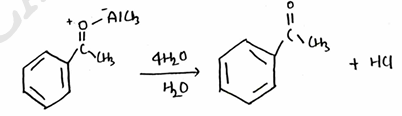
- Acetophenone + Complex Acetophenone +
- Required Acyl benzene (Acetophenone) product obtained.
Limitation of Friedal-Crafts Alkylations
- The halide must be either an alkyl halides. Vinyl, aryl do not react (their intermediate carbocations are too unstable).
- Over alkylation can be a problem since the product is more reactive than the starting material. This can be usually controlled with an excess of benzene.
- The Lewis acid catalyst often complexes to aryl amines making them very unreactive.
Limitation of Friedal-crafts acylations
- Acylation can only be used to give ketones. This is because decomposes to & under the reaction condition.
- The lewis acid catalyst often complexes to aryl amines making them very unreactive.
- Amines and alcohols can give competing N or O acylation rather than the required ring acylation.
Effects of Substituents on Activity of Rings
Substituent
In benzene ring, when any H atom replace and group attached himself at this place. And this process is known as Substitution.
- Benzene is highly reactive ring due to presence of resonance ($\pi$ bond delocalisation).
- When any substituent attached on ring it change the activity and nature of ring and this is depends on the nature of substituents which attached on the benzene ring.
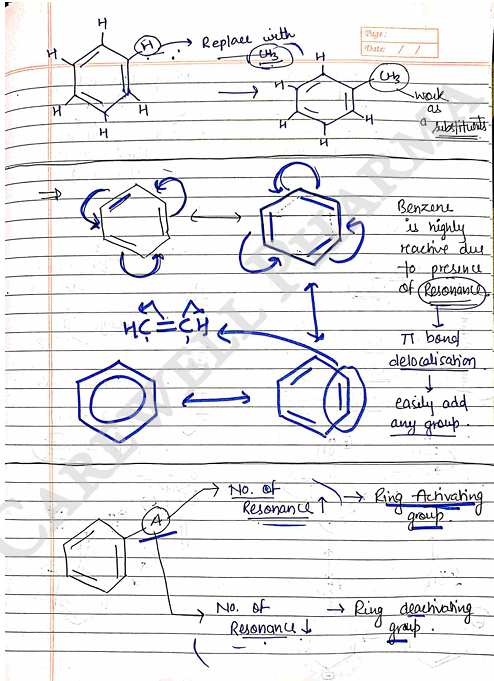
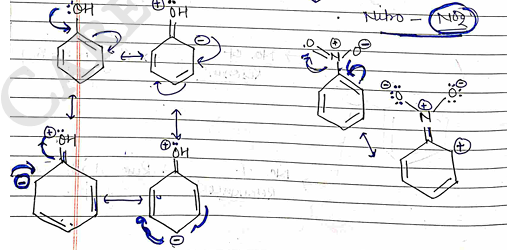
Ring Activating Group → tend to donate electron density to the ring. e.g., Alkyl group, hydroxy (-OH) etc
Ring Deactivating roup → tend to withdraw electron density to the ring. e.g., Halogens, Carbonyl etc
Strong Activating:
- Alkoxide ($-O^-$)
- Amine ($-NH_2$)
- Hydroxy ($-OH$)
Strong deactivating:
- Ammonium ($-NR_3^+$)
- Nitro ($-NO_2$)
- Cyano ($-CN$)
Structure and Uses of DDT, Saccharin, BHC & Chloramine
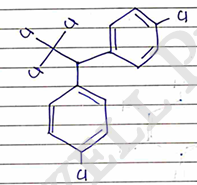
I) DDT (Dichloro Diphenyl Trichloroethane)
Molecular formula → C_{14}H_9Cl_5$
M.W
Uses
- In some places it is used in the control of mosquito that spread malaria.
- It is used for pesticide control.
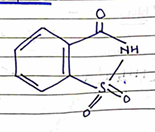
II) Saccharin (Benzoic Sulfimide)
M. Formula →
M. Weight →
Uses
- It is used as an artificial sweetener, with No food energy.
- It is very helpful for diabetic patients.
- It is about 300-400 times sweeter as sucrose and 600 times more than Sugar.
- Used in Coldrinks, cookies, medicines.
III) BHC (Benzene Hexa Chloride)
- Also known as Lindane.
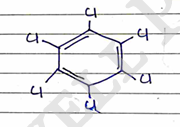
Uses
i) It is used for treatment of Scabies and lice.
ii) It is used as Stomach and contact insecticides.
iii) It is more volatile than DDT and has fumigant action.
IV) Chloramine
- These are a group of chemical compounds that contain chlorine and Ammonia. $NH_2Cl$
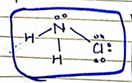
- Used as disinfectants, which treat drinking Water.