Pharmaceutical Microbiology - Unit 5
Syllabus
Types of spoilage, factors affecting the microbial spoilage of pharmaceutical products, sources and types of microbial contaminants, assessment of microbial contamination and spoilage. Preservation of pharmaceutical products using antimicrobial agents, evaluation of microbial stability of formulations.
Growth of animal cells in culture, general procedure for cell culture, Primary, established and transformed cell cultures. Application of cell cultures in pharmaceutical industry and research
Scroll to Download
MICROBIOLOGY UNIT-5
Types of Spoilage, factor affecting the microbial Spoilage of pharmaceutical products.
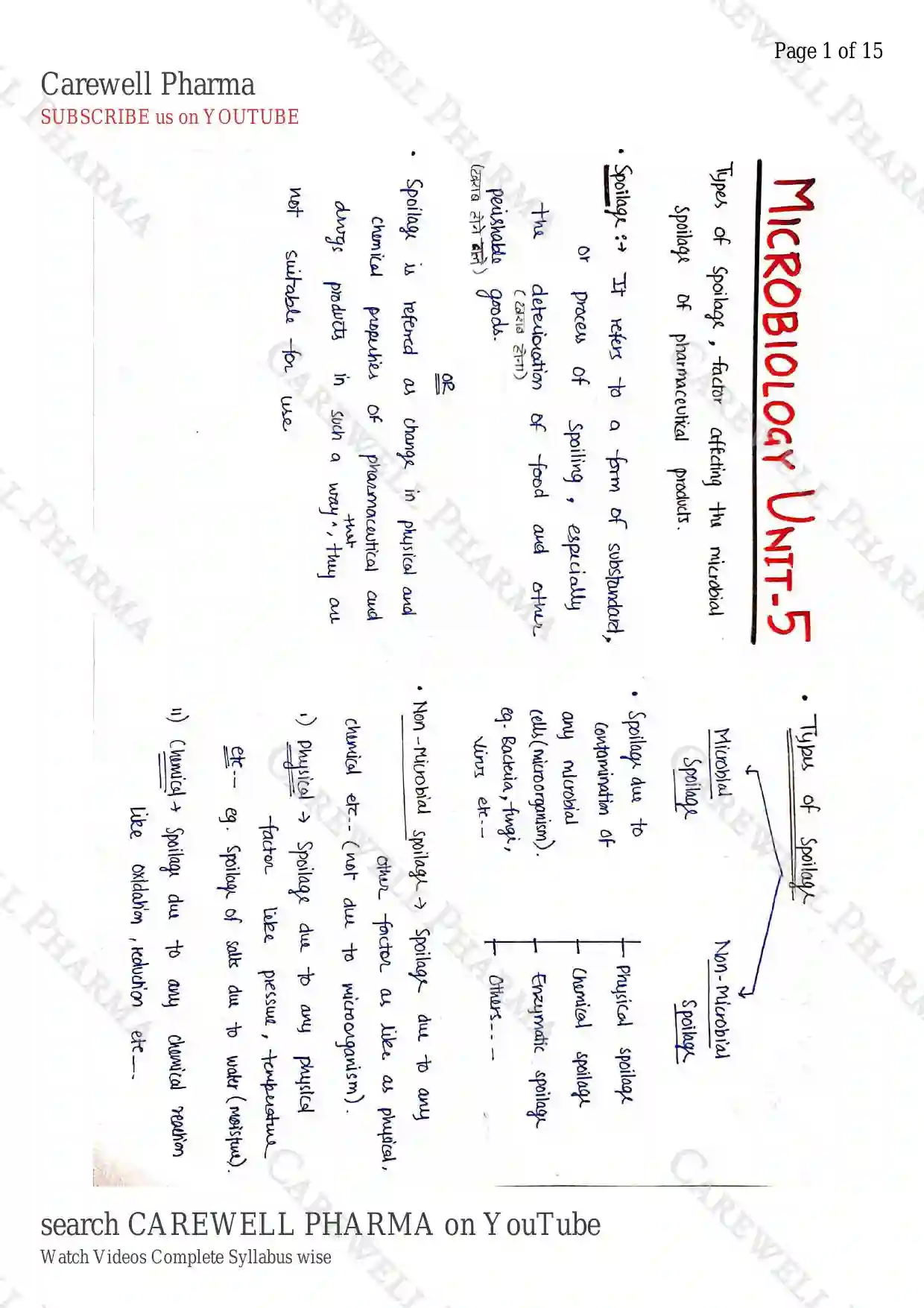
Spoilage
It refers to the process of a form of substandard, Spoiling, especially deterioration of food and other (खराब होना) perishable goods. OR
- Spoilage is referred as change in physical and Chemical properties of drugs products in such a way, they are not suitable for pharmaceutical and use.
Types of Spoilage
- Microbial Spoilage
- Spoilage due to Contamination of any microbial Cells (microorganism).
- eg. Bacteria, fungi, Virus ete--
- Non-Microbial Spoilage
- Physical spoilage
- Chemical spoilage
- Enzymatic spoilage
- Others..-
Non-Microbial Spoilage
Spoilage due to any other factor as like as physical, chemical etc. (not due to microorganism).
Physical Spoilage → due to any physical factor like pressure, temperature etc.
Eg. Spoilage of salts due to water (moisture).Chemical Spoilage → due to any chemical reaction like oxidation, reduction ete.
Enzymatic Spoilage due to any enzyme like as lipase, protease, maltase ete
Eg. hydrolysis of lipid due to lipase etc.
- Microbial Spoilage
- It is spoilage of any pharmaceutical products or drugs due to contamination of microorganism and then products, further not intended for use.
- Pharmaceutical products may be considered to be microbiologically spoiled if low level of pathogenic microbes or a toxic microbial metabolites are present and detectable physical or chemical changes have occured in the products...
- Types of Microbial Spoilage
i) Infection induced by contaminated pharmaceutical products
Pharmaceutical products may be contaminated by pathogenic microorganism mainly from raw material or at the time of preparation, which cause serious infection to the patients...
Eg. Septicaemia due to pseudomonas ete.-
ii) Physio-Chemical Spoilage
Due to microbial contamination, there are change in physical and chemical properties of drugs.
iii) Observable Effect of Microbial Attack on Products
Microbial spoilage of different dosage form may be detected by Organoleptic tests.
These spoiled products may release very unpleasant smelling and tasting metabolites such as 'sour' 'fishy' ete-
iv) Ingredients Susceptible to Microbial Attack
a) Therapeutic agents → Many drugs are capable of gross degradation by a wide variety of microorganism.
Eq. Aspirin may be converted to salicylic acid and penicillin (by $\beta$-lactamase).
b) Preservatives and Disinfectants → Most organic and disinfectants are metabolised readily by many bacteria and fungi.
Eg. Pseudomonas species have metabolised 4-hydroxy-benzoate ester preservatives contained in eye drops and caused serious eye infections.
c) Sweetening, flavoring and Coloring Agents → Many Sugars and other sweetening agents used in pharmacy are ready substrates for microbial growth.
Eq. flavoring agents such as peppermint water and chloroform supports growth of bacteria and yeast.
Factor Affecting the microbial spoilage of pharmaceutical products.
- Nutritional Factors
- Most of the organic and inorganic ingredients act as potential carbon or nitrogen substrates for microbial growth.
- Glucose, water, carbon, nitrogen, ete- normally used as nutritional factor for pharmaceutical products.
- these factors also provides better environment for growth of microorganism.
- liquid products has more chance of microbial spoilage.
- Water (Moisture Content)
- Microorganism readily need water or moisture to grow.
- The presence of uncomplexed water in any formulation support microbial growth.
Eg. spoilage of dry tablets or drugs due to moisture.
- Temperature
- Spoilage of pharmaceuticals could occurs over the range of about , because it is optimum temp. for bacterial growth (Mostly bacteria grow).
- Syrups and multidose eye drops preparation are sometimes dispersed with the label 'store in cool place' to reduce the risk of in use contamination.
- pH
- Extremes of pH prevent microbial attack. Antacid mixtures, mouth washes shows growth of pseudomonas species at neutral pH.
- Many bacteria grow at pH range (2.5-7.5)
- Acidic condition favour fungus and yeast proliferation.
- Redox Potential
- The ability of microbes to grow in an environment is influenced by its oxidation-reduction balance (redox potential).
- Eg: Vacuum packaging of food stuff or the inclusion of oxygen absorbers in the package are to minimize oxygen level and reduce microbial spoilage.
SOURCE AND TYPES OF MICROBIAL CONTAMINATION
- The microbial contamination of pharmaceutical products is influenced by the environment in which they are manufactured and by the material used in their formulation.
- Sources and types are described as follow!-
- Atmosphere
- Microorganisms are carried into the atmosphere suspended on particles of dust, skin, clothing, moisture or sputum following coughing or sneezing.
- The microbial content of the air may be increased during the handling of contaminated material during dispensing, blending and formulation.
- Microbes commonly isolated from the atmosphere are bacteria and fungi.
Eg. Staphylococcus, Bacillus spp., Penicillium spp. ete..
- Water
- It is one of the main constituents of many products and it is also used for washing and cooling process.
- Different types of microbes are present in fresh water and some microbes from sewage may contaminate the water. eg. Streptococcus faecalis, Pseudomonas spp. etc-
- Softened water is often used for washing containers and for formulation may be contaminants through. Bacillus and staphylococcus spp.
- Raw Materials
- Raw materials, particularly of natural origin are potentially rich source of microorganism.
- Products from animal sources such as gelatin, pancreas, cochineal etc may be contaminated with different pathogens.
- Some plants origin material such as agar, starch, acacia etc. used for pharmaceuticals are source of microbial contamination.
- It contain mainly bacteria and fungi. eg. Bacillus spp., Pseudomonas spp. ete
- Process Operators
- Microorganism may be transfered to pharmaceutical formulation from operators.
- Natural skin flora are the main source of contamination.
Eg. Staphylococcus aureus, Sarcina spp. ete--.
- Equipment
- The equipment and utensils are used in processing, holding, etc.. are the common sources of pharmaceutical microbial contamination.
- It is due to improper cleaning and calibration of equipments..
- Packaging
- Microbial contamination of packaging material is dependent upon its composition and storage condition. Glass containers cardboxes etc- carry different types of microbes if not treated (sterilized) with suitable method.
Eg. Bacillus, Penicillium ete
- Buildings
- Different molds and few bacterial species are the most common flora of walls and ceiling. eg. Aspergillus niger & flavis ete
- It is also due to Rough floors, walls or poor ventilation.
ASSESMENT OF MICROBIAL CONTAMINATION AND SPOILAGE
It is determination of microbes present in a given product and the level to which it is deteriorated or degraded.
- Physical and Chemical Changes
- Physical and chemical changes of different pharmaceutical formulations indicates microbial contamination and spoilage.
- Change in viscocity, pH, emulsion stability ete... indicates microbial spoilage.
- Sterility Test
- These are those test which confirms that the products are free from all microorganism.
- With the help of this test, we can identify the microbial contamination and spoilage of products.
- But, It is important that materials are to be tested for sterility are not subject to contamination from the environment during the course of the test.
- Assessment of viable microorganism in non-sterile products
- Non-sterile products are tested for viable microorganism for detection of pathogens and total viable count.
- This can be identified through "Microbial Limit tests".
- Estimation of Pyrogens
- Pyrogens which cause rise in body temp. (fever). Two main procedure use for this (detection of Pyrogens).
- The BP pyrogen test, which requires administration of the injection to laboratory rabbits.
- In which, their body temp. is monitored for a period of time.
- The LAL test [Limulus Amoebocyte lysate test] in which the pyrogen containing sample causes gel formation in the lysis product of amoebocyte cells of the giant horseshoe crab limulus polyphemus.
PRESERVATION OF PHARMACEUTICAL PRODUCTS USING ANTIMICROBIAL AGENT
- An antimicrobial agent (preservatives) are the chemical substance used to improve shelf life of drug or formulations and inhibit the growth of microbes and reduces the risk of spoilage of pharmaceutical products.
- A single preservative is not suitable for preservation of all pharmaceutical formulations, combination of two or more preservatives are used to extend the spectrum of preservation.
- The main function of antimicrobial preservatives is to prevent the growth of unwanted microorganism in pharmaceutical preparations.
- The correct approach to prevention has as its foundation in two important principles.
- The first of these is that the addition of a preservative to a product must not be done to mask any deficiencies in the manufacturing procedures.
- The preservative should be an integral part of the formulation, choosen to afford protection in that particular environment.
- Preservatives are widely employed in pharmaceuticals dosage forms such as emulsions, suspension, semisolids, parenteral preparations etc...
- There are some commonly preservatives in different dosage forms:-
Preservatives Used in Pharmaceutical Formulations
| Formulations | Preservative |
|---|---|
| 1) Tablet | Methyl paraben, Phenol, Cresol |
| 2) Eye drops | Benzalkonium chloride, Phenyl mercuric nitrate |
| 3) Liquids/mixtures | Alcohol, Methyl paraben, chloroform |
| 4) Semisolids | Chlorocresol, Dichlorobenzyl alcohol |
Characteristics of Preservatives
- Should be able to kill all the microbes contaminants rapidly.
- It should be non-toxic.
- Not be irritant.
- It should be physically and chemically stable.
- Effective at low concentration throughout the life of the medicine.
- Cost effective.
Evaluation of Microbial Stability of Formulation
- This test is applied to the formulated medicines in its final container to determine whether it is protected against microbial spoilage.
- It is used to check stability of Multiple dose such as parenteral, oral, nasal, topical and opthalamic products made with aqueous bases or vehicle.
- It is used to check the effectiveness of antimicrobial preservatives.
- These pharmaceutical formulation also evaluated at time to time (once evaluated under 6 months).
- The test and standard apply only to the product in the original, unopened container, in which it is supplied by manufacture.
- Medium Used
For the initial cultivation of test microorganism, Use Soyabean casein digest agar medium.
Choice of test microorganisms and inoculum preparation
- The intension is to use microorganism which are likely to arise in the raw material used in the product and which occurs in the manufacturing environment and represent a particular health hazard, if they grew in the product.
- The test Microorganism used for preservative efficacy tests are..
- Staphylococcus aureus ATCC 6538,
- Pseudomonas aeruginosa ATCC 9027,
- Escherichia coli ATCC 8739,
- Candida albicans ATCC 10231 and
- Aspergillus brasiliensis ATCC 16404.
- Fresh stock culture of each test microorganism is subcultured on the surface of soyabean casein digest agar medium.
- Incubate the bacterial culture at for 18-24 hours.
- Using sterile saline sol^n, harvest the bacteria and dilute suitably with sterile saline sol^n to bring the count to about CFU/ml.
PROCEDURE
- Innoculate each original product container with one of the standardised microbial suspension using a ratio equivalent to 0.1 ml of inoculum suspension to 20ml of product, and mix.
- Final concentration should be microbes per ml of products.
- Determine the number of viable microorganism by the plate count method and calculated the initial concentration of microbes per ml.
- Incubate the inoculated containers or tubes at room temp.
- Determine the viable count by the plate count method at 7, 14, and 28 day subsequent to inoculation.
- Calculation the percentage of reduction in cfu per ml for each organism at the states test intervals and express the change in terms of percentage of initial concentration.
- Cfu (Colony-forming unit)
Interpretation of Results
- For parenteral, ophthalmic, sterile nasal & otic preps, concn of viable bacteria is not more than 10% of initial concentration at 7 days & not more than 0.1% of initial concn at 14 days and there is further decrease in count at 28 days.
- For topical preparation, Conc^n of viable bacteria is not more than 1% of initial concn at 14 days and there is further decrease in count at 28 days.
- For oral not more than 10% of the initial concn at 14 days and further decrease.
ANIMAL CELL CULTURE
- Growth of animal cell in culture, general procedure for cell culture, Primary, established and transformed cell cultures.
- Applications of cell cultures in pharmaceutical industry and research.
Growth of Animale Cell in Culture
- The animal cell culture is a technique in which cells are obtained from animals, and maintained in a suitable medium.
- The culture produced by the cell or tissue taken from an organism is called as Primary Culture.
- The sequence of culture obtained from the first subcultivation of the primary culture is Called 'Cell line'.
- The first attempt to grow animal cells in culture is attributed to Ross Harrison in 1907. He was able to Cultivate frog embryonic nerve cells using the hanging drop technique.
Culture Media
- Design of animal cell culture media is more difficult than that of microorganism & plant cultures.
- Culture media are used to support the Survival as well as growth.
- Selection of media is dependent on type of cells and main Objective of culture.
- Culture media classified as Natural and Artificial/Synthesized.
- Natural → This media are obtained from natural sources such as plasma clot or extracts, coagulans, biological fluids and tissue extracts.
- Blood plasma provide a nutritive substrate and supporting structure for many types of cultures.
- Blood serum (fibrinogen free plasma) is used in animal tissue culture is mixture of plasma proteins, peptides, Lipid Carbohydrates, harmones, enzymes and minerals.
- Artificial Media → It is prepared by adding Organic and inorganic nutrients, vitamines, Salts, Serum protein, carbohydrates, and gases.
- Serum Containing media in which serum is added in 5 to 20% amount.
- Serum free media These are developed to overcome the limitations of serum. It has ability to make the medium more selective for a particular cell types.
Procedure for Cell Culture
A piece of tissue from the organism is usually quite complex and it contain connective tissue cells, variety of blood cells and reticuloendothelial cells.
The first cell suspension is isolated and then inoculated into a new culture vessel along with fresh medium (primary cell culture).
Stages for Cell Culture!
i) Isolation of the tissue
ii) disaggregation
iii) seeding the culture into culture vessels.
- Isolation of The Tissue
- The explant from an excised (cut surgically) portion of the body of an animal is used for the culture of animal cells in a suitable nutrient medium.
- animals are mice, rabbits, guinea pig ete
- Organs from which cells are to be isolated are surface sterilised with 70% alcohol and then removed aseptically.
- The tissue isolate from explant is either stored in freeze or used immediately.
- Disaggregation of Tissue
- A primary cell culture is obtained by disaggregating the tissue mechanically, enzymatically or by use of chelating agent. (EDTA)
- Seeding the Culture Into the Culture Vessels
- The dissociated (primary) cell grow well when seeded on culture plates at high density.
Types of Cell Culture
- Primary Cell Culture
- When the cells are surgically removed from an organ and placed into suitable culture environment, they will attach, divide and grow.
- It is first step to established an cell culture.
- This is called primary cell culture.
- Established Cell Culture
- When the primary cell lines continue to grow and divide, they are Sub cultured in fresh media to maintain their viability and growth.
- After many subculturing (about 70 times) these cells are Called established cell lines (cell culture).
- Primary cell culture can grow very slowly, but established cell line grow faster.
- Primary cell maintains the properties of parent cells, but establised has some altered properties.
- Transformed Cell Culture
- In which established cell lines cells become immortal (i.e. cells have the capacity to grow indefinitely).
- This capacity is generated due to transformation in genetic material, due to this transformation, cells loose the sensitivity to external stimuli and also sometimes shows changes in chromosomal numbers.
Application of cell cultures in pharmaceutical Industry and research
There are various application of cell cultures
Virology → Cultivation and study of virus is called virology. Virus are cultured for vaccine production, genetic engineering and to study their infection pathology.
Model System → It is used as a model system in research that helps us to study basic cells biology, effects of substances on cells ete..
Production of Vaccines → Cells are used to produces vaccines. eq. for hepatitis, rabies, chicken pox vaccines.
Toxicity Study → Cultured cells are widely used alone or with animals to study the therapeutic and toxic effects of drugs, cosmetics and other chemicals.
- Also helps in development of dose fixation studies of any therapeutic agents.
Cancer Research → Culture animal cells are transformed into cancer cell and examined for therapeutic effects of any drug or chemical agent or any other method.
- This helps to develop any technique, method or any drug for cancer treatment.
Genetic Engineering → Cells culture in artificial media are used for genetic engineering manipulation in genetic material (DNA or RNA).