Pharmaceutical Engineering - Unit 5
Syllabus
Materials of pharmaceutical plant construction, Corrosion and its prevention: Factors affecting during materials selected for Pharmaceutical plant construction, Theories of corrosion, types of corrosion and there prevention. Ferrous and nonferrous metals, inorganic and organic non metals, basic of material handling systems. 83
Scroll to Download
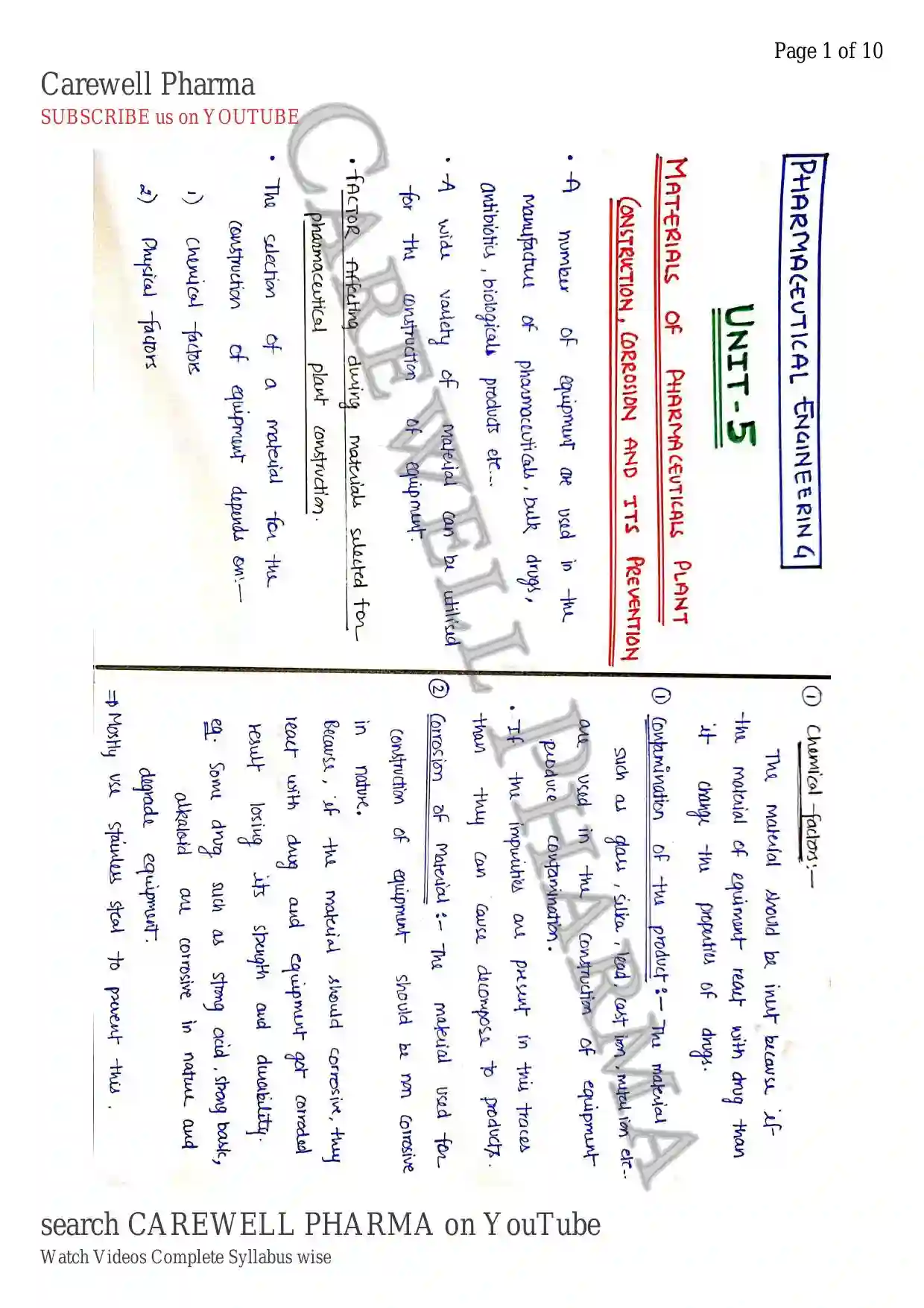
PHARMACEUTICAL ENGINEERING UNIT-5
MATERIALS OF PHARMACEUTICALS PLANT CONSTRUCTION, CORROSION AND ITS PREVENTION
- A number of equipment are used in the Manufacture of pharmaceuticals, bulk drugs, antibiotics, biologicals products ete....
- A wide variety of Material can be utilised for the construction of equipment.
Factor Affecting during materials selected for pharmaceutical plant construction.
- The selection of a material for the construction of equipment depends on:-
- Chemical factors
- Physical factors
1) Chemical Factors
The material should be inut because if the material of equiment react with drug than change the properties of drugs.
Contamination of The Product → The material such as glass, silika, lead, cast iron, metal ion ete... are used in the construction of equipment Produce contamination.
- If the impurities are present in this traces than they can cause decompose to products.
Corrosion of Material → The material used for construction of equipment should be non corrosive in nature.
- Because, if the material should corrosive, they react with drug and equipment got corroded result losing its spength and durability.
- eg. Some drug such as strong acid, strong base, alkaloid are corrosive in nature and degrade equipment.
- Mostly use stainless steal to prevent this.
2) Physical Factors
Strength → The material should be sufficient spength because in manufacturing process of pharmaceuticals involves high pressure and high stress condition.
- So, the material used for equipment has ability to tolerate (endur) these stresses. IRON AND STEAL
Mass → The material should be light in weight, because many times equipment are transported or moved.
- So, it is possible (easy) when material is light in weight.
Wear Properties → There are possibility of friction b/w moving parts (materials) and their chance that some surface of material of equipment can contaminants into drugs.
- So, it is also important in selecting materials.
Thermal Conductivity → In some processes, there are use of high heat or temp. and this (drying, evaporations) types of processes may be damages or fracture materials (plastic, rubbers etc.)
- So we have to use thermostable material for that types of processes (eg. stainless steel, iron, etc-)
Ease of Fabrications → During fabrication, the material undergoes various process such as casting, forging, welding, etc.
- So, the material used should be easily moulded.
- eg. Glass, plastic
Cleaning → The material should have smooth and polished surface for easy cleaning.
- stainless steel and glasses etc.
Sterilization → In the production of parenterals, Opthalmic etc sterilization is an essential step.
- So, material should be stable with it.
Economic Factors → Before manufacturing, material's budget (cost) must be considered.
- Initial costs and maintainance of plants must be economical.
CORROSION
- Corrosion is defined as the process of decomposition or destruction of metallic materials in the presence of environment through any electro-chemical reaction.
- It occurs due to attack of gases or vapour [dry corrosion], or due to aqueous media [wet corrosion].
- eg. Iron rust etc... [formation of rust on iron]
Theories of Corrosion
- Acid theory
- Dry (chemical theory)
- Electrochemical theory [Galvanic theory]
1) Acid Theory of Corrosion
This theory states that the acid cause corrosion of a metal.
(Carbon dioxide), atmospheric oxygen and moisture are responsible for corrosion.
Rust represented as:
i) Carbon dioxide react with water in atmosphere form carbonic acid, which convert iron to iron bicarbonate.
ii) Ferrous bicarbonate is the oxidized by atmospheric oxygen to formed hydrated ferric oxide (rust).
2) Dry or Chemical Theory of Corrosion
This theory states that, corrosion is due to the reaction of atmospheric gases such as Oxygen, halogens, sulphur oxides etc...
eg. Alkali, and alkaline earth metals reacts with oxygen at room temperature and forms corresponding oxides.
3) Galvanic Theory of Corrosion (electrochemical)
It occurs when the two dissimilar metal or metal dipped partially or fully in conducting Liquid.
- This cause formation of a galvanic cell on the metal surface.
- Some part of metal surface act as anode and rest as cathode.
- Chemicals in environment act as electrolyte and cause oxidation of anodic part (corrosion at anode) while reduction at cathode.
- So, formation of corrosion take place at metals.
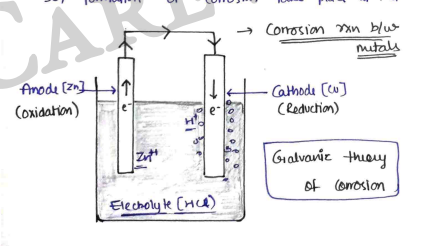
- It occurs when current flow from anode to cathods
- Two metal (Zn) anode and (Cu) cathode when dipped in electrolytic sol^n, they form galvanic cells.
- When these electrodes connected to wire spontaneous reactions occurs.
- At anode (oxidation) Indicate rough surface $Zn \rightarrow Zn^{++} + 2e^-$
- At cathode (reduction): formation of bubbles at surface $2H^+ + 2e^- \rightarrow H_2$
- When current flow, the anode metal got corroded.
Corrosion Involving Oxygen:-
at cathode
- Presence of moisture (water) promotes corrosion.
TYPES OF CORROSION
- General Corrosion [uniform attack corrosion]
- Localised corrosion
- Pitting Corrosion
- Crevice corrosion
- Structural corrosion
- Biological corrosion
- fretting corrosion
- Galvanic corrosion
- Corrosion fatigue
1) General corrosion
Also known as Uniform attack corrosion.
- It is most common type of corrosion and is caused by chemical that damage the entire surface of metal.
2) Localised Corrosion
This type of corrosion occurs at any particular (local) area on metal surface.
i) Pitting Corrosion → Pitting corrosion occurs when a small hole or cavity is formed in the metal surface. That area becomes anodic, while a remaining metal become cathodic, produces localized galvanic reaction. it produce corrosion.
ii) Crevice Corrosion → Similar to pitting, crevice corrosion occurs at a specific location. Solution get deposited to crevice and drying of a liquid take more time, as result crevice corrosion occurs.
iii) Fretting Corrosion → It occurs as a result of repeated wearing / sliding / vibration of metal on an uneven rough surface.
iv) Galvanic Corrosion → It occurs when two different metals are found together in a corrosive electrolyte.
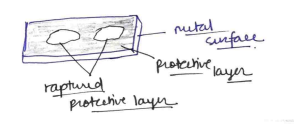
v) Corrosion Fatigue → Due to repetition, metal surface get corroded by corrosive media. Because, the protective oxide film that prevent corrosion get raptured.
3) Structural corrosion
In this type of corrosion, structural strength of metal get reduced due to corrosion.
eg. Dezincification [De-alloying]
- Alloys are the mixture of many metals.
- Dezincification is a process which selectively remove zinc from an alloy. (basically copper alloy)
4) Biological Corrosion
This type of corrosion occur due to metabolic activity of microorganism which cause deterioration of metal.
- Anaerobes sulphate-reducing bacteria in the soil produces hydrogen sulphite and calcium sulphite.
- When these compound comes in contact with Underground pipes, convert iron to iron sulphide.
PREVENTION OF CORROSION
Corrosion is an natural process, but it can be controlled by using effective method.
i) Painting and Coating [Polished]
- Iron is given a suitable coating to or painted exclude the atmosphere (prevent metal surface from environment).
ii) Alloying
- Alloying of iron with metal like Ni, Cr, V etc... make it resistant to corrosion.
iii) Cathodic Protection
- In this process the metal that is to be protected from corrosion is made the cathode of an electrochemical cells.
iv) Design of Equipment
- The proper design reduce corrosion and also time & cost required for corrosion maintenance.
- So, eliminate or minimize the dead spaces or crevice.
v) Use of Corrosion Inhibitors
- They are used to decrease corrosion of metals, but used in only critical amount (less than 0.1% by weight).
- eg. Chromates, phosphates and silicates are used to protect iron & steel in aqueous solutions.
Pharmaceutical Engineering Unit 5
- Ferrous and non-ferrous metals
- Inorganic and Organic non metals
- Basics of material handling systems.
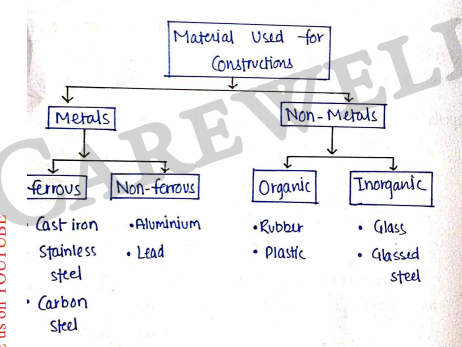
Classification of materials for plant constructions
- Material Used for Constructions
- Metals
- ferrous
- Cast iron
- Stainless steel
- Carbon steel
- Non-ferrous
- Aluminium
- Lead
- ferrous
- Non-Metals
- Organic
- Rubber
- Plastic
- Inorganic
- Glass
- Glassed steel
- Organic
- Metals
Ferrous Metals
- They are widely used as construction material because it is mechanically strong, easy available and economical.
1) Cast Iron → It is combination of iron with carbon content greater than 2%.
- It is cheap and available easily so greater in demand.
- It has low thermal conductivity.
Uses → It is used to jacketed steam pans.
- It is used as lining material with plastic.
ii) Stainless Steel → It is an alloy of iron.
- It contain 12-30% chromium, 0-2% Nickel, low percentages of carbon, columbian, copper, molybdenum, selenium, tantalum and titanium.
Used → It is widely used in industries because it is heat resistant, corrosion resistant, easily fabricated, and have high tensile spength. eg. Martensitic, $\alpha$-ferritic, etc... (type 410) (type 430)
iii) Carbon Steel → It is an iron alloy having low percentage of carbon content.
- It is cheapest and easy to fabricate.
- It contain 0.4% carbon, 0.7% manganese, 1.85% Nickel, 0.8% chromium and 0.25% molybdenum.
Uses → It is used for construction of pipes and plates.
- Also used as supporting structure for plant vessels.
Non-ferrous Metals
A non-ferrous metals is a metal, including alloys, that does not contain iron in appreciable amounts.
i) Aluminium → It is available in large number of alloys.
- It is cheap and light in weight.
- It has sufficient mechanical strength.
- Their maintenance and cleaning is easy.
- It is resistant to corrosion.
Uses → It is used for manufacturing of barrels, container, tanks, rail tankers and tubes.
ii) Lead → It is used in less percentage because in large amount it produce toxicity.
- So, generally used for non food products.
- is cheap.
Organic - Non-Metals
Mainly two materials are widely used in plant construction-
- Rubber ii) Plastic
i) Rubber → It is used as lining material.
- Both natural and synthetic rubber are used.
- Natural rubber is naturally occuring polymer, which is obtain as latex from rubber tree.
- include soft and hard rubber, Soft rubber is used as lining material for plants, as it can bond easily to the steel.
- Hard rubber is used for making gloves, bands, Also used for doors.
- Synthetic rubber are more resistance to oxidation, solvent oils & other chemicals.
- It includes neoprene, nitril rubber, butyl rubber.
- Neoprene used as rubber stoppers, insulating material in electrical cables, etc..
- Butyl rubber is Used for closure of freeze dried product containers because of its low water vapour permeability.
- Silicon rubber is resistant to high & low temp.
ii) Plastic → It is most commonly used material.
It is light in weight & variety of shapes. Not Used in case of higher temperature.
Two types of plastic:-
i) Thermoplastic → They got softened with application of pressure and heat but regain their original shape on cooling. eg. Polyethylene, PVC etc.
ii) Thermosetting → They are permanently shaped to rigid structure when pressure and heat is applied. eg. Phenol-formaldehyde.
Uses → It is used to made pipes and tubing.
- Used for storage of inorganic salts and weak acid. Used as insulating material.
- Plastic do not corrode in air or water.
Inorganic Non-Metals
i) Glass → Glass container is widely used in daily life.
- It is composed of sand (pure silica), soda ash (sodium carbonate), limestone (calcium carbonate) and cullet (broken glass).
- Glass in its solid state is considered as supercooled liquids.
- Attractive in appearance, inert, cheap etc.-
Uses → it is widely used in pharmaceuticals industries and labs, in Glasswares.
- It is fragile in nature and damaged by thermal shock (disadvantage).
ii) Glassed Steel → It is inorganic condition of fusion. It is cooled to rigid condition without crystallization.
- Used in heavy vessels, excellent resistant to all acid.
- Suitable in case of transparent pipes.
BASICS OF MATERIAL HANDLING SYSTEMS
- Materials handling is the movement, protection, storage and control of materials products used during manufacturing, storage, distribution, consumptions and disposal.
- There are different types of handling instruments are required for different types of materials.
Importance
- To provide better working conditions.
- To increase storage conditions.
- Reducing manufacturing cycle time.
- To lowers unit materials handlings cost.
- function of production control.
- Concern with scheduling of production control.
Principles
- Materials should be moved as little as possible.
- Rehandling and back tracking of materials should be avoided.
- Design of materials handling equipment should be such that it can increase the effectiveness.
- Periodically repairing, maintenance and checkup of existing materials handling equipment.
- As a process, material handling incorporates a wide range of manual, semi-automated and automated equipment.
Conveying → It is the process of transport of material from one place to another.
- Most commonly equipment used for material handling are Conveyors.