Pharmaceutical Engineering - Unit 4
Syllabus
Filtration: Objectives, applications, Theories & Factors influencing filtration, filter aids, filter medias. Principle, Construction, Working, Uses, Merits and demerits of plate & frame filter, filter leaf, rotary drum filter, Meta filter & Cartridge filter, membrane filters and Seidtz filter.
Centrifugation: Objectives, principle & applications of Centrifugation, principles, construction, working, uses, merits and demerits of Perforated basket centrifuge, Non-perforated basket centrifuge, semi continuous centrifuge & super centrifuge.
Scroll to Download
PHARMACEUTICAL ENGINEERING UNIT 4
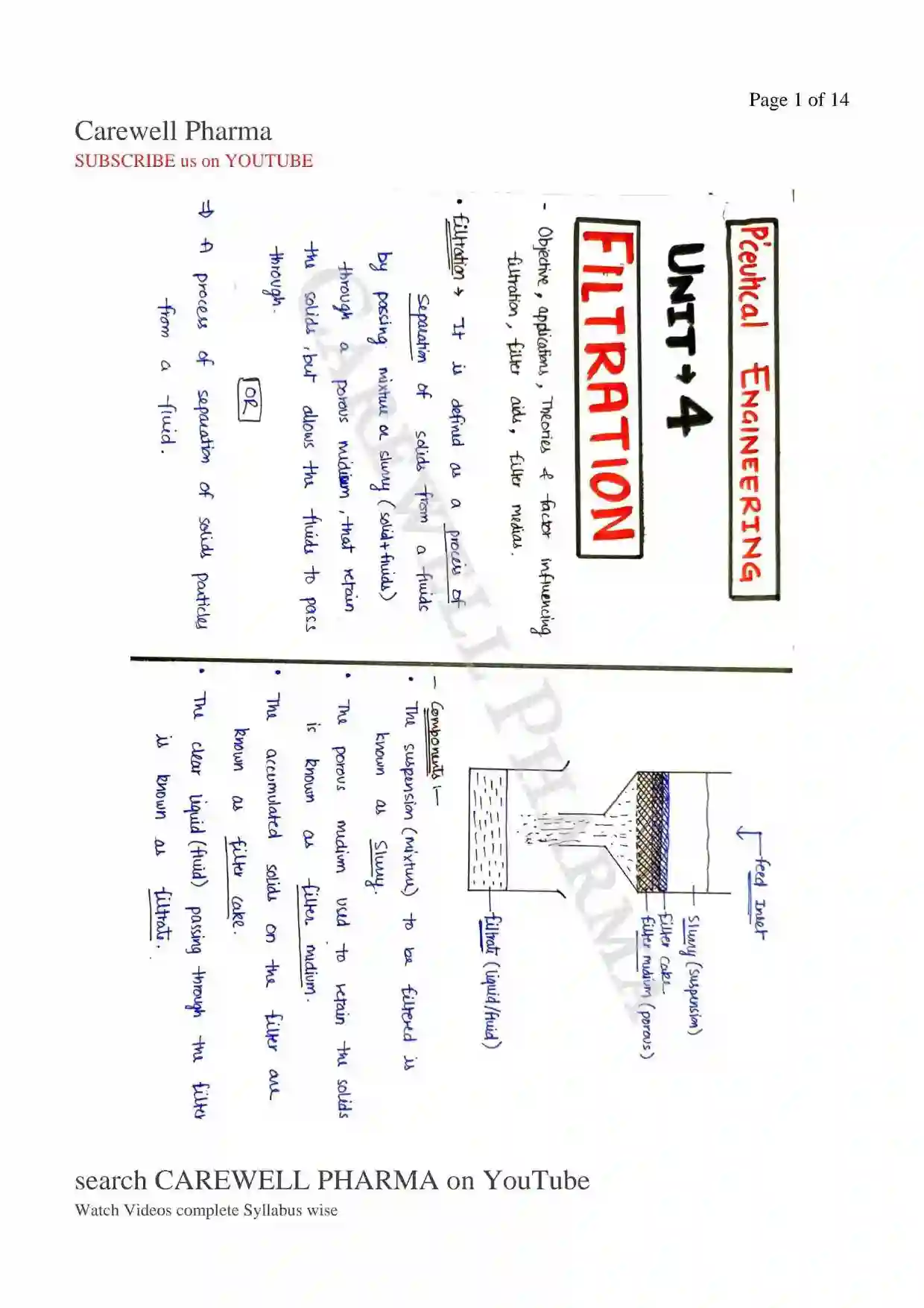
FILTRATION
Objective, applications, Theories & factor influencing filtration, filter aids, filter medias.
Filtration
It is defined as a process of separation of solids from a fluids by passing mixture on slurry (solid+fluids) through a porous midium, that retain the solids, but allows the fluids to pass through.
OR
A process of separation of solids particles from a fluid.
Components
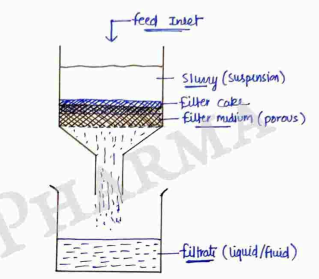
- The suspension (mixture) to be filtered is known as Slurry.
- The porous medium used to retain the solids is known filter midium.
- The accumulated solids on the filter are known as filter cake.
- The clear Liquid (fluid) passing through the filter is known as filtrate.
Mechanism
- Filtration take places, when the pores of the filter medium are smaller than the size of particles to be separated.
- So, the filter midium resist solid particles and allow the fluid (Liquid) to pass.
- Now, filter cake also resist some slurry and act as a secondary filter mudia or secondary filteration. (Cake filtration)
Objective and Applications
Production of Sterile Products → Air is filtered through HEPA filters (High Efficiency Particulate Air) in sterilization process or in Laminar air flow to obtain Sterile air.
Production of Bulk Drugs → Solids of intermediate and finished product are separated from the reaction mixture by filteration technique. By this method, impurities can be removed.
Production of Liquid Oral Formulation → Filtration is an essential step in the production of Liquid oral solution for obtaining clear solution (clarification).
- Dewaxing of oils
- Removing suspended oils from aq. solutions. (eq. Syrup, elixirs, eye drops etc..)
Waste Water Treatment → Waste solids must be separated from the waste liquid prior to its disposal.
Clarification → When suspending solid particles are less than 1% in any Liquid (fluid) on any slurry.
THEORIES OF FILTRATION
In filtration, the flow of liquid follow basic rules that govern the flow of any Liquid through the midium offering resistance.
- Driving force is the pressure differential b/w the upstream and downstream of the filter.
- Resistance, which resist the filtration.
Poiseuille's Equation → Poiseuille considered that filtration is similar to the streamline flow of a Liquid under pressure through Capillaries.
Where,
= rate of flow ($m^3/s$)
= pressure difference across the filter, Pa
= radius of the capillary in the filter bed, m
= thickness of the filter cake (capillary length),
= viscocity of the filtrate, Pa·s
Darcy's Equation → The factor influencing the rate of filtration has been incorporated into an equ.
Where,
= permeability coefficient of cake ($m^2$)
= Surface area of filter medium ($m^2$)
= Pressure difference, (Pa)
= Viscocity of the filtrate. (Pa·s)
= thickness of filter cake (length of Capillary)
kozeny-Carman Equation → This is the resultant equ of Poiseuille and Darcy, which is widely used in filteration.
Where,
= porosity of the cake (bed)
= Surface area of the particles comprising the cake
= Kozeny constant.
other terms same as poiseuille's & Darcy's.
Factor Influencing Filtration
i) Surface Area of Filter Media → Acc. to Darcy's Rate of filtration is directly proportional to surface area of filter media.
or
ii) Particle Size of Solids
iii) Filter Cake (Resistance)
- filteration is decrease on increasing filter cake.
iv) Viscocity
or
v) Pressure Difference ($\Delta P$) → The rate of filteration is directly proportional to the overall pressure drop across filter media and filter cake.
(\Delta P$) $\text{Pressure difference} \propto \text{Rate of filtration}.
So,
FILTER MEDIA & FILTER AIDS
Filter Midia → Those substance which help in filteration process, which retain the solid residue (filtercake) and allow to pass Liquid, and also provide mechanical support for filter cake.
Characteristics
- It must be inert (not sensitive)
- It should have sufficient mechanical strength.
- It should allow the maximum passage of Liquid
- Resistance to corrosive
Materials Used as Filter Media
- Filter paper
- Woven material (made up of wool, cotton, silk etc.)
- Asbestos
- Membrane filter
- ete...
Filter Aids → filter aid forms a surface deposite which screen out the solids and also prevents the plugging of the supporting filter medium.
Characteristics
- It must be inert.
- Porous rather than dense
- Low specific gravity
- Recoverable
- eg. Talk, Charcoal, Asbestos, Bentonite, keiselguhr ete...
Principle, Construction, Working, Uses, Merits and demerits of
- Plate and frame filter
- Filter leaf
- Rotary drum filter
- Meta filter
- Cartridge filter
- Membrane filters
- Seidtz filter.
Plate and Frame Filter [filter Press]
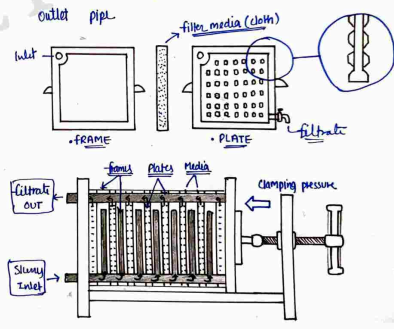
Principle → The mechanism is surface filtration. The slurry enters the frames by pressure and flows through the filter media. The filtrate is collected on the plates and sent to the outlet.
Construction
- It consist of plates and frames.
- The frame is open and is used as an inlet for the material to be filtered.
- Plate has groove support to the filter cloth.
- The plates and frame may be made of various metals which provide resistance to corrosion or prevent metallic contamination of the filtrate (Usually made up of alluminium alloy).
- Filter cloth is fitted on each side of the plate.
- The plate and frames are placed alternatively and fitted in the outer frame of the press.
- Each plate acts as a single filtration unit. The outlet of each plate is connected to a common outlet pipe.
Working It involves two steps:-
i) Filtration → The slurry is inlet through common inlet pipe of all filter frame, which further pass through filter midia (cloth) and the filtrate (liquid) is collected in the plates from where it is collected through common outlet pipe.
- The cake is deposited in the frames, the process of filtration is continued untill the frame is filled with filter cake.
ii) Washing → When the process is stopped, the frame is emptied or washed with Water.
- It is necessary because filter cake create resistance for filtration.
- After washing, the cycle (filtration) is restarted.
Uses
- Removal of precipitated protein from insulin liquors.
- If use filter sheet of asbestos and cellulose, it is capable of retaining bacteria.
Advantages
- It provides large filtering area.
- Efficient washing of the cake is possible.
- Construction is very simple and vareity of material can be used.
Disadvantages
- It is an expensive filter.
- It is batch filter.
FILTER LEAF
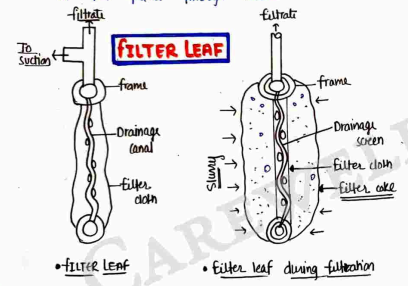
Principle → Filter leaf is an apparatus consisting of a longitudinal drainage screen covered with a filter cloth. The mechanism is surface filtration and acts as seive or strainer. Vacuum or pressure can be applied to increase the rate of filtration.
Construction
- Consists of narrow frame enclosing a drainage screen or grooved plate.
- The frame may be of any shape, circular, square or rectangular.
- The whole unit is covered with filter cloth.
- The outlet for the filtrate connects to the interior of the frame through suction.
Working
- Filter leaf during filtration
- The filter leaf is immersed in a slurry.
- Vacuum system is connected to the filtrate outlet.
- The slurry passes through the filter cloth.
- Finally filtrate enters the drainage canal and goes through the outlet into the receiver.
- Air is passed to flow in reversed direction which facilitates removal of cake.
Uses
- The filter leaf is satisfactory if the solid content is not too high, about 5%, i.e., dilute suspension.
Advantages
- It is the simplest form of filter used for batch process.
- Efficiency of washing is high.
Disadvantages
- filter cloth life is relatively short.
- Not suitable for high throughputs.
ROTARY DRUM FILTER
Principle → It is based on the principle of filtering the slurry through sieve-like mechanism on a rotating drum surface, under the condition of vacuum.
- In addition, compression, drying and removing the filter cake is possible.
Construction
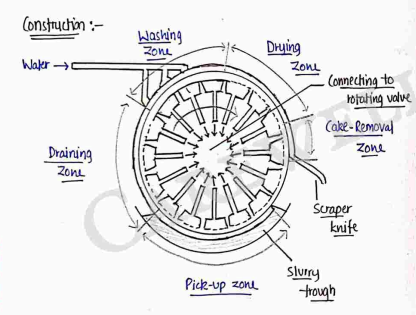
- It consists of a metal cylinder mounted horizontally. Drum have, diameter 3 metres, length 3.5m, and surface area 20 m².
- Filter cloth is used as filter media.
- The drum is radially partitioned dividing the annular space into separate compartments. Each of it is connected by a internal pipe to the centre of the drum through a rotating valve.
Working
- The drum is dipped into the slurry (speed of drum is less than 1 revolution per minute) and vacuum is applied to the outlet, which is connected to the filtrate receiver. (Pick-up Zone)
- When the cake has formed, the cake drained or partially dried by vacuum. (Draining zone)
- The drum is sprayed with water to wash the cake (Washing zone)
- Retaining the vacuum connection drains the cake and produces partial dryness. (Drying zone)
- Then cake is removed by doctor knife (Cake-removal zone).
- A pre-coat of filter aid is deposited on the drum to prevent blocking of filter cloth during filtration process.
Uses
- Used to filter slurries containing high proportion of solids (15-30%).
- Used in filtration of calcium carbonate, starch etc.
Advantage
- Labour cost is low due to automatic and continuous process.
- Filter has large surface area.
- Cake is removed simultaneously.
Disadvantage
- Expensive equipment.
- Cake tends to crack.
META FILTER OR Edge Filter
Principle → Metafilter function as a surface filtration for the separation of particles.
Construction
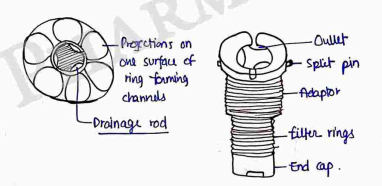
- It consist of a grooved, drainage rod on which are packed a number of metallic rings.
- Rings made up of stainless steel and have thickness 0.8 mm, Inside diameter 15 mm, Outside diameter 22 mm.
- These rings have a number of semicircular projection on one surface and when they are packed on the rod, the opening b/w the rings is about 0.2 mm.
Working
- These filter are placed in a vessel and operated by pumping the slurry with pressure / Vacuum at outlet.
- The slurry passes through the channel formed on the edges between the rings.
- The clear Liquid rises up and collected into the reciever.
Uses
Metafilter can be used for -
- Clarification of syrups
- filtration of injection solution.
- Clarification of insulin Liquors.
Advantage
- Used under high pressure.
- Running costs are low, as separate filter media is not used.
- It is extremely versatile filter.
CARTRIDGE FILTER
Principle → Cartridge filter is a thin porous membrane In which pre-filter and membrane filter are combined into a single unit.
- The filtration action is mainly sieve-like and the particles are retained on the surface.
Construction
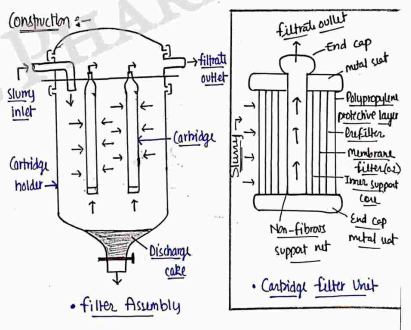
- Cartridge filter has cylindrical configuration with disposal or changeable filter media.
- These are made up of filter plastic or metal.
- It is made up of two membrane filter made of polypropylene, a prefilter and an actual membrane filter with (0.2 $\mu$m) housed in a holder.
Working
- The slurry is pumped into the cartridge holder.
- It passes through Cartridge filter unit by the Mechanism of straining.
- The clear Liquid passes to the centre and moves up to collect through the outlet.
Uses
- Used for preperation of particulate free solution for parentral and Ophthalamic Uses.
Membrane Filter
Principle → It act like as sieve and the particulate matter is retained on the surface of membrane.
Construction
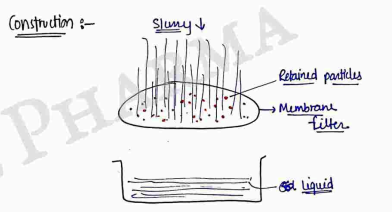
- Membrane filters are made of thin and flat membranes of cellulose derivatives, such as, cellulose acetate and cellulose nitrate.
- These filters are brittle when in dry condition and can be stored for an indefinite period.
- The filters are between 50 and 150 $\mu$m thick and are available in sizes upto 60 cm².
Advantages
- Stainless steel construction permits autoclaving for sterile operations.
- Rapid disassembling as well as reusing of filter media is possible.
Disadvantages
- Expensive due to cost of disposal elements.
Working
- A membrane filter has 400-500 million pores per square centimeter of filter surface.
- The pores are absolutely uniform in size and occupy about 80% of filter volume.
- To avoid rapid clogging of a membrane, pre-filter is often required.
- The selection of a membrane filter for a particular application depends on the particles to be removed.
Uses
- These filters are mainly used for sterilization of both aqueous and oily Liquids.
Advantages
- It is rapid.
- These are available as disposable items and hence cross-contamination is prevented.
Disadvantages
- cannot be used for filtration of organic solvents, such as alcohols, Ketones, esters and chloroform.
SEITZ FILTER
Principle
Based on sieve-like mechanism, tension through asbestos pad filter disc.
Construction
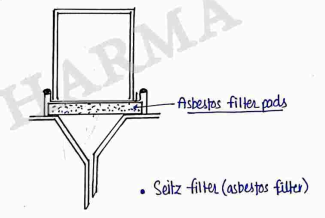
- Seitz filter (asbestos filter) Asbestos filter pads as a filtering medium.
- It consist of a pad of compressed asbestos.
- One upper part to fill the slurry.
- Lower part (funnel like structure) to receive filtrate.
- Typical seitz filter pads are about 2mm thick.
Working
- Add slurry from upper part.
- Slurry deposite on asbestos pad and filtrate is passed through it.
- The finest pore size gives almost perfect filtration and retain small viruses.
Uses
- Useful for sterile filtration.
- Also used for air filtration.
Advantages
- It is simple to use.
- Useful for viscous solution.
Disadvantages
- It is delicate or fragile.
- A new pad must be used for each filtration in order to avoid residue of previous filtration.
CENTRIFUGATION
- Centrifugation is the process in which separation of particles take place by using centrifugal force.
- It is used for separating either two immiscible liquids or a solids from a liquid.
- It is widely used or helpful when filtration process is not applicable.
- The equipment used for separation is known as centrifuge.
Principle
- The centrifugation involves the principle of sedimentation. We apply a centrifugal force to achieve a separation by difference in density.
- The particles having size more than 5 $\mu$m are separated by simple filtration process while the particles having size 5 $\mu$m or less do not sediment under gravity, the centrifugal force is used to separate them.
- Centrifugal force generated due to rotation which acts radially outwards.
Applications of Centrifugation
- Centrifugation is used for separation of blood cells from blood.
- Used for separating drug present in blood, urine and tissue fluids.
- It is widely used in bulk drug industry to separate crystalline material from suspension.
- It is also used to extract cream from milk.
- It also play a vital role in the fractionation of many subcellular organelles.
- It is used to obtain pure form of insulin by precipitating other fraction of protein and separating them.
- Ultracentrifugation is used for separation of virus particles which are utilized in industrial applications.
Equipment for Centrifugation
- Perforated Basket Centrifuge
- Non-perforated Basket Centrifuge
- Semi continuous Centrifuge
- Super Centrifuge
1) Perforated Basket Centrifuge
Principle → Separation occurs through perforated wall depends on the difference in the densities of solids and liquid phases.
Construction
- It consists of a basket made up of steel or any other suitable metal.
- It is perforated with filter cloth.
- The basket is suspended on a vertical shaft and driven by a motor.
- The basket is surrounded by Casing which collect the filterate and discharge through outlet.
- The diameter of basket is 0.9 meter.
- The diameter of perforation depends on crystal size.
- The basket operated at speed of 1000 rpm.
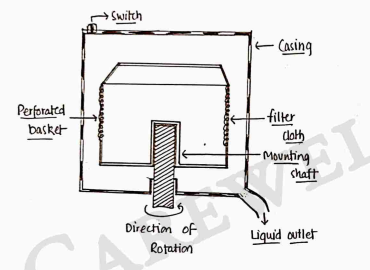
Working
- The material is loaded in to the basket when it is in stationary.
- Power is applied to rotate [5kw] then power reduced to 2 kw. (speed 1000RPM)
- The liquid passes through perforated wall while solid retains in the basket.
- Liquid is collected through casing, centrifuge is stopped by applying brake.
- Now unload the solid.
Uses
- Used to separate crystalline drugs (aspirin etc..) from mother liquor.
- Used to separate precipitated protein from insulin.
Advantages
- It occupy little space.
- Rapid process.
- Used when solid concentration in slurry is high.
Disadvantages:-
- Labour cost is high.
- Batch process.
2) Non-perforated basket centrifuge
Principle → The separation of solids and liquids phase depends on difference in densities of both phases without porous barrier [sedimentation].
Construction
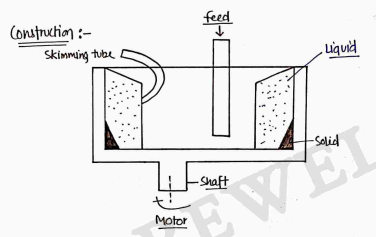
- Consists of non-perforated basket made of steel.
- The basket is mounted on vertical shaft which is rotated by motor.
Working
- The suspension is fed into the basket continuously through feed tube.
- During centrifugation solid deposited at side of basket while Liquid remaining at top which is removed by skimming tube.
- When sufficient amount of solid get deposited at the side of basket then it is removed intermittently by hand with the help of scraper blade.
Uses
- Non perforated basket centrifuge is useful when the solids offers high resistance to the flow of liquids.
3) SEMI CONTINUOUS CENTRIFUGE
Principle → Separation occurs through perforated wall depends on the difference in the density of solids and liquid phases.
Construction
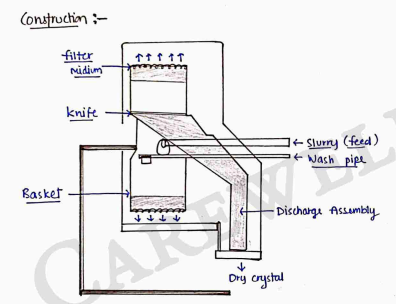
- It consist of perforated basket mounted on horizontal shaft and run continuously by motor.
- Feed introduced through feed pipe and wash the crystal through wash pipe.
Working
- The basket is rotated horizontally with motor.
- Suspension (slurry) introduced through feed pipe.
- The liquid (filtrate) is eliminated passed through perforated site of basket and solid residue (cake) remain inside the basket.
- When the height of cake is approx. 2-3 inch, the slurry inlet is stopped by "feeler diaphragm valve assembly".
- Then cake washed with water.
- After all that, the hydraulic apparatus raises the knife to cut the cake, which collected through outlet.
- The layer of cake is removed by a knife through discharge assembly.
Uses & Advantages
- Used to separate crystal from mother liquor.
- Used to clarify liquid removing unwanted solids dirt from oils.
Disadvantages
- Complicated process.
- High power consumption.
SUPER CENTRIFUGE
Principle → It is based on the principle of sedimentation and it is used to separate two immiscible liquid phases.
Construction
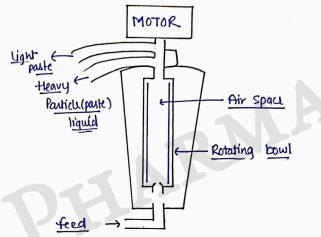
- It consists of a long, hollow, cylindrical bowl of small diameter and rotates on a vertical axis.
- Feed is introduced through the bottom through a nozzle with pressure.
- Two liquid outlets are provided at different height.
- It rotates approx. - 2000 rpm.
Working
- It rotates at 2000 rpm on its axis and then feed introduced through bottom nozzle with pressure.
- Two Liquid phases were separated acc. to their density, the heavier Liquid moves toward the periphery and lighter liquid forms an inner layer.
- Both liquids ascend to the upper part of bowl.
- These removed separately from different height through modified outlets.
Use
- Used for separating liquid phases of emulsion in food, bio chemical and pharmaceutical industries.