Pharmaceutical Engineering - Unit 3
Syllabus
Drying: Objectives, applications & mechanism of drying process, measurements & applications of Equilibrium Moisture content, rate of drying curve. principles, construction, working, uses, merits and demerits of Tray dryer, drum dryer spray dryer, fluidized bed dryer, vacuum dryer, freeze dryer.
Mixing: Objectives, applications & factors affecting mixing, Difference between solid and liquid mixing, mechanism of solid mixing, liquids mixing and semisolids mixing. Principles, Construction, Working, uses, Merits and Demerits of Double cone blender, twin shell blender, ribbon blender, Sigma blade mixer, planetarymixers, Propellers, Turbines, Paddles & Silverson Emulsifier,
Scroll to Download
PHARMACEUTICAL ENGINEERING UNIT-3RD
DRYING
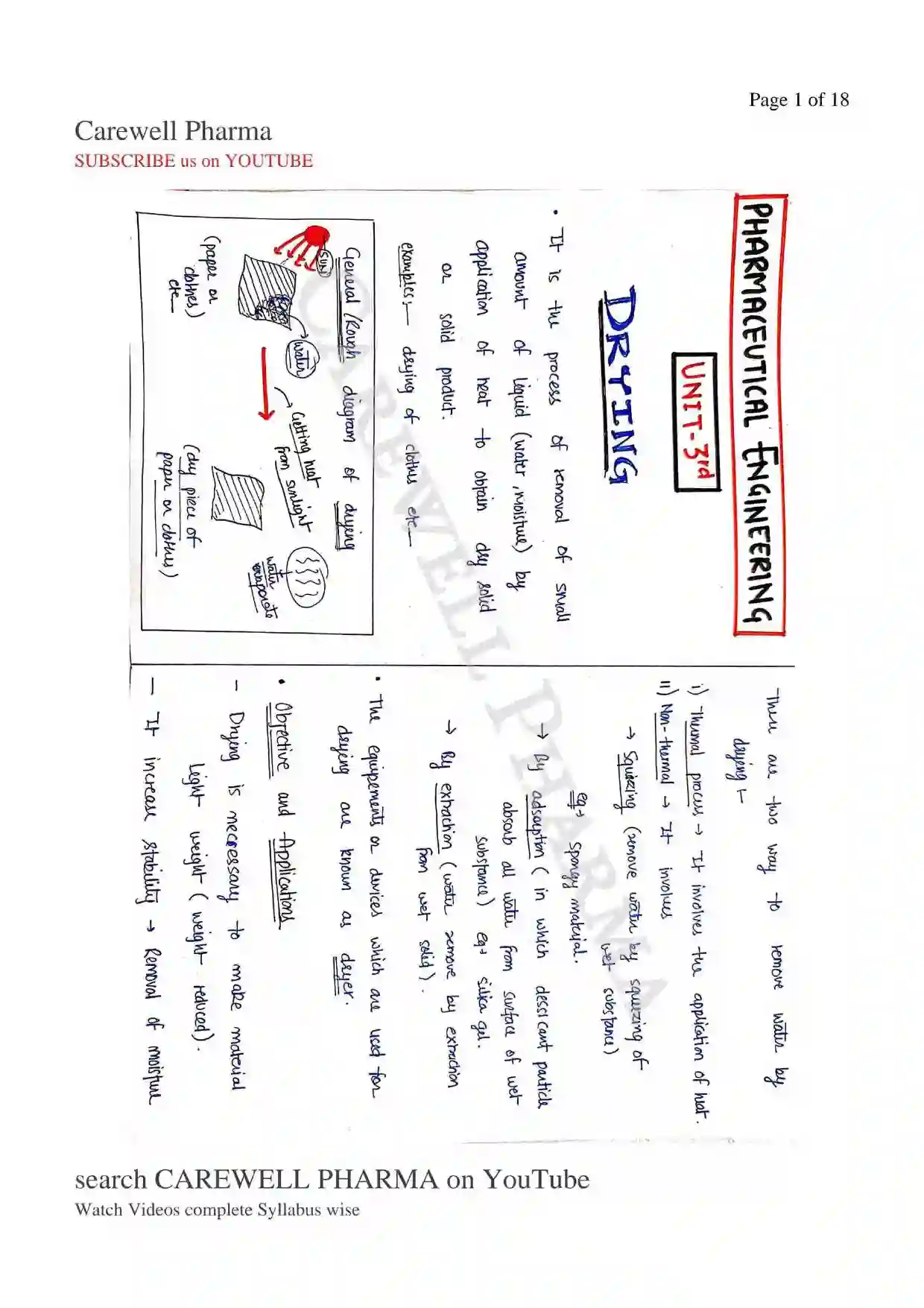
- It is the process of removal of small amount of liquid (water, moisture) by application of heat to obtain dry solid or solid product. Examples - drying of clothes etc-

There are two way to remove water by drying:-
i) Thermal Process → It involves the application of heat.
ii) Non-Thermal → It involves
Squizing (remove water by squizing of wet substance)
eg Spongy material.
By adsorption (in which dessicant particle absorb all water from surface of wet substance)
eg silica gel.
By extraction (water remove by extraction from wet solid).
- The equipments or devices which are used for drying are known as dryer.
Objective and Applications
- Drying is necessary to make material light weight (weight reduced).
- It increase stability Removal of moisture significant decrease rate of chemical reaction, chances of microbial attack or enzymatic action and thus improve stability.
- Viscous and sticky material are dried to improve flow property.
- During production of tablets, granules are dried to improve flow property as well as compression.
- Help in production of bulk drug and also help in preservation of drug product.
Mechanism of Drying Process
On thermal process of drying involve two process
i) Heat transfer
ii) Mass transfer
i) Heat Transfer → In this, heat is generated within the solid, and flow to the exterior surface.
ii) Mass Transfer → It involves movement of the moisture to the surface of the solid and its subsequent evaporation from the surface.

- There are also some theories of drying. here we discuss only about two-
i) Diffusion theory
ii) Capillary theory
i) Diffusion Theory → Acc. to diffusion law, heat transfer (move) from high concentration to low concentration.
So, when heat apply on wet solid, the bottom particles of liquid get heated, then they transfer their heat to another one (next), then it transfer to next, and on the last final particle of liquid (on top) get evaporated.
And finally dry solid obtained, all water (liquid) remove from wet solid.

ii) Capillary Theory → Their are some capillary like voids present in wet solid. So when we provide heat on that solid, liquid (water) get removed through that voids and we get dry solid.

Measurement of and applications of Equilibrium Moisture content
- EMC (Equilibrium Moisture Content) → When the moisture content of the solid is in equilibrium with the given partial pressure of vapour in the gas phase is called the Equilibrium Moisture Content (EMC).

- Gas have high temp. than moisture contain solid, so heat transfer into solid, and moisture transfer from solid into gas (air).
- When both have equal moisture, process stop, and it is called EMC.
- It also have two processes!-
i) Desorption → If solid contain more moisture than EMC, then solid will continuesly lose water until EMC is reached.
ii) Absorption → If solid contain less moisture than EMC, then solid will continuously absorb water, until EMC is reached.
- Bound Water → Moisture content of a substance that exert a equilibrium vapour pressure lower than that of the pure liquid at same temp.
- Unbound Water → Moisture content of a substance that exert equilibrium vapour pressure equal to that of the pure liquid at same temp.
- Free Moisture → The moisture content of the solid in excess of the equilibrium moisture content.
The moisture content is measured by ratio of weight of water in sample to weight of dry sample.
Measurement of EMC
The EMC of material can be determined by putting sample in dessicator which are maintained at known relative humidity.
The sample from each dessicator is collected and weighed at particular interval until a constant weight is achieved. The final moisture content is EMC.
Applications
- EMC data are useful in analysis of drying operation and particularly in predicting final moisture contents.
- Over drying can be prevented.
Rate of Drying Curve
It follow two drying zones,
i) Constant-rate period
ii) Falling-rate period
i) Constant-rate Period → The moisture vaporised per unit time per unit area of drying surface remains constant.
ii) Falling-rate Period → The amount of moisture vaporised per unit time per unit area of drying surface decrease continuosly.
Critical Moisture Content (CMC) → The break point of two zones, where the moisture content at which the constant rate drying period ends and the falling rate drying period starts.

- Point B represents equilibrium temp condition of the product surface.
- Curve BC (Constant rate) → It represent removal of unbound water from the product.
- Curve CD (first falling rate) → It occurs when wetted spots in the surface continually decline until the surface is dried.
- Curve DE (second falling rate) → It begins at point D when the surface is completely dry.
- Point E The point at which decrease in drying rate start is referred as the critical moisture content (CMC).
The rate of drying of a sample can be measured by the following calculation.
Loss on drying
By this we calculate how much percentage moisture removed from particles.
DRYER
The equipments or devices which are used for drying are known as dryer.
- Principles, Construction, working, uses, merits and demerits of
- Tray dryer
- Drum dryer
- Spray dryer
- Fluidized bed dryer
- Vacuum dryer
- Freeze dryer
1. Tray Dryer
Principle → In tray dryer, hot air is continuously circulated. Forced convection heating takes place to remove moisture from the solids placed in trays. Simultaneously, the moist air is removed partially.
Construction

- It consists of rectangular chamber whose walls are insulated.
- Trays are placed inside the heating chambers.
- the number of tray vary with the size of the dryer.
- Dryer is fitted with a fan for circulating air over the trays.
- There are also some direction vanes placed in the corner of chamber to direct air in expected path.
Working
- Firstly wet solid is loaded into tray, then trays are placed in the chamber.
- Now, fresh air is introduced through inlet, which passes through the heaters and get heated up.
- The hot air is circulated by means of fans at 2-5 metre/second. Turbulent flow lowers the partial vapour pressure in the atmosphere and also reduce the thickness of the air boundary layer.
- As water evaporates from the surface, the water is picked up by air.
- water diffuses from the interior of the solid by capillary action.
- These event occurs in a single pass of air. so the time of contact is short and the amount of water picked up in a single pass is small.
- Therefore the discharged air to the tune of 80-90% is circulated back through fans, only 10-20% fresh air is introduced.
- Moist air is discharge through outlet.
Uses
- Sticky material, plastic substance, granules mass can be dried in a tray dryer.
- Crystalline material, precipitates and pastes are dried.
- Crude drugs, chemicals, powders, tablet, granules or parts of equipment are dried.
Advantages
- Handling of material (loading & unloading) can be done without losses.
- It is operated batch-wise.
- Thus constant temperature and uniform airflow can be maintained over the material.
- Valuable product can be handled efficiently.
Disadvantages
- Tray dryer requires more labour to load and unload. Hence, cost increases.
- Process is time consuming.
- (In case of wet granules (tablets, capsules etc) achieving uniform drying, at the end of drying, trays are pulled out of the chamber and taken to a tray dumping station. drying is continued until the desired moisture content is obtained).
2. DRUM DRYER
Principle
A heated hollow metal drum rotates on its longitudinal axis, which is partially dipped in the solution to be dried. The solution is carried as a film on the surface of the dryer and the dried to form a layer. A suitable knife scraps the dried material, while the drum is rotating.
Construction

- It consists of a horizontally mounted hollow steel drum of 0.6 m to 3.0 m diameter and 0.6 to 4.0 m length, whose external surface is smoothly polished.
- Below the drum, feed pan is placed in such a way that a drum dips partially into the feed.
- On one side of the drum a spreader is placed and on the other side a doctor's knife is placed to scrap the dried material.
- A storage bin (conveyor) is placed connecting the knife to collect the material.
Working
- Steam is passed inside the drum, heat is transferred by conduction to the material, also drum is heated.
- Simultaneously drum is rotated at a rate of 1-10 revolutions per minutes.
- The liquid material present in the feed pan adheres as a thin layer to the external surface of the drum during its rotation.
- The material is completely dried during its journey in slightly less than one rotation.
- The dried material is scrapped by the doctor's knife, which then falls into storage bin.
- The time of contact of the material with hot metal is 6 to 15 seconds only.
- Therefore processing condition such as film thickness, steam temperature are all closely controlled.
Uses
- Used for drying solutions, slurries, suspension, etc...
- The product dried are milk products, starch products, ferrous salts, suspensions of zinc oxide, suspension of kaolin, yeast, pigments, malt extract, antibiotics, glandular extracts, insecticides, DDT, calcium and barium carbonates.
Advantages
- Drying time is less only a few seconds. Therefore, heat sensitive material can be dried.
- The product obtained is completely dried and is in the final form.
Disadvantages
- Maintainance cost of drum dryer is higher than spray dryer.
- Skilled operators are essential to control feed rate, film thickness, speed of rotation and temperature.
- Not suitable for solution of salts with less solubility.
3. Fluidised Bed Dryer
Principle
In fluidised bed dryer, hot air (gas) is passed at high pressure through a perforated bottom of the container containing granules to be dried. The granules are lifted from the bottom and suspended in the stream of air. This condition is called fluidized state. The hot gas is surrounding every granule to completely dry them. Thus, material or granules are uniformly dried.
Construction

- It is made up of stainless steel.
- A detachable bowl is placed at the bottom of the dryer (used for load material).
- A fan is mounted in the upper part for circulating hot air.
- fresh air inlet, prefilter and heat exchanger are connected serially to heat the air to the require temperatures.
- Bag filters are placed above the drying bowl for the recovery of fines.
Working
- The wet granules (material) to be dried are placed in the detachable bowl.
- Fresh air is allowed to pass through a prefilter, which subsequently gets heated by passing through a heat exchanger.
- The hot air flow through the bottom of the bowl. Simultaneously fan is allowed to rotate.
- The air velocity is gradually increased.
- When the velocity of the air is greater than settling velocity of granules, the granules remain partially suspended in the gas stream.
- After some time, granules rise in the container because of high velocity, later fall back in the random boiling motion (fluidized state).
- The gas surrounds every granules to completely dry them, the air leaves the dryer by passing through the bag filter.
- The entrained particles remain adhered to the inside surface of the bags. the bags are shaken to remove the entrained particles.
- The residence time for drying is about 40 minutes.
- The material is left for some time in the dryer for reaching ambient temperature.
- The bowl is taken out for discharging. The end product is free flowing.
Uses
- Used for drying of granules in the production of tablets. can be used for three operation, mixing, granulation and drying.
Advantages
- It requires less time to complete drying.
- Available in different sizes with drying capacity from 5 to 200 kg per hour.
- Also used in mixing.
Disadvantages
- Many organic powders develop electrostatic charges during drying. To avoid this, efficient electrical earthing of the dryer is essential.
- May cause some attrition, resulting in the production of fines.
4. Vacuum Dryer
Principle
In vacuum dryer, material is dried by the application of vacuum. When Vacuum is created, the pressure is lowered so that water boils at lower temperature. Hence water evaporate faster. The heat transfer become efficient, i.e., rate of drying enhances substantially.
Construction

- It is made of a cast iron heavy-jacketed vessels.
- It is so strong that it can withstand high vacuum within the oven and steam pressure in jacket.
- The enclosed space is divided into a number of portion by means of 20 hollow shelves, which are part of the jacket.
- These shelves provide larger surface area for conduction of heat.
- Over the shelves, metal trays are placed for keeping the material. The oven door can be locked tightly to give an air tight seal.
- The oven is connected to a vacuum pump by placing Condenser in between.
Working
- The material to be dried is spread on trays.
- The tray placed on the shelves, Door is closed firmly (air tight).
- Pressure is decreased up to 30-60 kilopascals by a vacuum pump.
- Steam or hot air is supplied into the hollow space of jacket and shelves.
- Heat transfer by conduction takes place. At this vacuum, evaporation of water from the material takes place at 25-30°C, on account of lowering of boiling point.
- Water vapours passes into the condenser where condensation takes place.
- At the end of the drying, vacuum line is disconnected. The material is collected from the trays.
Uses
- Used for drying of heat sensitive material, which undergoes decomposition.
- Dusty and hygroscopic materials. etc..
Advantages
- It provides large surface area for heat transfer.
- Handling of the material, trays and equipment is easy.
Disadvantages
- It has a limited capacity and used for batch process.
- It is more expensive than tray dryer.
- Labour and running costs are also high.
5. SPRAY DRYER
Principle
In spray dryer, the fluid to be dried is atomized into fine droplets, which are thrown radially into a moving stream of hot gas. The temperature of the droplets is immediately increased and fine droplets get dried instantaneously in the form of spherical particles.
This process completes in a few seconds before the droplets reach the wall of the dryer.
Construction

- It consists of a large cylinderical drying chamber with a short conical bottom, made up of stainless steel (diameter 2.5 to 9.0m and height 25m or more).
- An inlet for hot air is placed in the roof of the chamber, another inlet carrying spray-disk atomizer is also set in the roof.
- The spray disk atomizer is about 300 mm in diameter and rotates at a speed of 3000 to 50000 revolutions per minute.
- Their are also one inlet for feed at top in the roof.
- Bottom of the dryer is connected to cyclone separator.
Working
Drying of material in spray dryer involves 3 stages.
i) Atomization of The Liquid → The feed is introduced through the atomizer either by gravity or by using suitable pump to form fine droplets.
ii) Drying of The Liquid Droplets → Fine droplets are dried in the drying chamber by supplying hot air through the inlet.
iii) Recovery of The Dried Product → Centrifugal force of atomizer drives the droplets to follow helical path. Particles are dried during their journey and finally fall at the conical bottom, which further move into cyclone separation.
All these process are completed in few seconds. Particle size obtained is ranging from 2 to 500 nm. maximum size of spray dryer has capacity of 2000 kg per hour.
Uses
- The product is a better form than that obtained by any other dryer.
- The quantity of the material to be dried is large.
- Also used in drying of thermolabile, hygroscopic material and those material which undergoes chemical decomposition.
Advantages
- It is continuous process and very rapid.
- Labour costs are low for its combine function (evaporator + crystallizer + dryer + size reduction).
Disadvantages
- It is very bulky and expensive.
- Not always easy to operate.
6. FREEZE DRYER
- Also known as lyophilization
Principle
In freeze dryer, water is removed from the frozen state by sublimation, i.e., direct change of water from solid into vapour without conversion to a liquid phase.
Construction

- It consist of
- Drying chamber in which tray are loaded
- heat supply in the form of radiation
- Vapour condensing or adsorption system
- Vacuum pump or steam ejector or both.
Working
- It involves 5 stages
i) Preparation and pretreatment
ii) Prefreezing to solidify water
iii) Primary drying (sublimation of ice)
iv) Secondary drying (removal of residual moisture)
v) Packing.
i) Preparation and Pretreatment → It is essential process, which reduces the actual drying by 8-10 times. The liquid solution is pre-concentrated under normal tray drying, the final product becomes more porous.
ii) Prefreezing to Solidify Water → Vials, ampoules or bottles in which the solution is packed are frozen in cold shelves (about -50°C).
iii) Primary Drying (Sublimation of Ice) → In this step, the material to be dried is spread as much large surface as possible for sublimation. The temperature and pressure should be below the triple point of water, i.e. 0.0098°C and 0.533 kilopascals (4.58 mmHg) for the sublimation.
- Vacuum is applied to the tune of about 3mmHg on the frozen sample. The temperature is linearly increased to about 30°C in a span of hours.
- All the things has to be controlled in such a manner so as to get highest possible water vapour at ice surface, without melting the material.
- Primary drying stages removes easily removable moisture (98% to 99% water is removed). still traces of moisture is present in the sample.
iv) Secondary Drying → During this stages, traces of moisture is removed. Solid dessicants are also used for this. During this stages, cabinet is maintained at low temp. and atmospheric pressure.
- In this, the rate of drying is very low and it takes about 10 to 20 hours.
v) Packing → After vacuum is replaced by inert gas, the bottles and vials are closed.
Uses
- It is most commonly used in the production of dosage forms, such as injections, solutions and suspensions.
Advantages
- Thermolabile material (heat sensitive) can be dried.
- Loss of volatile material is less.
- Sterility can be maintained.
Disadvantages
- Equipment and running costs are high.
- The period of drying is high.
- The product should be only packed in vacuum or using inert gas or in container impervious to gases for prevent oxidation.
MIXING
Objective, Applications, factor affective mixing, Difference between Solid and Liquid mixing, Mechanism of solid mixing, liquid mixing, and semi solids mixing.
- Mixing is defined as a process in which two or more components are mix together and converted into one form (component).

- Mixing is an operation in which two ror more component in a separate or roughly mixed condition are treated, so that each particles lies as nearly as possible in contact with a particle of each of the other ingredient in uniformly.

Objective
- Simple physical mixing of material to form a uniform mixture.
- Dispersion of two immiscible liquid to form an emulsion.
- Dispersion of solid in liquid to form suspension or paste.
- Enhance physiochemical properties by mixing.
Applications
- It involved in the preparation of many types of formulations such as tablets, capsules, syrup etc.
- Also help in the crystallization of drug substance.
- Also liquid mixing by heat transfer.
- Helps in preparation of injectible products.
Factor Affecting Mixing
There are some factor which affect the mixing:-
i) Nature of Product → The same nature particles increase the rate of mixing.
(Same Nature Mixing $\uparrow$)
ii) Particle Size → The more smaller particles, the more mixing.
(Size of Particle Mixing $\uparrow$)
iii) Particle Shape → The same shape of particles increase mixing of these components.
(Same Particle shape Mixing $\uparrow$).
- Irregular shape particles mixing decrease the rate of mixing, and also non-uniform.
iv) Particle Charge → Different charge particles mixing may be decrease the mixing, because (+)ve & (+)ve charge particle not attract each other and not attached.
So, Neutral charge particles mixing increase the rate of mixing.
(Neutral charge particles Mixing $\uparrow$)
v) Density → More density, less mixing.
So, (Density $\propto \frac{1}{\text{Mixing}}$)
Difference Between Solid and Liquid Mixing
| Solid Mixing | Liquid Mixing |
|---|---|
| Product often consist of two or more easily identified phases. | Truly homogeneous liquid phase can be observed. |
| Large sample size is required for this. | Small sample size is sufficient to study degree of mixing. |
| Mixing requires high power. | Mixing requires low power. |
Mixing
It is of two types:
i) Homogeneous mixture
- Solid - Solid
- Liquid - Liquid
- Solid - Liquid
ii) Heterogeneous mixture
- Solid - liquid
- Solid - Gas
- Liquid - Gas
Mechanism of Solid Mixing
The principal mechanism in solid-solid mixing are:-
- Convective mixing
- Diffusive mixing
- Shear mixing
i) Convective Mixing → It is acheived by the inversion of the powder bed using blades or paddles or screw element. A large mass of material moves from one part to another.

ii) Diffusive Mixing → It involves the random motion of particles, (small particles or large particles) and change their position relative to one another. Occurs at the interfaces of dissimilar regions.

iii) Shear Mixing → In this mixing, the force of attraction between particles are broken down by applying shear on it. So, particles can easily move between regions of different composition and mix easily.

LIQUID-MIXING
- It is simple compared to solid-liquid or solid-solid mixing.
- It form homogeneous system (Liquid-liquid mixing).
two types Liquid
i) Miscible Liquid → Two liquid easily mix.
ii) Immiscible → Not easily mix (mix by using agents).
Mechanism
- Bulk transport mixing
- Turbulent mixing
- Laminar mixing
- Molecular diffusion mixing
i) Bulk Transport Mixing → The movement of a large portion of a material from one location to another location in a given system, with the help of rotating blades or paddles etc.

ii) Turbulent Mixing → In which mixing take place due to turbulent flow. Due to turbulent flow, velocity and speed of particles increase and they move faster. Due to move faster, they also create Eddy. (portion of particle moving as a unit in a direction).

- Turbulent flow is highly effective mechanism for mixing.
iii) Laminar Mixing → In which mixing of two opposite liquids takes place through laminar flow (applied shear stretches the interface between them).

iv) Molecular Diffusion → In this mixing, mixing takes place at molecular level (molecules diffuse due to thermal motion). [thermal motion = all particles of a body move in an orderly manner]. mixing take place due to concentration gradient. It take place for semi-solid like ointment, gel, etc..

Semi-Solid Mixing
- Semisolid dosage forms include ointments, pastes, cream, Jellies etc.
Mechanism
- For mixing of such dosage form, we use agitator, the agitator must move the material throughout the mixer.
- The mixing action include combination of low speed shear, smearing, wiping, folding, stretching, and compressing.
Mixing Equipments
- Twin shell blender
- Double Cone blender
- Ribbon Blender
- Sigma Blade mixer
- Planetary mixer
- Propellers
- Turbines
- Paddles
- Silverson Emulsifier
1) Twin Shell Blender (V Cone blender)
- for solid mixing
Principle
- The mixing occurs due to tumbling motion.
Construction

- It is made up of stainless steel or transparent plastic.
- Smaller models take a charge of 20 kg and rotates at 35 rpm. while large one has capacity about 1 ton and 15 rpm.
- It is connected with horizontal shaft, which connect with motor.
Working
- The material (to be blended) is loaded approx. 50-60% of its total volume.
- As the blender rotates, the material undergoes tumbling motion.
- When the V is inverted, the material split and recombine, this process yield to mixing of powder.
- After mixing, mixed material is collected in the bottom of V.
- Blender speed is need to maintain for prevent shear.
Uses
- Used in solid mixing.
2) Double Cone Blender
Principle
- The mixing occurs due to tumbling motion.
Construction

- All part of equipment are made up of stainless steel.
- It consist of two cones, which are attached and when rotated.
- One horizontal shaft drive which are attached with motor for rotation.
Working
- The material is filled up to 50-70% of its total volume.
- General rate of rotation is about 30 rpm, otherwise it depends on blender's size.
- When blender rotates, it create tumbling motion, due to this mixing occurs.
- It is an efficient design for mixing powders of different densities.
- It is usually charged and discharged through the same port.
Uses
- Homogeneous mixing of dry powders & granules.
- can be used for pharmaceuticals preparations, powders etc..
Advantages
- They handle large capacities.
- Easy to clean, load and unload.
- Requires minimum maintainance.
Disadvantage
- It is not suitable for ingredients of large differences in the particles size distribution.
- Not enough shear.
- Require high headspace for installation.
3) Ribbon Blenders
Principle
- It's principle based on shear. Moving blades in fixed (non-movable) shell. Shear is transferred to the powder bed by blades.
- Convective mixing also occurs as the powder bed is lifted and allowed to fall to the bottom of the container.
Construction

- It consists of a non-movable horizontal cylindrical shell usually open at the top.
- It is fitted with two helical blades, mounted on the same shaft.
- Blades have both right and left hand twist.
- Blades are connected to a fixed speed drive.
- Load from top and discharge from bottom.
Working:
- Material are introduced from the top of trough and then closed with a lid.
- Ribbon are allowed to rotate, one blade moves the solids slowly in one direction and others move them quickly in opposite direction.
- Convective mixing also occurs by tumbling action.
- The counteracting blades set up high shear and are effective in breaking up lumps or aggregates.
- Helical blades moves powders from one end to another and the mixing take place.
- Now, the blend (mixture) discharge from the bottom opening.
Uses
- It is used to mix finely divided solids, wet solids, sticky and plastic solids.
- Also used for liquid-solid and solid-solid mixing.
Advantages
- High shear can be applied using perforated baffles, which bring rubbing and breaking of aggregates.
Disadvantages
- Dead spots (areas that remain unmixed) are observed.
- It is having fixed speed drive.
4) Sigma Blade Mixer
Principle
- The mechanism of mixing is shear. Also convective mixing is achieved by cascading the material.
Construction

- It consist of double trough shaped stationary bowl.
- Two sigma shaped blades are fitted horizontally in each trough of the bowl.
- They are connected to a fixed speed drive.
- The mixer is loaded from top and unloaded by tilting the entire bowl.
Working
- Material (Powders) are introduced from the top of the trough and then covered it.
- Now, allowed the sigma blades to rotate through the fixed speed drive.
- The blades move at different speeds, one usually about twice the speed of other, resulting in lateral pulling of the material.
- By moving powders through blades, cascading action (convective) as well as shear action can achieved.
- By this, mixing take place and final mixture is discharge through tilting the entire bowl.
Uses
- It is commonly used for mixing of dough ingredient in the baking industry.
- Used for liquid-solid mixing, and mostly used in solid-solid mixing.
Advantages
- It has minimum dead spot during mixing.
- It has close tolerance b/w the blades and the side-walls as well as bottom of the mixer shell.
Disadvantages
- Sigma blade mixer works at a fixed speed.
5) Planetary Mixer
Principle
- In a planetary mixer, the blade tears the mass apart and shear is applied between moving blade and stationary wall. Mechanism of mixing is shear and also tumbling (convective motion) obtained.
Construction:

- It consists of a vertical cylindrical shell, which can be removed either by lowering it beneath the blade or raising the blade above the bowl.
- Mixing blade is mounted from the top of the bowl.
- The mixing shaft is driven by a planetary gear train.
- It rotates around the ring gear, which further rotates round the mixer blade.
- It is normally built with a variable speed drive.
Working
- In the planetary mixer, the agitator has a planetary motion. it rotates on its own central axis, and around the bowl, so that it reaches all part of the vessels.
- Beater is shaped to pass with close clearance over the side and bottom of the mixing bowl (no dead space in the mixing bowl).
- Material (powders) is introduced through top in the bowl.
- By moving powders (material) through blades shear is applied on material, and also powders makes an upward movement.
- So, tumbling motion is also obtained.
- Initially the blade moves slowly for premixing and finally at increased speed for active mixing (High shear can be applied for mixing).
- Emptying the bowl may be done by hand (scooping) or by dumping mechanism.
Uses
- Low speeds are used for dry mixing.
- fast speed in wet granulation.
- Steam jacketed bowls are used in the manufacture of sustained release product and ointments.
Advantages
- Speed of rotation can be varied as needed.
- More useful for wet granulation.
- No dead space (unmixing space).
Disadvantages
- It requires high power.
- It has limited size and is useful for batch work only.
Impellers
- These are those devices which are mainly used for liquid mixing.
- These are classified into three types on the basis of the shape and pitch of the blades that are attached to the central shaft.
- Propellers
- Turbines
- Paddles
i) Propellers
Principle
- It is based on the mechanism of shearing.
Construction
- A propeller normally contains a number of blades (three bladed design most common).
- It may be either right or left handed, depending on the direction of slant of their blades.
- The size of the propellers is small (sufficient for low viscous liquids).
- General speed up to 8000 revolution per minutes.

Workin
- Take a liquids which we have to mix in a container.
- Then, Dip the propeller in that container with the help of stand etc.
- Now, start the motor and allowed to rotate propeller.
- The propeller produces axial (longitudinal) movement of liquid, which yield to mixing.
- After completed mixing, remove the propeller from container. We get mixed liquid in container.
Uses
- Used when high mixing capacity is needed.
- Multivitamin elixir, disinfectant solution are manufactured using propellers.
Advantages
For high mixing capacity.
Effective gas-liquid dispersion is possible at the laboratory scale.
Disadvantage
- Not effective with liquid of viscosity greater than 5 pascal-second. eg. Glycerin, Castor oil etc.
ii) Turbines
Principle
- It work on the principle of shearing.
Construction

- A turbine consists of a circular disc to which a number of short blades are attached.
- The diameter of the turbine ranges from 30-50% of the diameter of the vessels.
- It rotates at a lower speed than propeller (50-200 revolution per minutes).
Working
- Take a liquid, which we have to mixed in a vessels.
- Then placed the turbine into vessels and start the rotation.
- Blades of turbine produces flow in liquid and produces shear, which also yield to mixing.
- After certain period when liquid mixed, turbine removed from the vessels.
Uses
- Effective for high viscous solution upto 7000 pascal-second. eg. Syrups, liquid parafines, glycerin etc.
Advantages
- It gives greater shearing forces than propellers, so these are suitable for emulsification.
iii) Paddles
Principle
- It work on the principle of shearing.
Construction
- A paddle consists of a hub centrally with two long flat blades attached to it vertically.
- Rotates at low speed (100 revolution per minutes).
- Paddles with two blades or four blades are common.

Working
- Take a liquids, which we have to mixed in a tanks, then placed the paddles into tanks and start the rotation.
- A shaft carrying hub-blades rotates at a low speed, they push the liquid radially and tangentially.
- After mixing paddles are removed from liquid tanks.
Uses
- Used in the manufacture of antacid suspensions, agar and pectin relatives purgatives etc.
Advantages
- Avoid dead spot in mixing.
- Vortex formation is not possible due to low speed.
Disadvantages
- Not suitable for mixing of suspension, baffles are necessary for this.
SILVERSON MIXER - EMULSIFIER
Principle
- It produce intense shearing force and turbulence by the use of high speed rotors.
Construction

- It consists of long supporting columns connected to a motor which gives support to the head.
- The central portion contain a shaft, one end of which is connected to the motor and other end is connected to the head.
- The head carries turbine blades, which are surrounded by a mesh, which is further enclosed by a cover having openings.
Working
- The head is placed in the vessels containing immiscible liquid (completely dipped).
- Then, start the motor, rotating shaft rotates the head, which in turn rotates turbine blades at a very high speed.
- This creates a pressure difference. As a result, liquids are sucked into the head from the center of the base and subjected to intense mixing action.
- Then liquid expel from the mesh through centrifugal forces.
- The intake and expulsion of the mixture ensure the rapid breakdown of particles and help to mix them.
Uses
- It is available in different sizes.
- Used for the preparation of emulsions and creams of fine particle size.
Advantages
- It can be used for batch operations.
Disadvantages
- Sometimes, there is a chance of blocking of pores of the mesh.