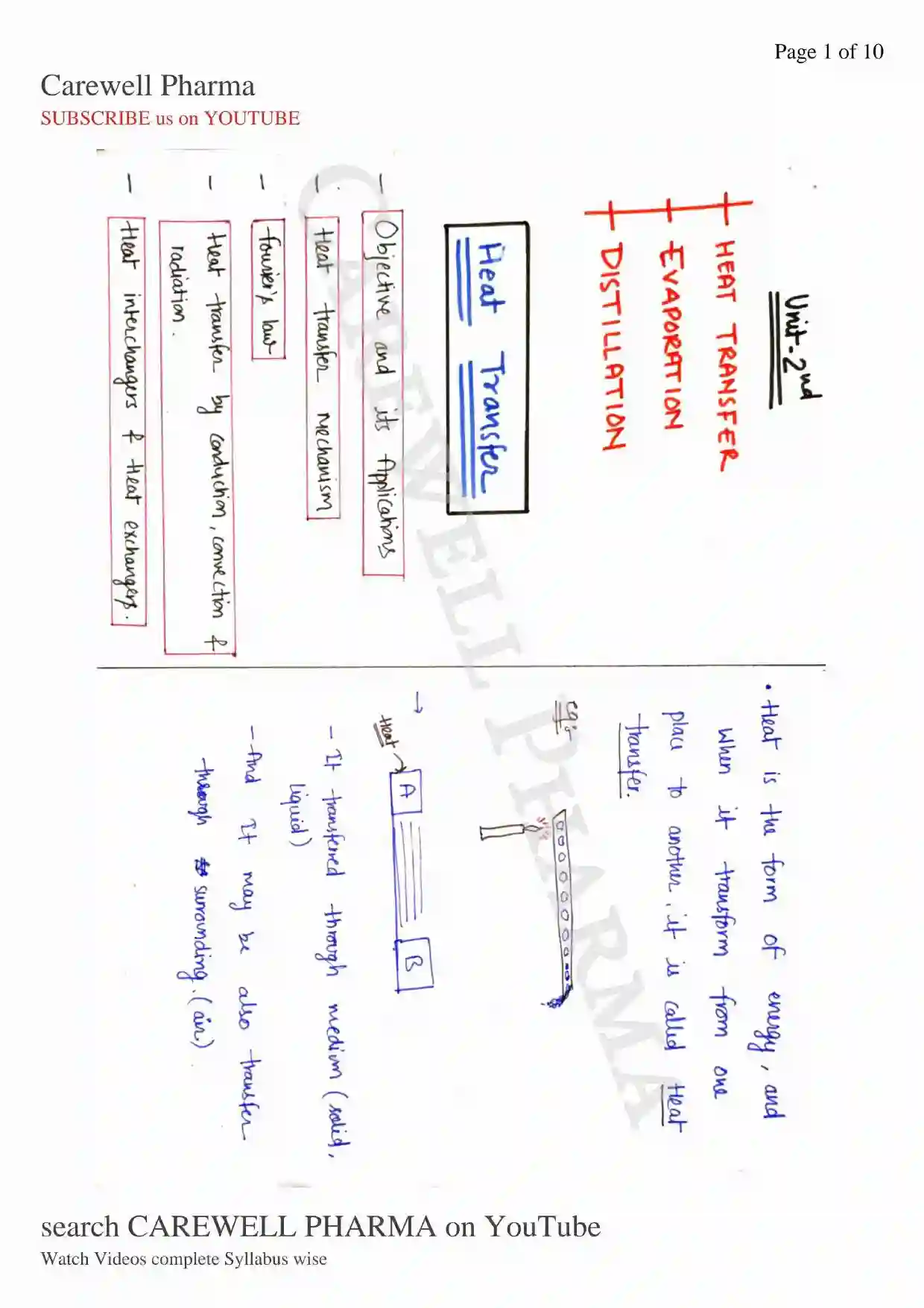
Pharmaceutical Engineering - Unit 2
Syllabus
Heat Transfer: Objectives, applications & Heat transfer mechanisms. Fourier’s law, Heat transfer by conduction, convection & radiation. Heat interchangers & heat exchangers.
Evaporation: Objectives, applications and factors influencing evaporation, differences between evaporation and other heat process. principles, construction, working, uses, merits and demerits of Steam jacketed kettle, horizontal tube evaporator, climbing film evaporator, forced circulation evaporator, multiple effect evaporator& Economy of multiple effect evaporator.
Distillation: Basic Principles and methodology of simple distillation,flash distillation, fractional distillation, distillation under reduced pressure, steam distillation & molecular distillation
Scroll to Download
PHARMACEUTICAL ENGINEERING UNIT-2ND
Heat Transfer
- Objective and its Applications
- Heat transfer Mechanism
- Fourier's law
- Heat transfer by conduction, convection & radiation.
- Heat interchangers & Heat exchangers.
- Heat is the form of energy, and when it transform from one place to another, it is called heat transfer.

- It transferred through medium (solid, liquid)
- And It may be also transfer through surrounding (air).
Applications
- Evaporation → It a process in which liquid transform into gas, through heat (by using heat.)
- Distillation → It is the process of separating components of a mixture based on different boiling points. And we boil mixture through heat.
- Drying → Removal of water or another solvent by evaporation from a solid, semisolid.
- Sterilization → A process which used to remove or kill bacteria, micro-organism (or for disinfactants) by using heat.
Heat Transfer Mechanism
How heat transfered It involves three processes.
- Conduction
- Convection
- Radiation
1) Conduction → In this heat transfer in a solid in series. in this, particles are directly connect with each other and heat transfer through one by one.

- In this, particles must be stationary.
- And heat transfer temperature gradient (difference of themperature)
- Heat transfer from high temperature to low.
2) Convection → It is the transfer of heat through the movement of liquid (fluid).
- In which initial position's particle absorb heat then displace with final's position's particles.

3) Radiation → In which heat direct transfer without medium (use surrounding air).
→ Electromagnetic waves.
Eg → Sun's heat to water for vapourisation
Fourier's Law
It states that
"The rate of change heat transfer is directly proportional to the area normal to the direction of heat flow & temperature gradient". and inversely proportion to the width of wall from which heat transfer.

Temperature Gradient → It is the difference of temperature from one place to another. ($dT$)
Acc to Law
So,
Where,
Rate of change of heat transfer
Area of wall
change in temperature
thickness of wall
Constant (proportionally constant)
- Negative sign indicates the drop in temperature from high temp to low.
Heat Transfer by Conduction, Convection & Radiation
1). Conduction
- Transfer of heat through a solid material, it may be through fluid, but fluid should be in stationary.
- It also depends upon temperature gradient, because heat transfer from high temperature to low temperature.

Now,
When we provide heat at one end of substance, then particles of that end vibrate vigorously and then they collide with neighboring particles and transfer their energy.
And this process should be continuous untill the last end particles should absorb heat.

Driving Force → which is responsible for heat transfer. Resistance → which resist some heat in heat transfer.
CONDUCTION
- It is the mode of heat transfer which occurs mostly in liquids and gases.
- In this method, heat transfer take place with the actual motion of matter from one place within the body to the others.

- When we boil water we have seen bubbles and currents develop in water on careful observation.
- This is example of convection, in which hot water at bottom become lighter and moves upwards, forcing the cold and denser water at the top to come down and thus heated up.
Radiation → It is another form of heat transfer. It does not require any medium and can be used for transfer of heat in a vaccum as well.
- This method uses electromagnetic waves which transfer heat from one place to other.
- The heat and light from the sun in our solar system reach our planet using radiation only.
Eg In winters, when we set near a fire we feel warm without touching fire, this is possible by radiation.

Heat Interchanger & Heat Exchangers
Heat Interchanger → These are those devices which are used for transferring of heat from one liquid to another liquid or from one gas to another through any medium (metal walls).

Heat Exchangers → These are those devices which are used for transferring of heat between two or more fluids. these are used in both cooling and heating processes.

Types of Heat Exchangers
i) Parallel Flow & Counter Flow
In which, hot steam and hot liquid direction is same is called Parallel flow.

11) If, direction of flow of hot steam & cold liquid is opposite, then it is called counter flow.

iii) Cross Flow
In which, direction of flow of liquid are perpendicularly cross to flow of hot steam.

Exchangers Examples
1) Concentric tube / Double Pipe Heat exchangers
- It consists of two pipe, in which one pipe is fit inside the other pipe.

- In this exchanger, hot steam (fluid) pass in inside tube and then that head fluid which we want to hot, pass into outside pipe.
- And After heating hot liquid pass out from outlet.
- Double pipe heat exchangers are simple and easy in used. so, this is used mostly in industries.
- This is also cheap for both design and maintainence.
2) Shell and Tube Exchangers → Shell and tube heat exchangers consists of a series of tubes which contain fluids that must either heated or cooled.

- A second fluid runs over the tubes that are being heated or cooled so that it can either provide the heat or absorb the heat required.
- A set of tubes is called tube bundles.
- Baffles → hold tubes in position (prevent sagging).
- So, firstly hot steam is passed from inlet and it out by passing tube bundles.
- Then we enter that fluid, which we want to heat, from upside and then, these fluid passes externally to tube bundles, which release heat.
- And the cold fluid absorb heat and become hot and pass out from outlet at downside.
- Shell and tube heat exchangers are typically used for high pressure applications.
Baffles → It create turbulent in flow of heat which prevent resistance or decrease resistance in heat transfer.
Helps to increase the heat transfer.
EVAPORATION
- Objective & Applications
- Factor Influencing Evaporation
- It is a process in which liquid is converting into Gas (vapours) by absorbing heat.

LIQUID GAS
Boiling Point → The temperature at which a liquid starts to boil, and liquid converts into vapours.
- Boiling point is different for different liquids.
Vapour Pressure → It is a measure of the tendency of a material to change into gaseous or vapour state, and it increases with temperature.
It is also different for different liquids.
Eg. Boiling point of water -
Boiling point of Alcohol -
- Evaporation is a surface phenomena, in which firstly liquid on surface evaporate.
Objective & Applications
- To get concentrated product.
- To remove water from aqueous solution.
- Removal of water from solid to get dry product.
- for weight reduce of particles.
- Manufacture of bulk drugs.
- Drying of clothes.
- Drying for drugs that are further manufacture in medicines.
Factor Influencing Evaporation
- Temperature
- Surface Area
- Vapour Pressure.
- Humidity
- Wind speed
Rate of Evaporation → That rate which may be increase or decrease evaporation.
Influencing (Affects) = (It may increase or decrease)
1) Temperature As the temperature increases, the rate of evaporation also increase. or evaporation increases with increase in temperature.
2) Surface Area → Surface Area As the surface area increases, the rate of evaporation increases. The evaporation increases with increase in surface area.
3) Vapour Pressure → As the vapour pressure of liquid increases, the rate of evaporation increase. or Evaporation increases with increase in vapour pressure.
4) Humidity → Humidity As the Humidity in atmosphere increases, the rate of evaporation decreases.
5) Wind Speed → Wind speed Increase in wind speed result in increased evaporation.
Difference between Evaporation and other heat process
Other Heat Process → Drying, Distillation, Crystallization, Sublimation, Boiling.
| EVAPORATION | OTHER HEAT PROCESSES |
|---|---|
| The Residue is concentrated liquid. | Drying Residue is Solid. |
| Purpose is to get Concentrated liquid. | Distillation It is the process of separation (separation is compulsory). |
| transforming liquid into a gas. | Crystallization Purpose of concentrating solution to get crystals. |
| It happened also on room temperature. | Sublimation transition of solid into Gas. |
| Boiling process of evaporation of a liquid at the boiling point of the liquid. |
1) Steam Jacketed Kettle / EVAPORATOR PAN
Also known as evaporating Pan.
Principle
- The principle used in this evaporator is Evaporation, in which (hot) steam passed and liquid get heat by absorbing and evaporate.
Construction

- It consists of a hemisphere pan which is made up of a copper or stainless steal.
- And this pan is covered at downside by an tube, which is made up of Copper (copper use, because it is good conductor of heat) and it is called Jacket.
- Stem is passed from a jacket, So Jacket contain one inlet for steam and also attached with condensate outlet. and vent for non-condensed gases.
- And One outlet at downside in kettle for discharge of products.
Working
- Firstly solution (aqueous extract) is placed in kettle.
- firstly hot steam is supplied in Jacket.
- If we do this in small scale then we stirred it manually.
- If we do it on large scale, then we use machines for stirring.
- Solution absorb heat from Jacket and start converting into vapours.
- That steam which condensed get out from condensate outlet and remaining steam is out in the form of vent.
- And, there in kettle. After evaporation final product collected from the product outlet.
Uses
- Used for concentrating aqueous extracts and thermostable liquors.
Merits (Advantages)
- It is used on both, small or large scale.
- Simple Construction, Easy in Use, cleaning, and also its maintainence.
- Not very expensive.
Demerits (Disadvantages)
- Not suitable for heat sensitive materials.
- Heat economy is less.
2) Horizontal Tube Evaporator
Principle
In this, evaporation takes place through a tube, which are horizontally fitted.
- Steam passed through tubes and liquid outside the tubes get heated by absorbing heat and convert into vapours and pass out from top.
Construction

- It consist of a large cylinder body in which, some tubes are fit in between cylinder horizontally.
- It is made up with cast iron or plated steal.
- And It is about 2.4-3.6 meter long and 1.8-2.4 m wide.
- One inlet for feed and outlet at downside for concentrate products.
- Steam inlet from which steam enter, and one outlet for discharge steam compartment.
- 6-8 tubes placed horizontally and steam passed through it.
Working
- Firstly feed enter through inlet, and steam enter from steam inlet.
- Now, steam release heat through tubes, and liquid absorb that heat and become heated and started to convert into vapours.
- Vapours is escape from outlet at top.
- Process continue untill we get the concentrated product, which we want.
- And then product collected through outlet at bottom.
Uses
- Used for non-viscous solutions.
Merits
- Easy to install and operate.
- Cheap (not expensive).
- Suitable for non-viscous liquids.
Demerits (Disadvantages)
- Not suitable for viscous liquid.
- Heat sensitive material (not-suitable).
3) Climbing Film Evaporator
Also known as Rising film Evaporator
Principle
In this, Evaporation takes place through a tube, which are vertically fitted in cylinder.
- Heat passed through steam in tubes, and liquid outside the tubes absorb heat and become heated and convert into small bubbles, which climb upward.
- And vapours outside (discharge) from top and concentrated liquid get at bottom by product outlet.
CONSTRUCTION

- It consist of steam jacketed tube.
- An entrainment separator (Deflector) is placed at the top to the vapour head.
- Also Condensate outlet for steam and vent outlet.
- And pipe for recirculation which circulate feed again.
- And at bottom product outlet, from which we get product (concentrated).
Working
- Preheated liquid feed is introduce from bottom and steam introduce (enter) into tubes.
- Liquid absorb heat and started to make small bubble which started to climb upward.
- Then that bubbles separated through deflector which is present on vapour head.
- And our liquid portion is passed in pipe for recirculation and vapour goes into separator.
- In which vapour discharge from top and liquid recirculate.
- And when liquid is concentrated (which we want), product get from product outlet.
Uses
- Used for clear liquids, foaming liquids, and corrosive solution.
- Also used for insulin, vitamins etc.
Advantage
- Provide large area of heat transfer.
- Suitable for heat sensitive material.
- Suitable foam-forming liquids.
Disadvantages → Expensive & Construction is complicated.
- Difficult to clean. Not suitable for very viscous liquid.
Forced Circulation Evaporator
Principle
- In this evaporator, liquid is circulated through tubes at high pressure by using pumps.
- And due to high pressure boiling does not take places, because boiling point is elevated.
- And liquid also create some form of agitation. When the liquid leaves the tubes and enters the vapour head, pressure falls suddenly.
- This lead to the flashing of super heated liquor, thus the evaporation occurs.
Construction

- One centrifugal pump.
- Steam jacketed tubes are held b/w two tubes sheets.
- Tube measure - 0.1 meter diameter, 2.5 meter long.
- A vapour head with deflector, and a cyclone separator which separate vapour & discharge from top from liquid.
- Further vapour enter in cyclone separator in which concentrated liquid fallen down.
- Vapour discharge at the top, and outlet for product discharge at bottom.
Working
- Firstly liquid feed introduce to the tubes by pump under high pressure.
- Then liquid move upward and then spikes the deflector, and by deflector liquid flashing into vapour and concentrated liquid.
- And then it recirculate again if we want more concentrated product.
- Finally we collect concentrated product from outlet.
- If it used under reduced pressure, it is suitable for thermolabile substances.
- It is used for the concentration of insulin and liver extracts.
Merits (Advantages)
- There are rapid liquid movement due to high heat transfer coefficient.
- It is suitable for the viscous preparation because pumping mechanism is used.
Demerits (Disadvantages)
- The equipment is expensive because the power is required for the circulating the liquids.
Multiple Effect Evaporators
Principle
In this, vertical tube evaporator are connected in series. it is used for large scale evaporation and also for higher concentrated product.
- It occurs in three steps!-
- Pre-heating of solution.
- Removal of water as vapour by steam heating.
- Condensing the vapour removed.
Construction

- It consist of three evaporator in series. in which, each evaporator consists of large cylinderical body (made up with cast iron).
- First evaporator has one steam inlet and one for feed, then first's evaporator's vapour outlet is attached with 2nd evaporator steam inlet and same 2nd is attached with 3rd.
- In 3rd evaporator there are one outlet in which we get highly concentrated product.
- In which approx (100) tubes are fitted.
- Each evaporate has condensate for steam.
- And in laste evaporate vapour is discharge in atmosphere through separator.
Working
- Firstly, pre-heated solution (feed) is introduce in each evaporator up to the level of upper tube sheets.
- The hot steam (heat) is introduce in 1st evaporator. and it supply continued until desired pressure is created in steam space of 1st evaporator.
- And heat transfer from steam to liquid, during this also some steam is convert into condensate, which is remove from condensate outlet.
- By absorbing heat, liquid temperature increases and its started to converted into vapours.
- And these formed vapour move to steam space of 2nd evaporator and work as steam.
- Then, the vapour of 1st evaporator transmit its heat to the liquid of 2nd evaporator and then condensate removed through condensate outlet.
- The same happened in 3rd Evaporator.
- And steam is continuous supplied untill heat is same in all three evaporators.
- And evaporator's product outlet is also connect in next's evaporator feed inlet, so feed is constant (same) in all evaporators.
- The process is continued, until liquid in evaporators reaches the desired viscocity.
- And final concentrated product collected from third evaporator outlet.
- And remaining vapour is discharge or separated through separator, which is connect with 3rd evaporator.
Uses
- It is used for large scale and continuous operation.
- Highly economical when compared with single effect.
Economy of Multiple Effect Evaporation
In this, we use pre-heated liquid, so does not require any extra heat for boiling.
No loss of heat, completely transfered into liquid.
So,
Economy of an Multiple effect evaporator is N times the economy of the single effect evaporator.
(
no. of evaporator used in Multiple effect evaporator).
- This is because, In one effect we use one steam inlet and get vapours in single effects.
- But in Multiple effect we get vapour in many evaporator by applying steam in only one evaporator.
DISTILLATION
- Distillation is used to purify a liquid by separating the components of a liquid mixture.
- And separation is occured, due to difference in boiling point of liquids.
SIMPLE DISTILLATION
It is used for separating the components of liquid mixtures.
Principle
- It is used for separating liquid having boiling point difference approx .
- The liquid having the lower boiling point, evaporate first and then collected it in another beaker through condensation, and other liquid is left behind in Round bottom flask.
Eg - Distillation of (Acetone + Water), Distillation of (Alcohol + Water) etc. - B.P. of water = , B.P. of Acetone = .

Methodology
- Firstly put the mixture in round bottom flask, which we want to separate.
- Then fit the thermometer at top. for check the temperature.
- Then in round bottom flask, vapour's outlet tube is connected with condenser which open in Receiver.
- And then, Start to provide heat to the Round bottom flask.
- Boiling point of both liquids in mixture is different.
- So boil mixture till reach boiling point of lower one.
- On reached boiling point, liquid (Acetone) start to converting into vapours.
- And then it collect in receiver through condenser, because when vapour passed through it again convert into liquid. cold liquid in condenser condens vapours.
- And other liquid (high boiling point) left in Round bottom flask and collected through it.
Boiling point difference is approx. or more than .
FLASH DISTILLATION
Principle
- In which we pass the entire liquid mixture from heater and increase the temperature upto their boiling point, so mixture is suddenly vapourized (flash), and when we pass it in high pressure zone to a low pressure zone through pressure reducing pump. So, vapour become cool and convert into liquid.
- It happened due to difference in boiling point. Low boiling point vapour condensed first, which we separate from second liquid.

Methodology
- Firstly feed is pumped through heater at a certain pressure (when mixture vaporized).
- Then liquid get heated and which further enters the vapour-liquid separator, through a pressure-reducing valve.
- Pressure reducing valve reduce the pressure and vapour started to be condensed, which we get in Vapour-liquid separator. And low boiling fraction remains as vapour.
- Now, firstly vapour's of high boiling fraction get condensed and we collect it.
- Then after some time second liquid also condense and we collect it.
- In vapour-liquid separator, their are sufficient time to separate out the liquid portion.
- So, liquid is collected from bottom and vapour's of second liquid separated out from top.
It is possible to obtain continuous flash distillation.
- It is possible by adjusting operating condition in such a way that the amount of feed exactly equal the amount of material removed.
- So, vapour and liquid concentration at any point remains constant in the unit.
Uses
- It is used for separating components, which boil at widely different temperature.
- Used in petroleum industry for refining crude oil.
Advantages
- It is continuous process.
Disadvantages
- Not suitable for those, whose boiling point are not differ widely.
- It is not efficient distillation when nearly pure components are required.
FRACTIONAL DISTILLATION
- It is used for separate for those whose boiling point are close (miscible volatile liquids).
- And in which we can separate more liquid components mixtures.
- it is separated by means of a fractionating column.
Introduction → It is a process in which vaporization of liquid mixture gives rise to a mixture of constituents from which the desired one is separated in pure form.
Principle
- When a liquid mixture is distilled, partial condensation of vapour is allowed to occur in a fractionating column.
- Now, that liquid's vapour which Boiling point is slightly low than other is pass out from fractionating column and through condenser it receive in receiver, while other liquid is condensed in Fractionating column and return back in distillation flask.
- Now, we change the receiver, and by applying same process, we also collect second liquid in receiver in pure form.

Construction
- It is same as simple distillation, one burner, round bottom flask, condenser, receiver, but the only difference is that, in this, fractionating column between round bottom flask (distillation) and condenser.
Methodology
- Firstly take mixture of miscible liquid mixture in distillation flask.
- liquid mixture has low boiling point difference.
- There are one fractionating column (vertical long tube) that affected continuously to condensation and revaporisation.
- Now after introducing mixture in flask. Start providing heating.
- Now, their boiling point (may be it little) some distance in. So, on heating, All the liquid mixture convert into vapours and start moving upward.
- Now, Those boiling point is less move upward first and other liquid's vapour is below from it.
- So, On moving upward from fractionating column, Low B.P. liquid's vapour passes easily (because it is upward) into condenser and collected into receiver.
- And Second liquid's vapours (High B.P.) condensed in fractionating column and return back into flask.
- After receiving, change the receiver, and we collect it, and other's liquid is left in flask.
- If we want it in pure form, then repeat this, and provide heat slightly more than before.
- And Also collect it from second receiver.
Uses
- Used for those liquid's mixture, whose B.P. is not far different.
eg : (Benzene + Acetone / Alcohol $78^\circ C$)
eg : (Acetone + Methyl alcohol / methanol $65^\circ C$).
eg : (Air + + Ar $-186^\circ C$). - So, it is used to separate out components from these mixtures.
Distillation Under Reduced Pressure (Vacuum Distillation)
The process in which a liquid is made to boil (convert into vapours) at temperature lower than its normal boiling point by reducing pressure on its surface is called distillation under reduced pressure.
Principle
- Liquid boils when vapour pressure is equal to the atmospheric pressure.
- If the external pressure is reduced by applying vacuum, the boiling point of liquid is lowered, therefore, the liquid boils at a lower temperature.
- So, we get vapours and distilled at lower temperature.
Construction

- It consists of a double-neck distillation flask known as claisen flask. in which, capillary tube in one neck, and thermometer in another neck.
- Capillary tube to prevent bumping and also regulate the air.
- The claisen flask is connected to a receiver through a condenser.
- Vacuum pump is attached through an adaptor to the receiver.
- A small pressure (manometer) should be connected through pump for check different pressure (which we reduced).
- Thick walled glass apparatus with inter-changeable standard glass joints are used for vacuum distillation.
Methodology
- Firstly take liquid and filled up to 1/2 or 2/3 of volume of flask.
- For avoid bumping process mix some amount of porcelain in it.
- And placed thermometer and other parts acc. to their construction.
- Apply required vacuum and reduced pressure, so liquid's b.p. decreases and we get liquid vapourised early.
- Now, vapours pass through condenser and pure liquid is collected in receiver.
Uses
- It is used for the concentration of extracts containing thermolabile (constituents which are sensitive to heat) in order to prevent their destruction.
- It is used for separating substances which undergo decomposition when heated under normal atmospheric pressure (eg. Glycerol) .
- Thermolabile: Enzymes, Vitamines, Glycosides etc.
Disadvantage
- In this distillation, foaming occurs due to vacuum, it may be overcome by adding capryl alcohol to the liquid.
STEAM DISTILLATION
- In which, we use steam for distillation. (immiscible liquids).
- It is used to separate high boiling substance from non-volatile impurities.
Principle
- A mixture of immiscible liquid begins to boil when sum of their vapour pressure is equal to atmospheric pressure.
- It is happened because steam has also some vapour pressure, which mix with the pressure of organic substance and reaches to its boiling point and steam can provide atmospheric pressure and liquid convert into vapours.

Construction
- Metallic steam can fitted with cork having two holes.
- Safety tube inserted up to bottom through one hole to maintain pressure in side steam can, moreover when steam comes out from safety tube indicates that can is empty.
- Through other hole bent tube is passed and other end of this tube is connected to the flask containing liquid mixture in which tube is dipped.
- Condenser is connected with flask and provision for receiver are made.
Working
- Firstly fill water in steam can and set all apparatus according to construction.
- Then fill impure organic liquid (organic liquid + non-volatile impurities) in distillation flask with some water.
- Organic liquid must be insoluble in water. (Aniline, Nitrobenzene, toluene etc).
- Now, After setup, start to providing heat to both, and steam also created in steam can, which further enter into distillation flask.
- Organic liquid mixture has high boiling point, so it get some heat from burner's heat and if we heat upto their boiling point, it may be decompose, because these are heat sensitive.
- So, these liquid mixture get vapour pressure from steam and it mix with steam and their vapour pressure * Now, these mixture converts into vapours and pass through condenser and receive (collected) into receiver.
- Non-volatile impurities is left in distillation flask because it does not convert into vapours.
- Product (water + pure organic substance) which collect in receiver is separated through separating funnel (insoluble).
Uses
- Used to separate immiscible liquids. eg. (water+ toluene, Aniline) etc.
- To extract volatile oils like clove, anise and eucalyptus oils.
- Purification of essential oils like almond oil also for some organic liquid.
- Preparation for Aromatic water.
Disadvantages
- Not suitable, if two immiscible liquids react with each other.
Molecular Distillation
- It is also called as Short path distillation or Evaporative distillation.
- It is used for those substance which have high boiling point, heat sensitive and easily oxidized substances by applying high vacuum (up to $10^{-5} \text{ mm Hg}$).
Principle
- By applying high vacuum, decrease boiling pressure, so substance evaporate at very low temperature.
- And there are very low distance between evaporator surface and condenser, so molecules mean free path of pressure is equal to it.
- But heavier molecules have shorter mean free path value than lighter molecules, so they both spikes condenser at different location and get distilled.
Mean Free Path of Molecules → The average distance through which a molecules can move without coming into collision with another. (or move between collision).
where,
vapour pressure, kPa.
density or
viscosity Pa·s
mean free path length. nm
Eg: Butyl phthalate = 30 nm (heavier) Olive oil = 20 nm.
Based on formation of liquid film, apparatus divided into two types:-
i) Falling film Molecular distillation / Wiped film Molecular still
ii) Centrifugal molecular still
i) Wiped Film Molecular Still

- Heat apply through Jacket, vessels is heated. then apply is vacuum and vapour wipers are rotated.
- Now, introduced the feed through feed inlet and it flow down the wall, which spread by (Polytetrafluoroethylene) PTFE wiper to form a thin film.
- Now, wiper rotated by speed approx. 3m/s so velocity of the film is 1.5m/s.
- The vapour molecules travel to its mean free path and spikes the condenser.
- Condensate collected into vessels and residue is collected from bottom.
- Product is collected from product outlet and residue collected from outlet residue and it re-circulated through feed inlet.
ii) Centrifugal Molecular Still

- Vacuum is applied at the centre of vessels (bucket), then rotate it on high speed.
- Now, feed is introduced into centre of vessels (bucket), through feed inlet.
- Due to high speed rotation, centrifugal force create, due to centrifugal force liquid move outward over the surface of bucket and form a film.
- The vapour molecules travel its mean free path then it spikes the condenser, then product is collected through product inlet.
- Residue is collected through residue outlet and re-circulated through feed.
Applications
- Preparation of some chemicals: dibutyl phthalate, dimethyl phthalate etc.
- Separation of Vitamins (eg. Vit. A from fish liver)
- Refining of fixed oils.
- Removal of undesirable compound eg Cholesterol removal from butter.
- Purification of oils.