Pharmaceutics 1 - Unit 5
Syllabus
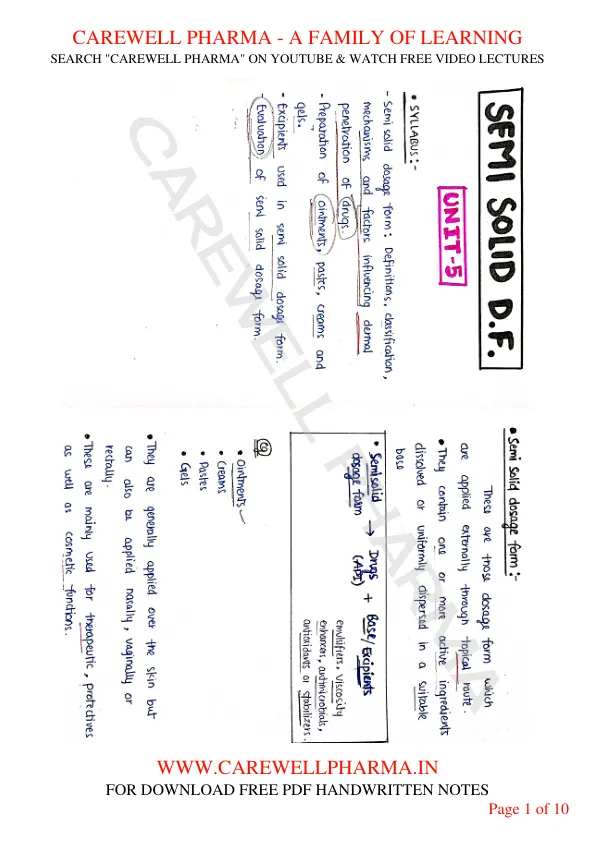
Semisolid dosage forms: Definitions, classification, mechanisms and factors influencing dermal penetration of drugs. Preparation of ointments, pastes, creams and gels. Excipients used in semi solid dosage forms. Evaluation of semi solid dosages forms
Scroll to Download
SEMI SOLID DOSAGE FORMS ## UNIT-5
SYLLABUS
- Semi solid dosage form : Definitions, classification, mechanisms and factors influencing dermal penetration of drugs.
- Preparation of ointments, pastes, creams and gels.
- Excipients used in semi solid dosage form.
- Evaluation of semi solid dosage form.
Semi Solid Dosage Form
- These are those dosage form which are applied externally through topical route.
- They contain one or more active ingredients dissolved or uniformly dispersed in a suitable base.

Examples :
- Ointments
- Creams
- Pastes
- Gels
- They are generally applied over the skin but can also be applied nasally, vaginally or rectally.
- These are mainly used for therapeutic, protectives as well as cosmetic functions.
Advantages
- They avoid the first pass metabolism.
- Best for unconscious patients.
- Bitter drugs can be administered.
- It is easy to apply and onset of action is fast.
- These drugs act directly on site of action.
Disadvantages
- They may cause skin irritation.
- They requires high cost of production.
- They are too bulky to handle.
- Less stable than solid dosage form, but more stable than liquid dosage form.
Classification
It can be classified on the basis of uses:

DERMAL PENETRATION OF DRUGS
- Dermal penetration : It is the phenomena through which drug absorb into blood through topical route (externally).
Mechanism : It is based on the process of diffusion.
- Diffusion is the process in which drug particles move from higher concentration to lower concentration across concentration gradients.
- Diffusion is based on the Fick's first law.
- Acc to it "The rate of diffusion of solute (drug) molecules through a barrier is proportional to the concentration gradient".

- The penetration of drugs occurs through transcellular, intercellular and appendageal routes.
Factors Influencing Dermal Penetration of Drugs
These are those factors which may affect the permeation/penetration of drugs. They are classified into two categories.
- Biological factors
- Physiochemical factors
1. Biological factors
These are those factors which are related to body and affects the penetration.
- Skin Condition
- Skin Age
- Blood Flow
- Regional Skin Sites
- Skin Metabolism
- Skin Hydration
i) Skin condition : There are various skin related factors which may affect permeation like Age, disease, climate, injury etc...
- Absorption is greater in young skin than old.
- Injured skin have great permeation.
ii) Skin Age : It is an important factor i.e. Childrens have more absorption of drugs than adults through skin, but it also tends to more toxic effects.
iii) Blood flow : If the blood flow is reduces, then it increases the penetration of drug. Because it increases the time of contact, so blood absorb more drug.
iv) Regional skin sites : It is also depends on the thickness of skins, which vary on different places.
- Thinner skin (facial skin) have more penetration than thicker skin (palm, sole of feet).
v) Skin metabolism : Our skin have ability to metabolise some drugs which may affect the drugs efficacy and absorption.
- Skin metabolises about of topically applied drugs.
- Ex: steroids hormones, chemical carcinogens etc...
vi) Skin Hydration : It is a condition, when skin get saturated with water (i.e. excess water absorb into skin), and skin tissue swells, softens and wrinkles.
- It increases the rate of permeation.
2. Physiochemical factors
These are those factors which are related to physical and chemical properties of drugs.
- Temperature and pH
- Diffusion coefficient
- Drug concentration
- Partition coefficient
- Molecular size and shape
- Percutaneous enhancers
i) Temperature and pH : Temp is directly proportional, so, if temp increases it increases penetration.
- Unionised molecules have great penetration.
- Drugs with pH value b/w (approx.), mostly below are best for drug penetration through skin.
ii) Diffusion coefficient : It mainly depends on the nature and state of drugs.
- Gases drugs (spray) have more penetration/absorption.
iii) Drug Concentration : It mainly based on the concentration gradient (i.e. High conc. to low conc.).
- e.g. High concentration of drugs have more penetration rate than normal.
iv) Partition coefficient : It is tell us about the nature of drugs i.e. either lipophilic or hydrophilic.
- Lipophilic (lipid soluble drugs) have more penetration.
v) Molecular size and shape : The smaller the size of molecules, the greater will be its penetration rate.
vi) Percutaneous Enhancers : These are those substances which are basically used to enhance the absorption of drugs through skin.
- Ex: Alcohols, acetone, DMSO (Dimethyl sulfoxide) etc.
EXCIPIENTS USED IN SEMISOLID DOSAGE FORM
- These are those excipients which are used in the formulation of semi-solid dosage form.
- These are of followings:
1. Semi solid bases : These are important excipient in which drug (API) and other excipients are mixed and make semi solids.
- It is mainly responcible for release and absorption of drugs.
Ideal properties of Bases :
- They should be compatible with skin pH and drugs.
- Inert, non-irritant and non-sensitizing.
- Protective, non greasy and easily removable.
- Release medicaments easily at the site of administration.
- It should be good stability.
Types of Bases :
- Oleaginous (Hydrocarbon) bases : These are mainly organic bases which is made up of fats and oils. These are water insoluble/hydrophobic. Greasy, sticky and non-washable.
- e.g. White petroleum, soft and liquid paraffin etc...
- Emulsifying bases : It forms o/w or w/o emulsions.
- W/O Emulsion base: water in oil type, these are hydrous, hydrophilic in nature, absorb water and can not be washed. e.g. cold cream, sulfur, zinc ointments.
- O/W Emulsion base: oil in water type, these are water soluble, water absorbable and water washable nature. e.g. Vanishing cream (polyethylene glycols) etc...
- Water soluble bases: These are greaseless, as they are oil free and they show complete solubility in water.
- e.g. PEG, Polysorbates, Macrogols etc...
2. Antioxidants : These are those substances which are used to prevent oxidation.
- e.g. Tocopherols, Ascorbic acid, BHA, BHT etc...
3. Vehicles : These are solvent used for preparations.
- e.g. Water, ethanol, phenol, alcohols etc...
4. Buffers : These are those substances which are mainly used to prevent the change in pH.
- e.g. Sodium citrate, sodium acetate etc...
5. Preservatives : These are those substances which are mainly used to prevent microbial growth.
- e.g. Benzoic acid, Methyl hydroxyl benzoate etc.
6. Humectants : These are those substances which are used to retain water and keep hydrated. These are hygroscopic in nature.
- e.g. Glycerins, propylene glycols, sorbitol etc...
7. Permeation enhancers : These are those substances which are used to increase the rate of penetration or absorption of drug through skin.
- e.g. Methanol, oleic acid etc...
PREPARATION OF SEMI SOLIDS
1. Ointments : These are certain semi solid preparations, that are intended to apply on the skin or mucous membrane. Their consistency is such that, they easily rubbed on the skin.
- e.g. Petroleum jelly, waxes, Lidocaine ointments etc.
- It is of three types: Hydrophobic/oleaginous, Emulsifying and Water soluble ointments.
- It can be prepared by using trituration and fusion methods.
2. Creams : These are semi-solid preparation, in which one or more medicaments are dissolved in emulsion base (i.e. w/o or o/w) or in other water soluble bases.
- Vanishing cream O/W emulsion
- Cold cream W/O emulsion
- These are aqueous cream, oily creams etc.
- It can be prepared by using fusion methods.
3. Pastes : These are semi solid preparations, that are intended to used externally on the surface of the skin.
- They contains large amount of finely powders, which formed a protective layers on skin.
- They can be prepared by using trituration and fusion method.
- e.g. Zinc Oxide, Calcium Carbonate, peptizole etc.
4. Gels : These are semi solid preparations which consisting of a condensed mass enclosed by a liquid.
- Gels are semi-rigid structures of three dimensional network of particles.
- e.g. Voltaren gel (treat osteoarthritis).
- Bases used are: Hydrogels, Organogels, thixotropic gels, rigid, elastic gels etc...
- It can be prepared through thermal changes, flocculation, chemical reactions.
- e.g. Calcium carbonate + Aluminium salt (aq) Al. hydroxide gel.
Methods of Preparation
Semisolid dosage form can be prepared by using following two methods:
- Trituration method
- Fusion method
1. Trituration Method
It is widely used method. If large amount of liquid have to add in base, then this is suitable.
Steps :
- Firstly we have to reduce the size of drugs and make a fine powder i.e. Size Reduction.
- Now, decrease the particle size of powder via triturating by using pestle and mortar and adding small amount of liquid i.e. Levigation.
- Now, add suitable base and this mixture along with other required excipients via trituration.
- Now, add remaining base to finalize weight.
- Now, perform homogenisation to reduce sizes, make semisolids/ointments more stable and more effective.
- Filled it and store it.
2. Fusion Method
This method involve heat and suitable for waxy material and hard bodies, and for those ointment bases which contain solid ingredients having diff-2 melting points.


EVALUATION OF SEMI SOLIDS
These are some tests which are performed to check that the prepared semi solid preparations are stable, therapeutically effective and fit to use.
- These are of followings
- Test of rate of absorption
- Test of non-irritancy (patch)
- Test of rate of penetration
- Test of rate of drug release
- Test of content uniformity
- Test of microbial content
1. Test of rate of absorption : In this, we have to check the amount of absorption of drugs through blood.
- For this, ointments/other preparation are rubbed on the skin portion.
- Then, as regular time intervals, blood serum and urine samples are withdrawn for analyse and estimates the amount of drug absorbed.
2. Test of non-irritancy : In this, we have to check that our preparation should be non-irritant.
- For this, select 24 human volunteers and ointment/other prep is applied on their back or forearms.
- It applied for 21 days, then check any type of inflammation, irritation. If not then it is good.
3. Test of rate of penetration : In this, we have to check the amount of drugs enter through skin per unit time.
- For this, A specific quantity of drugs is applied on particular area of skin.
- Then after specific time, remove that ointment/drug and measured its remaining quantity.
- Do it with other drugs and calculate its average penetrated quantity of drug per unit time.
4. Test of rate of drug release : In this, we have to check the amount of drug release from its base per unit time.
- For this, A clean test tube is thinly coated with preparation, then test tube is filled with saline/serum.
- Now, after definite time period estimate the drug concentration in that saline/serum solution.
5. Test of content uniformity : In this, we have to check that the drug is uniformaly distributed in all portion of preparation.
- For this, 10 filled preparation containers are taken and their net weight is determined.
- Now, the weight of all containers should be same.
6. Test of microbial content : In this, we have to check that ointment or other prep does not contain microbes.
- For this, sample solution are prepared then aseptically inoculated in of rabbit's plasma and incubated at for 1-4 hours.
- Absence of microbes passed this test.