Pharmaceutics 1 - Unit 4
Syllabus
Suppositories: Definition, types, advantages and disadvantages, types of bases, methods of preparations. Displacement value & its calculations, evaluation of suppositories.
Pharmaceutical incompatibilities: Definition, classification, physical, chemical and therapeutic incompatibilities with examples.
Scroll to Download
SUPPOSITORIES (Chapter-1, Unit-4)
UNIT-4
CHAPTER-1
SYLLABUS : Definition, Types, Advantages and Disadvantages, Types of Bases, Methods of Preparations. Displacement Value & its calculation, Evaluation of suppositories.
SUPPOSITORIES
- These are solid or semisolid dosage forms, which are meant for insertion into body cavity such as rectum, vagina etc.
- When these suppositories inserted, they melt, disintegrate and dissolve at body temp and give their effect either local or systemic distribution.
Ex. Pessaries, rectal suppositories etc.
Advantages of Suppositories
- It avoids first pass metabolism.
- It can be used for unconscious patients.
- It can be used for delivering higher amount of dose.
- It can be used for those patients who have swallowing difficulty [i.e. for childrens & old aged].
- Useful for local and rapid effects.
Disadvantages of Suppositories
- Patient acceptance and not comfortable.
- It is more expensive than tablets.
- Irritant drug can't administered.
- Need to store it at low temperature.
TYPES OF SUPPOSITORIES
On the basis of their use, it can be classified into five types :
- Rectal Suppositories
- Vaginal Suppositories
- Urethral Suppositories
- Nasal Suppositories
- Ear cones [Aurinaries]
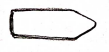
1. Rectal Suppositories :
- These are those suppositories which are meant for insertion into rectum.
- For adults, it is about and for infants, it is one-half.
- It contain theobroma oil or cocoa butter as suppositories base.
- Used for Sedatives, Analgesics, etc...
- Shape tapered at one end or both ends.
2. Vaginal Suppositories :
- Also known as Pessaries.
- These are those suppositories which are meant for insertion into vagina.
- These are globular / oviform shaped and weight is about and contain PEG base.
- These are mainly used for vaginal infection or as contraceptive drugs.
3. Urethral Suppositories :
- These are those suppositories which are meant for insertion into urethra.
- It is also known as Bougies.
- It is made up with cocoa butter and about for females, for males weight.
- These are in shape of micropellet ($1.4mm$ diameter, long) and inserted deep into urethra.
Eg. Alprostadil for treating erectile dysfunction.
4. Nasal Suppositories (Bougies) :
- These are those suppositories which are meant for insertion into nasal cavity.
- These are prepared from gelatoglycerine base.
- These are thinner, size, about weight.
5. Ear Cones :
- These are those suppositories which are meant for insertion into Ear cavity.
- Also known as Aurinaries.
- It is about in weight and cylindrical shaped and rarely used.
SUPPOSITORIES BASES
- These are those excipients which are used in the manufacturing of suppositories.
- These are the major part of suppositories and play major important role in:
- maintaining shape & solidity of suppositories.
- in the release of medicament.
- After inserted into body cavity, suppositories bases get melted and release medicament which provides effects.
Ex. Theobroma oil (cocoa butter), PEG (Polyethylene glycol), etc...
Properties of Ideal Suppositories Bases
- It should be melt at body temperature to release drug.
- It should be non toxic, non-irritant & non-sensitive.
- It should be compatible with most of the drugs.
- It should be easily mouldable and not adhere to moulds.
- It should be stable above its melting point and stable on storage.
- It should be retain its shape when handled.
TYPES OF SUPPOSITORIES BASES
On the basis of their composition and physical properties, these are classified as :
- Oleaginous (fatty) bases.
- Aqueous bases (or water soluble/miscible).
- Emulsifying bases.
1. Oleaginous bases : These are fatty bases and it is of two types
- Theobroma oil [cocoa butter]
- Triglycerides.
THEOBROMA OIL :
- It is also known as Cocoa butter.
- It is most commonly used suppositories bases as it considered as ideal base.
- It is yellowish white color and chocolate like taste.
- It exists as hard, amorphous solid at and melt at [body temp].
- It is obtained from the roasted seed of theobroma cocoa.
- Precautions : prevent over heating, some particulars drugs may alter its melting points.
TRIGLYCERIDES :
- These are made up of Hydrogenated vegetable oils.
- These are synthetic triglycerides.
- These are sometimes used as substitute of theobroma oil.
- These are expensive than theobroma oil.
- Ex. palm oil, coconut oil etc...
2. Aqueous bases : These are water soluble bases and it is further of two types:
- Glycerinated Gelatin : It is a mixture of glycerin and water which further made stiff jelly type by adding gelatin.
- This base is mostly used for vaginal suppositories.
- These suppositories should be store in cool place ($10-15^\circ C$) and also required preservatives.
- It is hygroscopic in nature.
- Polyethylene Glycols (PEG) :
- These bases are polymers in nature and used for prolonging release of drugs.
- Now a days, these bases are used for their properties like chemically stable, non-irritant and miscible with water.
3. Emulsifying Bases : These are also fatty bases, contains higher molecular weight.
- Massa esterinum: comprises of mono, di & triglycerides of fatty acids.
- Witepsol: comprises of hydrogenated triglycerides of lauric acid with added monoglycerides.
METHOD OF PREPARATION
It can be prepared by three methods :
- Hand Rolling Method
- Compression Method
- Hot Fusion Method
1. Hand Rolling method :
- It is the simplest and traditional method.
- It is used for a small scale or for few no. of suppositories by using cocoa butter with hands.
Process :
Firstly, cocoa butter, drug and all other ingredients are mixed properly by using pestle mortar.
- Prepared mass is shaped into ball by using palm, then into cylindrical form by using spatula, then cut small portion and form a conical shape by using hands.
- It is performed by skilful workers.
2. Compression Method :
- It is also known as cold compression moulding.
- In this, suppositories are prepared by compressing.
Process
- Firstly mix all ingredients with suppository base and make fine powder.
- Now, filled this mass in cylinder and apply lubricants in the moulds.
- On compression, suppositories mass filled into moulds and get shaped, then take out & packed.
3. Hot fusion method :
- In this method, heat is used. It is not suitable for heat sensitive substances.
Process :
- Firstly, suppository base is melted and the drug & other excipients are dissolved in it.
- Mixture is removed from the heat and poured into suppository moulds.
- After solidifies, suppositories are removed from moulds.
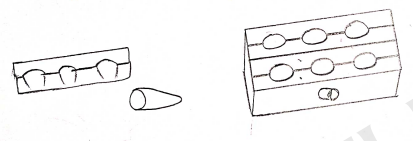
Suppository moulds :
- On small scale, it having 6-12 cavities of desired shapes and sizes.
- On large scale, it having around 500 moulds cavities.
DISPLACEMENT VALUE
- It is defined as it is the amount of drug that displaces one part of suppository base.
- It is necessary to calculate this, because suppositories of same size have possibilities to vary weight due to the nature of drugs.
- It can be calculated on the basis of theobroma oil as suppository base.
Formula:
Where,
- = amount of medicament present in suppositories.
- = weight of suppositories (no medicine) [base]
- = weight of medicament
- = amount of base displace by medicament
EVALUATION OF SUPPOSITORIES
- Suppositories should be evaluated to check that they fulfils the standard requirements or not.
- Following tests should be performed :
- Visual examination / appearance test
- Mechanical strength/crushing test
- Uniformity of weight/drug content
- Melting range test
- Dissolution/disintegration test
- Softening or liquefaction test
1. Visual examination :
- In this, we check the appearance of suppositories by visually.
- It is performed by examination of shape, surface, color, odour manually.
2. Mechanical strength/crushing test :
- In this, we have to check brittleness and elasticity of suppositories.
- For this, suppository fit in machine and apply external weight/force on it.
- An ideal suppository can tolerate/face about pressure.
- Mainly used to check transportation condition.
3. Uniformity of weight :
- In this, we have to check the weight of suppositories are equal and they contain equal amount of drugs.
- For an ideal suppositories, deviation is not more than b/w average and individual weight.
- For this, weigh 20 suppositories and calculate their average weight.
4. Melting Range test :
- In this, we have to check the melting range/point of suppositories.
- For this, put suppositories in water bath for 30 min at .
5. Disintegration/dissolution test :
- To check the dissolution rate of suppositories.
- Put suppositories in dissolution/disintegration apparatus, then filled with suitable dispersion medium at temp .
- Then check their time of dissolution.
6. Softening/Liquefaction :
- In this, we have to measured time in which suppository get completely liquify.
PACKAGING : Suppositories are individually wrapped then filled in plastic, tin, aluminium containers.
PHARMACEUTICAL INCOMPATIBILITY
UNIT-4
CHAPTER-2
SYLLABUS : Definition, Classification, Physical, Chemical and therapeutic incompatibilities with examples.
DEFINITION
- Pharmaceutical incompatibility is a condition which occurs when two or more substances are mixed together and forms an undesirable product, which may affect the safety, efficacy and appearance of the pharmaceutical preparation.
- It may occurs during compounding, dispensing, formulation, manufacturing, packaging and administration of drugs.
CLASSIFICATION/TYPES
It is divided into three types:
- Physical incompatibility
- Chemical incompatibility
- Therapeutic incompatibility
1. PHYSICAL INCOMPATIBILITY
- When two or more non-compatible substances are mixed together, a physical change takes place and an unacceptable product is formed.
- It may changes in the color, odour, taste, viscosity, appearance of product.
This incompatibility occured due to :
- Immiscibility
- Insolubility
- Precipitation
- Liquefaction
Corrections :
- Change the order of mixing of ingredients of the prescription.
- Emulsification.
- Addition of suspending agents.
- Change in the form of ingredients.
(I) Immiscibility : In this, oils and water are immiscible with each other. They can be made miscible with water by emulsification.
- Eg :
- Rx
- Castor Oil:
- Water upto:
- Make an emulsion.
- Correction : In this, castor oil is immiscible with water. To overcome this, an emulsifying agent is used.
(II) Insolubility : It is the inability of material to dissolve in a particular solvent system.
- Eg:
- Rx
- Phenacetin:
- Caffeine:
- Orange syrup:
- Water upto:
- Make a mixture/suspension.
- Correction: In this, phenacetin is insoluble so tragacanth is used as suspending agent to make as stable suspension.
(III) Precipitation : In this, a drug in solution may be precipitated, if the solvent is added in which drug is insoluble.
- Eg:
- Rx
- Tincture benzoin compound:
- Glycerin:
- Rose water q.s.:
- Correction: Tincture benzoin compound contains resins and this resin is insoluble in water so it can be formed precipitate.
- Addition of tincture with rapid stirring prevent this.
(IV) Liquefaction : When two or more low melting point solids are mixed together, they form soft mass or liquid known as Eutectic mixture.
- Eg:
- Rx
- Menthol:
- Camphor:
- Ammonium chloride:
- Light magnesium sulphate:
- Make an insufflation.
- Correction : On mixing, Menthol, camphor and ammonium chloride get liquefied due to lowering of melting point below room temperature. To prevent, mix light magnesium sulphate.
Correction
- Change the order of mixing of ingredients of the prescription.
- Emulsification
- Addition of suspending agents.
- Change in the form of ingredients.
2. CHEMICAL INCOMPATIBILITY
- When two or more non-compatible substances or ingredients of prescription are mixed together, a chemical change takes place and an inactive or toxic product may be formed.
- It may changes to the structure as well as pharmacological properties of drugs.
- Result: Decomposition of drugs, precipitation, color change.
- These changes may be immediate or may be after some period of time i.e. delayed incompatible chemical changes.
Types of chemical incompatibility :
Chemical incompatibility can be occured due to chemical changes:
- Oxidation
- Hydrolysis
- Polymerisation
- Isomerisation
(I) Oxidation : It is the condition of gain of Oxygen and Loss of electrons. It can decompose the complete solution/drugs.
- It may due to atmospheric oxygen, light, temp, presence of pre-oxidants etc.
- Eg: Phenolic compounds, antibiotics, volatile oils etc..
- Prevention: It can be prevented by using antioxidants, protected from light, using buffers to maintain pH.
(II) Hydrolysis : It is a condition or chemical reaction in which water reacts with compound and break its covalent bond and breakdown of compound, lead to its decomposition.
- Eg: Codeine phosphate Codeine Phosphate
- It may be due to presence of water, pH and temperature.
- Prevention:
- Protect from moisture.
- Add water absorbing substance.
- Use appropriate solvent instead of water.
(III) Polymerisation : In this, single unit of chemicals (monomers) bond together to form a long chain polymer.
- Eg: Formaldehyde paraformaldehyde (white precipitate).
- Prevention: It can be prevented by storing formaldehyde at suitable temp and add (15%) methanol.
- It can be cause due to temp, light, solvent, impurities etc..
(IV) Isomerisation : In this, drugs converts into its isomers. Isomers are identical in their formula but different in their structure.
- Eg: l$-adrenaline $\rightarrow $d$-adrenaline (less active than $l$-adrenaline) due to change in temp & pH.
- Prevention: It can be prevent by manage temp, pH, solvent and impurities.
Chemical Incompatibility can further divided into two types :
Tolerated incompatibility : In this, the chemical interaction can be minimised by changing the order of mixing or mixing the solution in dilute form but no alteration is made in formulation.
Adjusted incompatibility : In this, the chemical interaction can be prevented by addition or removal of one of the reacting ingredients of a prescription.
3. THERAPEUTIC INCOMPATIBILITY
- It may be a result of prescribing certain drugs to a patient with the intention to produce specific degree of pharmacological action, but the nature or intensity of the action produced is different from that intended by the prescriber.
This occurs due to following reasons:
- Error in dosage / overdose.
- Wrong dosage form.
- Contraindicated drugs.
- Drug interactions etc..
(I) Error in dosage/overdose : It may be a result from error in writing or interpreting the prescription order.
The most serious type of error is overdose, lead to poisoning.
Eg:
- Rx
- Atropine Sulphate:
- Phenobarbital:
- Make Capsules. (10)
- One capsule to be taken three time a day.
In this, dose of Atropine sulphate and phenobarbital are 12 times more than the normal dose. The prescription is reffered back to the prescriber to correct the dose of drugs.
(II) Wrong dosage form :
- There are certain drugs which have quite similar names. So, their is always a chance/danger of dispensing the wrong dose.
- Eg: Digitoxin and Digoxin, Prednisone & Prednisonal.
- The prescription should be check properly and if need clarification then must clarify from prescriber.
(III) Contra-indicated drugs :
- There are certain drugs which may be contraindicated in a particular disease or a particular patient who is allergic to it.
- Eg:
- Corticosteroids are contraindicated in peptic ulcer.
- Penicillin is contraindicated in its allergic patients.
- To prevent this, must check patient history and its allergic condition before prescribe drugs.
(IV) Drug interactions :
- The effect of one drug is altered/changed by the simultaneous administration of another drugs.
- Eg:
- Rx
- Tetracycline hydrochloride:
- Take ten capsules
- Direction Take with milk
- Tetracycline is inactivated by calcium, which is present in milk. So, it should not be taken with milk.
- The prescription may be reffered back to physician to change the direction.
CORRECTIONS
- Dosing error/overdose should be avoided.
- Drug provide in specific desired form.
- Avoid contraindicated drugs.
- Drugs with drug interaction should be avoided.