Pharmaceutics 1 - Unit 3
Syllabus
Monophasic liquids: Definitions and preparations of Gargles, Mouthwashes, Throat Paint, Eardrops, Nasal drops, Enemas, Syrups, Elixirs, Liniments and Lotions.
Biphasic liquids: -
Suspensions: Definition, advantages and disadvantages, classifications, Preparation of suspensions; Flocculated and Deflocculated suspension & stability problems and methods to overcome.
Emulsions: Definition, classification, emulsifying agent, test for the identification of type ofEmulsion, Methods of preparation & stability problems and methods to overcome.
Scroll to Download
MONOPHASIC LIQUIDS
Unit 3
Chapter 1
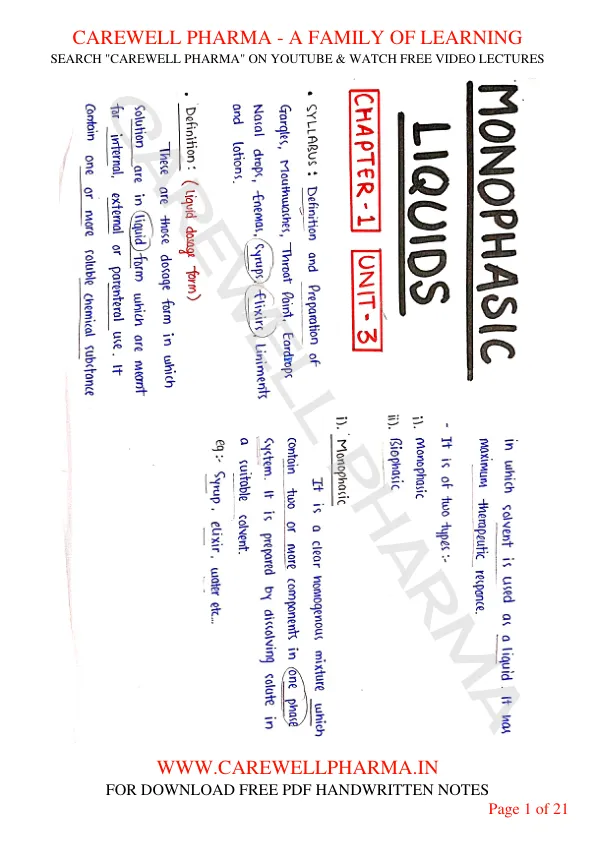
Syllabus : Definition and Preparation of Gargles, Mouthwashes, Throat Paint, Eardrops, Nasal drops, Enemas, Syrups, Elixirs, Liniments and Lotions.
Definition
These are those dosage form in which solution are in liquid form which are meant for internal, external or parenteral use.
- It contain one or more soluble chemical substance in which solvent is used as a liquid.
- It has maximum therapeutic responce.
It is of two types:
- Monophasic
- Biophasic
i). Monophasic
It is a clear homogenous mixture which contain two or more components in one phase system. It is prepared by dissolving solute in a suitable solvent.
- eg: Syrup, elixir, water etc...
CLASSIFICATIONS
Internal use
- Syrup
- Elixirs
External use
- Mouth
- Gargles
- Mouthwashes
- Throat paint
- Skin
- Lotion
- Liniments
- Body Cavity
- Ear Drops
- Nasal Drops
- Enemas
Internal Use
i). Syrup
A syrup is a concentrated solution of sugar (sucrose) in water. The sucrose at the concentration of is dissolved in water.
- In Syrup, sucrose contains w/w sugar. (I.P)
- Simply w/v sucrose solution in purified water. (U.S.P).
Types :
Simple syrup : Simply 85% w/v sucrose solution in purified water. (U.S.P.)
Medicated Syrup : Syrup contains any medicament. e.g. cough syrup etc...
Flavoured Syrup : It contains flavouring agents and are mostly used to improve the taste of salty, bitter or unpleasant taste etc... e.g.:- Orange syrup etc...
External Use
1). Gargles
The are meant for external use and are available in concentrated form. It is used to prevent or treat throat infection.
- They mainly used by mixing with warm water.
- Eg:- Potassium chlorate and phenol glycin gargles (B.P.C.).
Recipe:
- Potassium chlorate:
- Patent blue V:
- Liquified phenol:
- Water:
Procedure:
- Dissolve the potassium chlorate in warm water.
- Cool and add liquified phenol.
- Add the dye solution and filtered.
- Make up the volume and transfer to a container.
Labelling: For external use only.
2). Mouthwash
It is aq. solution with pleasant taste and odour used to clean the mouth or buccal cavity. It is used for two purpose therapeutic and Cosmetic.
Type :
Cosmetic/Non-medicated (OTC) : It include over the counter mouthwash. Mainly used to protect teeth and gums from bacteria. Prevent halitosis.
Therapeutic/Medicated : Those which contain fluoride are prescribed mouthwash. Mainly used to treat dental plaque, gingivitis. Prevent tooth decay.
Ingredients :
- Boric acid:
- Thymol:
- Eucalyptol:
- Methyl Salicylate:
- Menthol:
- Alcohol:
- Water:
Procedure :
- Boric acid is dissolved in of water.
- Other ingredient is Dissolved in of alcohol separately.
- Add aq. solution in alcoholic solution.
- Add of talc (purified talc) occasionally.
- Allowed to stand with stirring for 48 hours.
- Filtered the solution and add water and alcohol.
3). Nasal Drops
These are those solution which are introduce into the nose cavity with the help of dropper.
- These solution contain antiseptics, local analgesics or vasoconstrictors.
- They should not be used for prolonged periods.
eg : Ephedrine Hydrochloride.
Ingredients :
- Ephedrine Hydrochloride:
- Chlorbutol:
- Sodium chloride:
- Purified water:
Procedure :
- All ingredients are dissolved in purified water.
- Filtered the solution.
- Dispensed in clear bottle.
4). Lotion
These are those substance which is intended to be applied externally on broken skin without friction. They provide local cooling, protection and antiseptic action. They applied directly on the skin or in dressing.
eg : Calamine Lotion.
Recipe :
- Calamine
- Zinc oxide
- Bentonite
- Sodium citrate
- Liquefied phenol
- Glycerine
- Rose water
Procedure :
- Sodium citrate is dissolved in rose water.
- Triturated with calamine, zinc oxide, bentonite.
- Add liquefied phenol and glycerine in mixture.
- Add purified water to make up the volume.
- Transferred to a bottle, labelled and dispense.
5). Liniments
These are the liquid preparation which is meant for external application to the skin by rubbing of skin to reduce pain they are applied on a warm dressing or with brush to produce analgesic and soothing effect.
eg: Camphor Liniment.
Recipe :
- Camphor:
- Arachis Oil:
Procedure :
- Dissolve camphor in arachis oil in dry and closed vessel.
- The vessel is immersed in luke warm water with continuos agitation.
- Store in well closed container and kept in cool place.
6). Ear Drops
These substance are meant for external use. These are the solution which are instilled into ear through dropper for cleaning of ear.
- They are used for cleaning the ear, softening wax, and treating mild infections.
eg: Sodium bicarbonate Ear Drops B.P.
Recipe :
- Sodium bicarbonate:
- Glycerine:
- Purified water (q.s):
Procedure :
- Sodium bicarbonate is dissolved in water.
- Glycerin is added in this solution.
- Water is added to make up the volume.
7). Throat paint
These are viscous liquid prepn. used for mouth and throat infection. They provide local action and used to treat ulcerative stomatitis, tonsillitis.
- Also prolong the action of the medicament.
eg: Crystal Violet Paint.
Recipe :
- Crystal violet:
- Purified water (q.s):
Procedure :
- Crystal violet is dissolved in purified water.
- Sufficient water is added to make up the volume.
8). Enemas
They are also known as clysters which are rectal injection employed to cleaning bowel. It is used to treat constipation problem in lower gastrointestinal series for local application.
2. Elixirs
The are clear, flavoured, sweetened hydro-alcoholic preparation for oral administeration.
Formulation :
- Vehicles solvent: alcohol, water, glycerin etc...
- Preservatives: paraben
- Flavouring & coloring agents.
Types :
- Medicated elixirs: If elixir contain drug or other ingredients. eg:- Antibiotic elixirs etc...
- Non-medicated elixirs: They do not contain any medicine but contain aromatic or pleasantly flavoured substances. Used as solvents for other preperations.
Method :
- Dissolve ingredients in suitable solvent i.e. alcohol soluble substance are dissolve in alcohol and water soluble in water separately.
- The aqueous solution is then added to the alcoholic solution with constant stirring.
- Adjust the volume with the vehicle and allow elixir to stand for some time to permit the oil globules to coalesce.
- Filter the solution to get a clear product.
Formulation of Syrup
The syrup consist of:
- Sugar or sucrose w/w of sugar.
- Purified water.
- Medicament (antipyretics, sedatives etc...).
- Preservatives - Parabens.
- Coloring and Flavouring agents.
Method of preparation
1. Agitation without heat :
- Suitable for syrup which contains volatile substance.

- Active substance is added in solution and agited in a glass-stoppered bottle to protect the syrup from contamination and loss of volatile oils.
2. Solution with heat (Hot process) :
- Heat approx. of distilled water to boiling. Add sucrose in small amount to hot water while stirring.
- Suitable for syrup which contains volatile substances.
- Continue adding sucrose (in small portion) allowing each batch to dissolve before adding the next.
- Finally filter the syrup and make up desired volume with remaing amount of distilled water.
- Note: Excessive heating may cause inversion of Sucrose.
BIPHASIC LIQUID DOSAGE FORM
Unit 3
Chapter 2
Syllabus :
Biphasic Liquids
Suspensions: Definition, Advantages and Disadvantages, Classifications, Preparation of Suspension; Flocculated and Deflocculated Suspension and Stability Problems and Method to overcome.
Emulsions: Definition, Classification, Emulsifying agents, test for identification of type of Emulsions, Method of preparation and stability problems and Methods to overcome.
Biphasic liquids
These are those liquid dosage form which contain two phases, which are immiscible with each others.
- They contains one dispersed phase (drugs) that is dissolved in dispersion medium (solvent).

It is of two types
Suspensions - finely divided drug particles dissolved in liquid solvent.
Emulsions - Two immiscible liquid preperation dissolved in each other.
SUSPENSIONS
It is a biphasic liquid dosage form of medicament in which the finely divided solid particles are suspended or dispersed in a liquid with the help of suspending agents.
- The Solid particle act as disperse phase where as liquid vehicle act as the continous phase.
- It is ranging from to micron are dispersed in a liquid or semisolid vehicle.

Advantages
- Higher rate of bioavailability.
- It is easy to swallow the insoluble medicament.
Disadvantages
- Need shaking before use.
- Accuracy of dosage is less.
- Storage of suspension may leads to changes in disperse system.
Formulation / Excipients used in suspension
i). Wetting agents: These are those agents which reduce the surface tension of water and increase the spreading abilities of a liquid.
eg: Propylene Glycol USP.
ii). Flocculating agents (Suspending agents): The are the chemical additives that cause suspended solid to form aggregates called flocs which are easier to separates. It is widely used in water treatment plants.
eg: Aluminum sulphate.
iii). Thickeners: These are those substance which can increase the viscosity of a liquid without changing its other properties.
eg: Polysaccharides.
iv). Buffers and Preservatives:
- Buffers are those solution that can resist pH change upon the addition of an acidic or basic components. They maintaining the pH of the solution and stable.
eg: Ammonium acetate.
- Preservatives are those agents which prevents things from decaying/degradation/contamination.
eg: Nitrates.
v). Colouring agents: These are those substance which are used to change the colour of a material (painting, printing).
eg: Lead oxide, Copper sulfate.
vi). Flavouring agents: These are those agents which are added to the food to mask the bitter taste.
eg: Peppermint.
Procedure
- Grinding the insoluble materials in the mortor to a smooth paste with a vehicle containing the wetting agents.
- All soluble ingredients with some portion of vehicle are added to the smooth paste (step 1) to get Slurry.
- The slurry is transferred to a graduated cylinder, the mortor is rinsed with some part of vehicles.
- Add suspending agent / Flocculating agent if any by mixing into vehicles.
- Finally adjust the volume by vehicle.
- Stored in wide mouth containers. Store in a cool dry place.
Classification
i). Flocculated Suspensions : These agents produce bridging between the particles to form aggregates or flocs also have weak vander waal attraction forces.
ii). Deflocculated Suspension : These agents undergo aggregation at slower rate. They have shorter shelf life.
| Flocculated | Deflocculated |
|---|---|
| In this types of suspension the particles form a network like structure or flocculation. | In this type of suspension the particle exists as separate entity. |
| Due to smaller particles (higher size) the sedimention rate is high. | Due to small particles the sedimention rate is slow. |
| Re-dispersion is easily done by agitation. | Re-dispersion is difficult by agitation. (hard cake) |
| Bio-availability is low. | Bio-availabity is high. |
| Supernatent liquid is clear. | Supernatent liquid is not clear. |
| Suspension is not pleasing in appearance. | Suspension is pleasing in appearance. |
| Stable. | Very less stable. |
Suspending Agents
They are also known as hydrophilic colloids. These agents provide particles to settle down slowly and Re-dispersed on shaking or agitating the container.
- It reduce the Interfacial tension between the solid particles and liquids medium, thus produce a required quality.
eg: Tragacanth mucilage.
Ideal Suspending Agent
- High viscosity during shelf storage.
- Low viscosity at high shear rate.
- It should be free flowing during agitation.
Stability Problems and Methods to overcome.
1). Poor Re-Dispersibility (Caking) : The Dense mass of insoluble solid particles settle at the bottom which is known as caking.
Overcome :
- Modification in the pH of the dispersion phase also prevents caking.
- Suitable suspending agents or mixture is added in the suspension.
- By adding flocculating agents.
2). Cap Locking : It is a filling problem in which dispersed particles crystalline on the threads of the bottle cap and interfering during cap removal.
Overcome :
- Different vehicles containing sucrose, glucose used in the preparation to overcome the problem.
3). Colour change : Light sensitive preparation may change their colour in the presence of light due to increased surface area.
Overcome :
- The bottle containing light sensitive preparation should be kept in dark place.
4). Change in Viscocity : The long term storage of preparation may change their viscosity.
Overcome :
- Add suitable viscosity agents in the preparation.
5). Caking : Formation of hard cake.
Overcome :
- By Adding Flocculating agents.
5). pH change: During long storage, pH may changes.
Overcome :
- By adding buffering agents.
EMULSION
An emulsion is a biphasic liquid dosage form in which two immiscible liquids are mixed together to form a stable emulsion with the help of emulsifying agent.
eg : Vanishing cream, Gel, Lotion.
Advantages :
- More rapid absorbed.
- Sustained release medication.
- Mask unpleasant taste.
- Improved bio-availability.
- Easy to produce and scale up.
- High encapsulation efficiency.
- More economic.
Disadvantage:
- Chances of cracking emulsion.
- Dose accuracy decrease.
- Unstable emulsion.
Types:
i) Oil in water: O/W These are those types of emulsion in which oil is a dispersed phase and water is continous phase.
eg: Milk, Creams, Lotions.
ii) Water in oil: W/O These are those type of emulsion in which water is mixed in oil or water is dispersed phase and oil is continous phase.
eg: Butter, Cold cream.
Emulsifying Agent
These are those substance which help to produce stable emulsion. These agents reduce the interfacial tension between two phase i.e. oil phase & aqueous phase. Surfactants are mainly used as emulsifying agents. The efficient emusifying agent can be grouped into three categories.
1). Naturally Occuring Emulsifying Agents : These are obtained from vegetables or animals. Their quality differ from batch to batch. Best emulsifying agent are Polysaccharides.
2). Synthetic Surfactants : These are those agents which have surface active properties. some examples of surfactants are Anionic, cationic surfactants. Benzal konium Chloride.
3). Finely Divided Solids : They are absorbed at the o/w interface. A w/o emulsion is produced when the solid particles become wet with oil.
Test for identification of type of Emulsion
1). Miscibility Tests : In this, the liquids, miscible with continous phase of emulsion will also be miscible with the emulsion.
- For o/w emulsion miscible with water and not with oil.
- For w/o emulsion miscible with oil and not with water.
2). Conductivity Test : In this type the current is passed in the emulsion if current passed then emulsion is o/w type because water is in continous phase. So, it pass the current and if current not passed then it is w/o.
3). Dilution Test : The emulstion is diluted with water. In case the emulsion remain stable it is o/w & if it breaks then it is w/o.
4). Dye Test : The scarlet dye is mixed with the emulsion. Place a drop of the emulsion on a microscopic slide, cover it with cover-slip and examine it.
- If the disperse globules appears red & ground colourless it is o/w & reverse for w/o.
5). Flourescence Test : Flourescence add in the emulsion, pass the uv (ultraviolet radiation).
- If whole field is Flourescence the emulsion is w/o and droplets Flourescence indication o/w.
Preparation of Emulsion
- Dry gum method.
- Wet gum method.
- Bottle method.
1). Dry gum method : In this method, the oil is first triturated with gum with a little amount of water to form the primary emulsion.
- The trituration is continued till a 'Clicking' sound is heared and a thick white cream is formed.
- Once the primary emulsion is formed, the remaining quantity of water is slowly added to form the final emulsion.
- Ratio used [4:2:1] [oil: water: gum]
2). Wet gum method : In this method, firstly gum and water are triturated together to form a mucilage.
- The required quantity of oil is then added gradually in small portions through trituration to form the primary emulsions.
- Remaining quantity of water is added to make the final emulsion.
- Ratio used [4:2:1] - [oil: water: Gum]
3). Bottle method: [Forbes method] Used to prepare emulsion of volatile oils, or subtance having very low viscosities.
- 1 part gum / acacia is placed in a dry bottle.
- 2 part of oil are added.
- Shake the mixture throughly after capping.
- A volume of water (approx. equal to oil) is added in portions.
- Again shake the mixture througly until the Primary emulsion is formed.
- Dilute it with proper volume of water.
Stability Problems and Methods to overcome
1). Coalescence : The oily particles (Dispersed phase) because of sticky nature attract each other and they aggregate to form big particles.

Overcome :
- Suitable emulsifying machinery should be employed in the preparation.
- Precaution should be undertaken while adding emulsifying agents.
2). Breaking (Cracking) : Due to improve mixing of oil and water in emulsion, Emulsion get separated into two layer oil and water. It is also occured due to improper ratio of oil and water.

Overcome :
- More emusifying agents should be added in the preparation.
- The temperature at which the emulsion are store should be under control.
- Regulate the concentration of disperse phase.
3). Flocculation : In this, due to increased surface free energy particles get aggregated to form floccutes to decrease surface area.

Overcome : A high energy barrier exists in the presence of high charged density on the dispersed droplets.
4). Creaming : It is a reversible phenomenon. In which droplets of dispersed phase come together or deposite at the surface of the emulsion.
Overcome:
- The viscosity of continous phase can be improved by adding viscosity enhancers.
- The density difference between the two phases should be reduced.
- The emulsion should be stored in a cool place at a low temperature.
5). Phase inversions : In this, the phase of emulsion get inverted (O/W W/O). It happened due to mixing problem or by choosing wrong dispresed phase during formulation.
Overcome (General for stability):
- Add adequate quantity of preservatives in the preparation.
- Suitable preservative for each oil and aqueous phase should be used.
Evalution
- Determination of particles size and particle count.
- Determination of viscosity.
- Determination of phase separation.
- Determination of electrophoretic properties.