Pharmaceutical Analysis - Unit 5
Syllabus
Electrochemical methods of analysis
Conductometry - Introduction, Conductivity cell, Conductometric titrations, applications.
Potentiometry - Electrochemical cell, construction and working of reference (Standard hydrogen, silver chloride electrode and calomel electrode) and indicator electrodes (metal electrodes and glass electrode), methods to determine end point of potentiometric titration and applications.
Polarography - Principle, Ilkovic equation, construction and working of dropping mercury electrode and rotating platinum electrode, applications.
Scroll to Download
Electrochemical Methods of Analysis
Unit-5
Chapter-1
Syllabus
a) Conductometry : Introduction, Conductivity cell, titrations, applications.
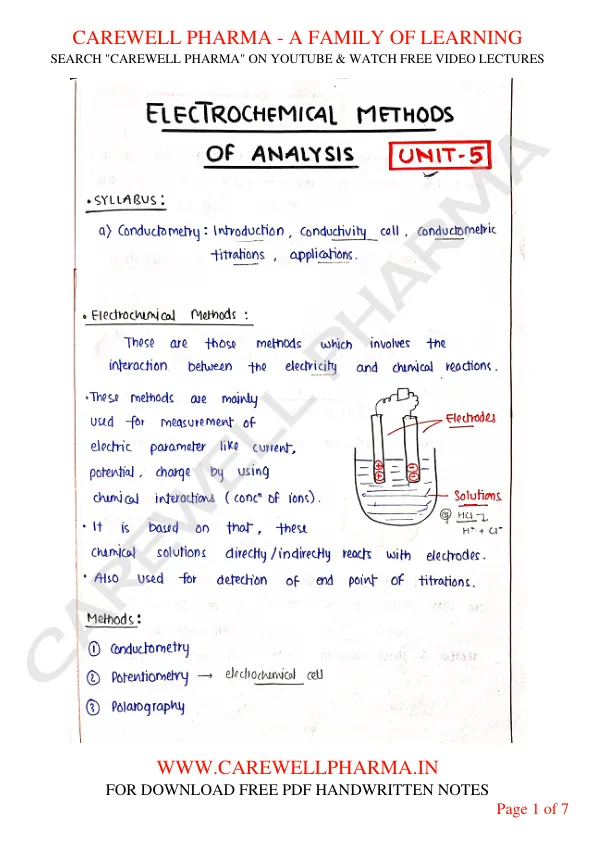
Electrochemical Methods
These are those methods which involves the interaction between the electricity and chemical reactions.
- These methods are mainly used for measurement of electric parameter like current, potential, charge by using chemical interactions (conc of ions).

- It is based on that, these chemical solutions directly/indirectly reacts with electrodes.
- Also used for detection of end point of titrations.
Methods
- Conductometry
- Potentiometry
- Polarography
Conductometry
- It is the measurement of conductivity of a solution due to the mobility (movement) of cations and anions towards respectively electrodes.
- It is basically used for the measurement of conductance by using instrument conductometer.
Conductance
It is the ability of solution to pass electric current. It is denoted by G.
Unit: Siemens (S) or or mho ($\Omega^{-1}$)
It is inversely proportional to the resistance.
It depends on:
 - concentration of ions.
 - mobility/movement of ions.
 - temperature of solution.

- The main principle of conductometry is that the ions present in a solution in a chemical cell are responsible for the flow of electric current. So, when these ions moves towards anode (+) or cathode (-) the conductance starts.
(e.g., $HCl \rightarrow H^+ + Cl^-$) * move towards cathode (-) * move towards anode (+)
Terms Related to Conductometry
- Conductance / conductivity follow ohm's law.
Ohm's Law
- It states that the strength of current ($I$) passing through conductor is directly proportional to potential difference & inversely to resistance ($R$).

Specific Resistance
- The Resistance ($R$) of the conductor is directly proportional to the length ($l$) and inversely proportional to its area of cross section ($a$).

Specific Conductivity
It is the inverse of specific resistance.
Instrumentation
- The instrument used for measurement of conductance are known as Conductometers.
- It is based on the wheatstone bridge circuit.
- It consists of
- Conductivity cells (contains electrodes)
- Beaker
- Mechanical stirring device

Conductivity Cells
- It is made up with glass vessels in which two electrodes are presents at a definite distance i.e. 1cm, and these electrodes are used to measure conductance.
- Electrodes are made up of platinum (pt) and are coated with platinum black to avoid polarisation and to increase surface area.
- Surface area of electrode is and distance between two electrode is .
It is of three types
1. Low concentration : It contains a jar in which two electrodes are dipped in solution and electrodes are made up of platinum.
2. Precipitate type : It is used for those which contain precipitate solution. It contains magnetic stirrer, due to this precipitate does not stick on surface of electrode.
3. Dipped type : Electrodes completely dipped in solution due to its compressed size.

Conductometric Titration
It is the determination of end point of a titration by means of conductivity measurements is known as conductometric titration.
Principle
- It is based on the principle that, during titration one ion is replaced by others which differ in ionic conductance.
- Due to this, graph occurs between change in conductance and volume of titrant had sharp changes which helps in detection of end point.
- Conductivity changes occurs due to change in no. of ions or mobility.
Procedure
- Firstly calibrate the instrument.
- Conductivity cell immersed in analyte solution.
- Titrant filled in burette and noted the reading.
- Now, titrant added dropwise into solution.
- A sharp changes in conductance implies the end point and the observed value must be plotted graphically.
- The equivalence point can be obtained from the point of insertion b/w the two lines.
Types of Titrations
1. Strong Acid with a Strong Base
2. Strong Acid with a Weak Base

3. Weak Acid with a Strong Base
(e.g., Acetic acid with sodium hydroxide)
Reaction:

4. Weak Acid with a Weak Base
(e.g., Acetic acid with ammonium hydroxide)
Reaction:

Applications
- It is used to check water pollution in lake, rivers and other water reservoir.
- Also used to check solubility of sparingly soluble salts.
- Used to trace antibiotics.
- Used to check alkalinity of fresh water.
- Purity of distilled and de-ionised water can be determined.
POTENTIOMETRY
UNIT 5
CHAPTER 2
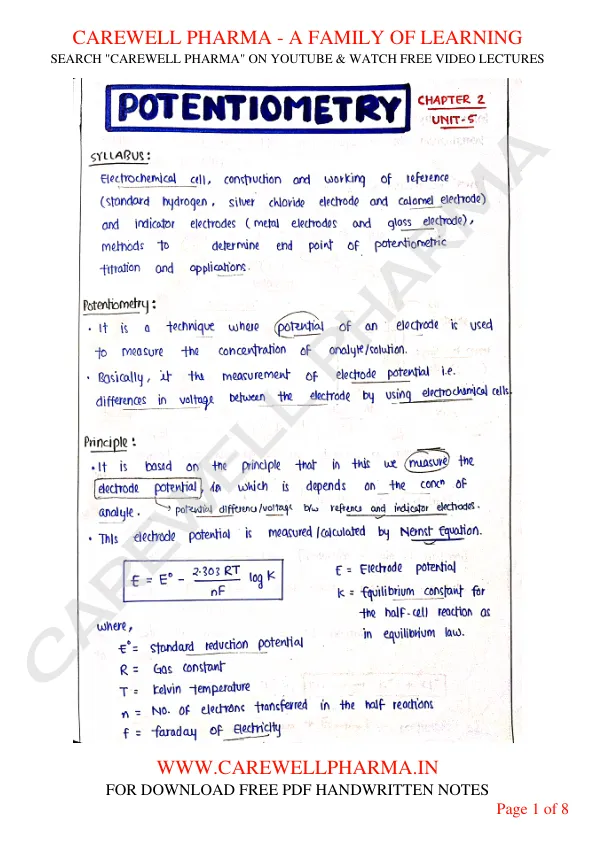
Syllabus : Electrochemical cell, construction and working of reference (standard hydrogen, silver chloride electrode and colored electrode) and indicator electrodes (Metal electrodes and glass electrode), methods to determine end point of potentiometric titration and applications.
Potentiometry
- It is a potentiometric technique where potential of an electrode is used to measure the concentration of analyte/solution.
- Basically, it the measurement of electrode potential i.e. differences in voltage between the electrode by using electrochemical cells.
Principle
- It is based on the principle that in this we measure the potential difference/voltage b/w refrence and indicator electrodes.
- electrode potential, in which is depends on the conc$^n$ of analyle.
- This electrode potential is measured / Calculated by Nernst Equation.

where,
- Standard reduction potential
- Gas constant
- Kelvin temperature
- Electrode potential
- Equilibrium constant for the half-cell reaction as in equilibrium law.
- No. of electrons transferred in the half reactions
- Faraday of Electricity
ELECTROCHEMICAL CELL
These are those cells which converts the physical/chemical energy into electrical energy and helps in the measurement of electrode potential.
- It helps in the generation of voltage (i.e. electromotive force) and current by using chemical reactions.
- Each electrochemical cell is composed of two half-cells.

- Electrochemical cells, also known as voltaic or galvanic cell.
- At anode, [Oxidation loss of electron]
- At cathode, [Reduction Gain of electron]
- Salt bridge: It is the electrical contact made between both the half-cells.
- it maintain the ionic disbalance and neutralise it.
- to complete the circuit.
- , [$KCl \longrightarrow K^+ + Cl^-$]
(E = Electromotive force)
Electrodes
They are mainly used to measure the voltage. There are mainly two types of electrodes used in potentiometry.
1. Reference/standard electrode
- Standard hydrogen
- Silver cloride electrode
- Calomel electrode
2. Indicator electrode
- Metal electrode
- Glass electrode
1. Reference electrode
These are those electrode, which have known electrode potential.
- It is completely independent of the concentration of analyle solution.
- But, used for the determination of the analyte by maintaining the fixed potential.
Standard Hydrogen Electrode
It contains a glass tube with a platinum wire sealed within it.
- platinum foil coated with pt. black to Increase surface area.
- This act as platinum electrode, which immersed in 1M HCl to maintain the conc$^nof $H^+ ions.

- The Hydrogen ($H_2$) gas in pure form is continuously bubbled in the acidic solution at T = 298K and pressure = 1 atm.
- It is attached with another half cell with analyle sol$^n$.
Working:
- When it act as anode:-
- When it act as cathode:-
Silver - Silver Cloride electrode
It is used in pH meters as the internal reference electrode.
Construction
- It contains a silver wire coated with AgCl (silver chloride).
- The electrode is immersed in solution of potassium chloride [KCl] having 1M of ion.
- It is represented as

Working
- there is a reaction b/w Ag (silver metal) and AgCl (silver cloride).
Calomel electrode
It often employed as a secondary standard reference electrode.
- A platinum wire, immersed in liquid mercury, is covered with calomel (i.e. $Hg_2Cl_2$) paste.

- The tube is filled with 1M saturated solution of potassium chloride (KCl).
- The narrow glass tube in which KCl solution is filled has a salt bridge which can connect this electrode to different electrodes.
It can be represented as: $$Cl^- (1M) | Hg_2Cl_2, Hg$$
Working : reactions for half-cell of calomel electrode is $$Hg_2Cl_2 + 2e^- \longrightarrow 2Hg + 2Cl^-$$ Or $$Hg_2^{2+} + 2e^- \longrightarrow 2Hg \quad [\because 2Hg \longrightarrow Hg_2^{2+} + 2e^-]$$
2. Indicator Electrodes
These are used in pair with reference electrode and connected with voltmeter.
- It is used to determine the concentration of analyle in the sample solution.
Metal Electrode
- It generate electric potential as a result of redox reaction on the surface of metal.
- Platinum or gold metals are used in indicator electrodes.
Glass Eletrode
- the measurement of pH for any given solution can be done easily using a glass electrode.

- It includes a thin-walled bulb at the bottom and a glass tube at top.
- The bulb is filled with 0.1 M HCl solution.
- A silver (Ag) wire, covered with AgCl is present at the lower end of glass tube.
- It is represented as:
POTENTIOMETER
It is an instrument which is used in potentiometry.
It consists of
- Electrodes:
- References
- Indicator
- Vessels
- Titration burette
- Magnetic stirrer

Electrodes : It contains both reference and indicator.
Vessels : It contains sample/analyle solution, whoose concentration to be measured.
Titration burette : It contains standard solution which is used for titration.
Magnetic stirrer : It increases the reaction.
eg.
End Point Detection
The end point or the equivalent point can be located using various methods.
- There is a sharp change in electrode potential when equivalence point (end point) is reached.
- End point should be reached near equal quantity of titrant and titrand.
I) pH measurement : In this, pH meter is used to measure the pH of solution, throughout the titration.
- A sharp/significant (imp) change in pH can be the endpoint of this, especially in acid-base titration.
II) Graphical methods : It involves plotting the potential difference (voltage) against the volume of titrant added.

- A smooth curve is draw joining all the points.
- The endpoint corresponds to the steepest (higher magnitude) slope on the graph.
Specific Titrations:
Acid-Base Titration : in this, the endpoint is detected using pH meter. the pH at equivalence point is close to 7.
Redox : the end point is determined by monitoring changes in the voltage due to the transfer of electrons between the analyle and titrant.
Complexometric Titrations : In this, the endpoint is typically detected using indicators or electrodes sensitive to metal ions.
APPLICATIONS
- It is used in clinical chemistry for the analysis of electrolytes such as Na, K, Ca, H and Cl and dissolved gases such as .
- Used for the determination of endpoint of an acid base titration.
- It used in environmental chemistry for analysis of , , , in water and waste water.
- Used in agriculture for analysis of , , I, Ca, K, CN, Cl in soils, plant materials, fertilizers etc.
- It also used in food processing departments in:-
- Salt content in dairy products
- Ca in dairy products and beer
- K in fruit juice
- F in drinking water and other drinks
- and in meat preservatives.
- Also used in assay of Nitrazepam and other sulpha drugs.
POLAROGRAPHY
UNIT-5
CHAPTER-3
Syllabus : Principle, Ilkovic equation, construction and working of dropping mercury electrode and rotating platinum electrode, applications.
Polarography
- It was invented by Jaroslav Heyrovsky.
- It is an electrochemical method of analysis which involves the measurement of current flowing between electrode in the solution when some voltage applied, which helps to determine the concentration of a solute/analyte.
Principle
- It is based on the principle that when voltage (EMF) is applied between the electrodes, reduction takes place, or oxidation electrons ($e^-$) move and current flow.
- Now, this flowing current is measured which is depends on the concentration of ions/analyle.
- Two electrodes:
- Polarizable Electrode Dropping Mercury Electrode (DME).
- Non-polarizable electrode Calomel electrode.
- The instrument is called Polarograph and the curve is called polarogram which is formed as current-voltage curve (sigmoid shape).
Polarographic currents
It is a current which we have to measured i.e.
Diffusion Current ($i_d$) = When voltage is applied in a solution, diffusion of ions/analyte takes place which generate current i.e. known as diffusion current.
- It is measured by using Ilkovic equation.
where,
diffusion current
no. of electron
diffusion coefficient
Mercury flow rate
mercury drop time (s)
concentration of analyte/ions.
Acc. to this,
Instrumentation
- It includes two electrodes i.e. a polarographic cell.
- Sample solution
- Polarograph
- Indicator (polarisable electrode) act as cathode (-)ve. DME (Dropping mercury electrode) or RPE (Rotating Platinum electrode).
- Reference (non-polarisable electrode) act as anode (+) ve.
- Battery connection
DROPPING MERCURY ELECTRODE
- It is the working electrode which is used in polarography.
- In polarography, it act as indicator electrode.
Construction
- It is made up of three components:
- Mercury reservoir vessels or Mercury (Hg).
- Standing tube with adjacent stopcock
- Capillary
- Small mercury drop is received from the orifice of fine glass capillary tube.

- Capillary length 5-12 cm
- internal diameter 0.02-0.05 mm
- interval b/w drops 1-5 sec
Working
- It is polarisable and work as indicator electrode.
- In this, it act as cathode and reference electrode act as anode or vice-versa.
- Analyle sol$^n$ is placed in a beaker and supporting electrolyte KCl is added.
- pure / gas is bubbled through the solution, to take out oxygen.
- Then gradually increasing voltage is applied to polarographic cell, and current flowing is recorded.

Working
- In this, gradually increasing voltage is applied between two electrodes.
- Due to this, electrolysis or polarisation (diffusion of ions/analyte) of solution takes place, which generates current by flowing of electrons.
- Mercury continuously drops from the reservoir through a capillary tube into the solution. The interval b/w the drops of Hg is 2-5 second.
- there are
- act as cathode (-) ve.
- another electrode i.e. reference electrode (standard calomel electrode) - which act as anode (+) ve.
- Now, current flow through b/w these electrode and data or results are obtained through polarogram in the form of current-voltage curve.
- gase pass to expel out oxygen ($O_2$).
ROTATING PLATINUM ELECTRODE
- It is also used as indicator electrode in polarography.
- It is used in case of high positive potential (above 0.4V). where DME can not be used.

- The electrode is constructed from a standard "mercury seal".
- A wire is connected b/w the mercury seal & applied voltage.
- The electrode is rotated with a constant speed of 600 rpm.
- It's working is similar as DME.
APPLICATIONS OF POLAROGRAPHY
- Quantitative determination - It helps in the determination of concentration of drugs, metal ions, dissolved oxygen, etc.
- Qualitative determination - It helps in the determination of trace metals like Cu, Pb, Al, Mn etc.
- It also helps in the determination of -
- Vitamins estimation of both fat-soluble & water soluble vitamins.
- Hormones Thyroxine, insulin, adrenaline, etc.
- Antibiotics Penicillin, streptomycin and chloramphenicol etc.
- It is also used in physical, Inorganic and organic chemistry for research work.
- also used in the fields of biochemistry, pharmaceutical chemistry and environmental chemistry etc.
Chapter 1
Chapter 2
Chapter 3