Pharmaceutical Analysis - Unit 3
Syllabus
Precipitation titrations: Mohr’s method, Volhard’s, Modified Volhard’s, Fajans method, estimation of sodium chloride.
Complexometric titration: Classification, metal ion indicators, masking and demasking reagents, estimation of Magnesium sulphate, and calcium gluconate.
Gravimetry: Principle and steps involved in gravimetric analysis. Purity of the precipitate: co-precipitation and post precipitation, Estimation of barium sulphate.
Basic Principles,methods and application of diazotisation titration. Estimation of sodium nitrite and sodium nitrate.
Scroll to Download
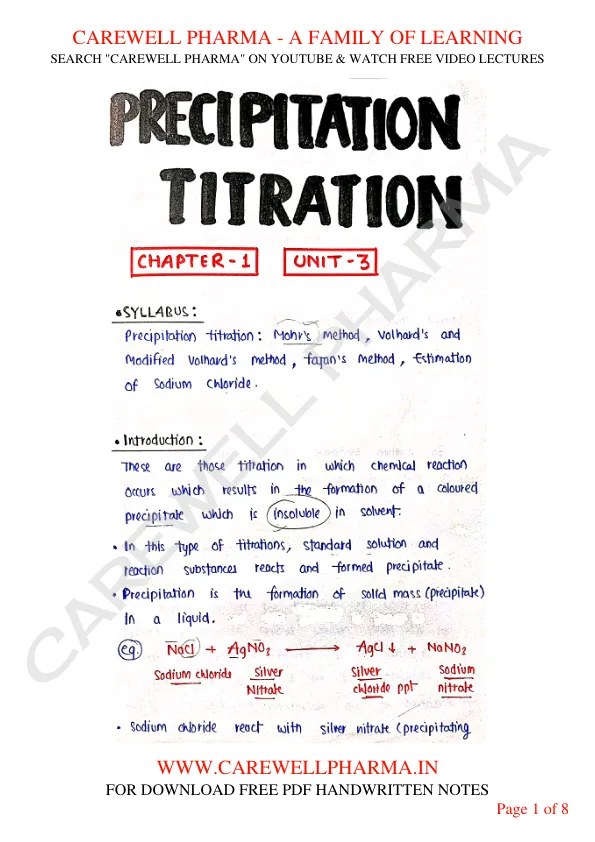
PRECIPITATION TITRATION
CHAPTER-1
UNIT-3
SYLLABUS
Precipitation titration: Volhard's and Mohr's method. Modified Volhard's method, Fajan's method, Estimation of Sodium Chloride.
Introduction:
These are those titration in which chemical reaction occurs which results in the formation of a coloured precipitate which is insoluble in solvent.
In this type of titrations, standard solution and reaction substances reacts and formed precipitate.
Precipitation is the formation of solid mass (precipitate) in a liquid.

Sodium chloride react with silver nitrate (precipitating agents) which formed the Silver chloride precipitate.
It is also known as Argentometric titration, because it involves the reaction of silver ($Ag$).
These methods involves the formation of halides ($Cl^-, Br^-$).
TYPES OF PRECIPITATION TITRATION
It is of three types -
- Mohr's method
- Volhard's method and modified Volhard's method
- Fajan's method
1 MOHR'S METHOD
It is one of the important method of precipitation titration and for the first time it was developed by Mohr in 1856.
Potassium chromate ($K_2CrO_4$) is used as Indicator.
Principle
This method involves the titration of silver nitrates against halides in neutral solution using 2% of solution of potassium chromate as an indicator.
- The end point is marked by the appearance of brick red coloured precipitate due to formation of silver chromate and silver chloride.

Procedure
- 1-2 gm of solution is dissolved in water then add 50 ml of this solution into volumetric flask.
- 2ml of 0.1M potassium chromate indicator is added.

- A burette is filled with solution and initial reading is noted.
- During titration, reacts with and form (silver chloride) precipitate.
- Now, when all the chloride ion used, react with indicator and forms precipitate (red coloured) which indicates end point.
Calculation
where, volume of sol$^n$ (burette reading) used.
Limitations
- It is not possible to use titration in basic solution, otherwise it will produce Silver hydroxide.
- Not possible to use titration in the presence of ammonia ions, and many anions ($PO_4^{3-}, S^{2-}$ etc...).
Pharmaceutical applications of Mohr's method:
- Some of the important drug determined by this method are :-
- Sodium chloride and dextrose injection.
- used for determination of chloride, Bromide and thiocyanate (chromate ion).
VOLHARD'S METHOD
This method was designed by germen scientist Jacob Volhard in 1874.
- This method is used for the estimation of silver by titrating against a standard thiocyanate solution in the presence of ferric salt as indicator.
Principle
- It is a type of Back titration.
- In this method, firstly Sodium chloride is titrated against (Silver nitrate) - in excess.
- Then, this excess amount of is titrated against thiocyanate sol$^n$ till end point (form reddish brown color).
Procedure
- Firstly Standard 0.1 N , 0.1 N will be prepared.
- indicator is prepared and purified nitric acid (acidic medium).
- The excess amount of is used for the titration of solution.
- After complete precipitation of silver chloride ($AgCl$), excess amount of is added.
- Now, the excess amount of is titrated against potassium thiocyanate ($KSCN$) and also add ferric salt ($Fe^{3+}$) as Indicator.

- A standard solution of is added from a burette to a solution of (silver salt) in the presence of nitric acid and ferric indicator.
- In this, a precipitate of silver thiocyanate ($AgSCN$) continues to be formed till the silver get completely precipitation.
- After this, the addition of further drop of thiocyanate reacts with ferric ion to form a red colored ferric thiocyanate complex.

- The appearance of reddish brown indicates the end point.
Pharmaceutical Applications
Some important drug determined by this method is Aminophylline, Clorophenothane, Ethionamide. Sodium chloride injection.
MODIFIED VOLHARD'S METHOD
Chloroform or Other wetting agents are added, after addition of excess amount of silver nitrate because precipitate of may be solubilized in the solution during estimation. So addition of chloroform will prevent the solubility of .
FAJAN'S METHOD
This method was introduced by Fajan in 1923-24.
This method employs adsorption indicator for detection of end point.
Principle
- This method is based on the absorption indicator, in which indicator get adsorbed on the surface of precipitate which change the color of precipitate and marks the end point.
- Indicator used are : fluorescein, Dichloroflourescein, Eosin etc.
Procedure
Firstly, Chloride ion is titrated against silver nitrate Which forms the silver chloride percipetate.
Now, excess of chloride ions get adsorbed on the silver chloride precipitate forming uniform layers. Thus the Primary adsorbed layer of chloride ions holds the secondary adsorbed layer of ions.
Now, after the equivalence point, the silver chloride adsorbs excess of ions as primary adsorbed layer, which further adsorbed the indicator fluorescein ($Fl^-$) ions as Secondary adsorbed Layer.
- Due to this adsorption, a pink color complex formed which indicates the end point.

USES
- Helps in standardisation of unknown sol$^n$.
- Standardization of solution.
- determination of complexes.
Applications
- Applications of Precipitation titrations.
- removal of salts from water during water treatment, in qualitative inorganic analysis.
- used in metallurgy.
- estimation of various substances.
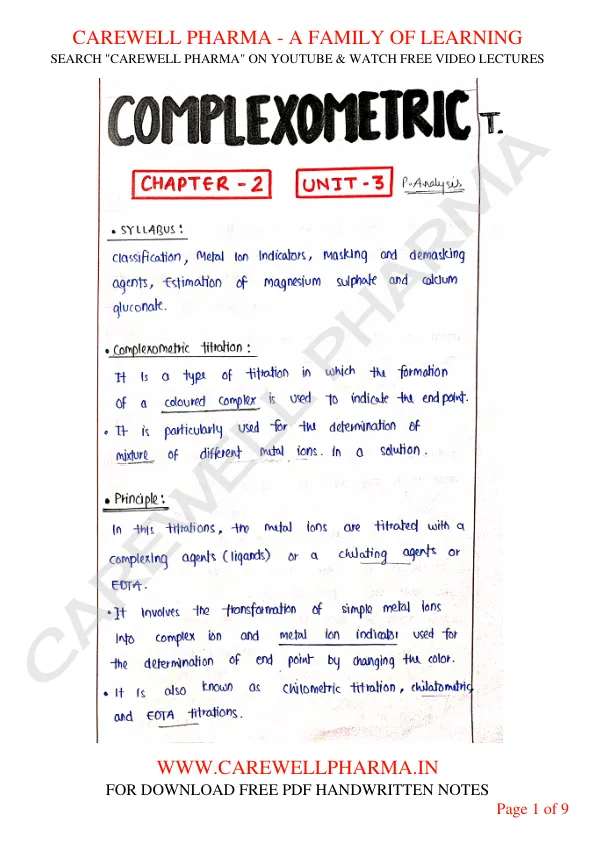
COMPLEXOMETRIC TITRATION
CHAPTER-2
UNIT-3
SYLLABUS
Classification, Metal ion Indicators, masking and demasking agents, Estimation of magnesium sulphate, and calcium gluconate.
Complexometric Titration
It is a type of titration in which the formation of a coloured complex is used to indicate the endpoint.
- It is particularly used for the determination of mixture of different metal ions. in a solution.
Principle
- In this titrations, the metal ions are titrated with a complexing agents (ligands) or chelating agents or EDTA.
- It involves the transformation of simple metal ions into complex ion and metal ion indicator used for the determination of end point by changing the color.
- It is also known as Chelometric titration, chelatometric and EDTA titrations.

LIGANDS
These are complexing or chelating agents which have ability to donate electrons and bind with metal ions to produce a complex ion.
they are of following:-
1. Monodentate / Unidentate - these ligands are bound to metal ions only at one place or only have one donor atom.
eg , Halide ions etc..
2. Bidentate - these ligands are bound to metal ions at two place or have two donor atom.
eg Ethylene diamine ($H_2\ddot{N}-CH_2-CH_2-\ddot{N}H_2$)
3. Multidentate ligands - these ligands are bound to metal ions at more than one or two place or have more than one donor atom.
eg EDTA [$C_{10}H_{16}N_2O_8$]
Ethylene Diamine Tetra Acetic Acid
- It is used in the form of Disodium EDTA. (water soluble)

Classification of Complexometric titration
It is of four types -
- Direct Titration
- Back / Indirect Titration
- Replacement titration
- Alkalimetric titration
1. Direct titration:- It is similar to acid-base titrations, which involves the titration of metal Ion solution against chelating agents till end point.
2. Back/Indirect Titration:- It is similar as volhard methods, in which the excess amount of EDTA (ligand) solution is used for the titration of metal ion solution, then this excess EDTA is titrated with standard solution of a second metal ion.
3. Replacement titration:- In this, the metal ion to be analyzed is displace the metal from Ligand complex.
- It is used when, direct or indirect titration do not give sharp end point.
eq.
4. Alkalimetric titration:- It is used for the determination of anions which do not react with EDTA chelate. Protons ($H^+$) from disodium EDTA are displaced by a heavy metal and titrated with sodium alkali.
Metal Ion Indicators
These are those indicators which are used in a complexometric titration.
- It is used for the determination of metal ions, that's why it is known as metal ion indicator.
- These indicators show different-2 colors in different conditions i.e. different in its free state and different color in its complex state.
- Also known as PM indicators.
Mechanism of Action
Let, M = Metal ion, I = Indicator, EDTA = Ligand
Firstly, prepare the setup for titration, filled burette with EDTA and take metal ion solution in conical flask.
Now, add some amount of indicator (I) (eg. Mordant black II).
Initially, Metal reacts with metal ion indicator and forms metal-Indicator complex and also some free metal ions. $$M + I \rightarrow M-I$$ Red color (wine red) metal indicator complex
Now, during titration, ligands (EDTA) react with excess metal and form metal-EDTA complex. After this, EDTA (ligand) react with metal-indicator complex and replace/remove indicator from this complex and form metal-EDTA complexes.
Now, when indicator comes into its free state, it show its original color (i.e. blue) which indicates the end point.
(Red) (Metal ion) (Ligand) (Blue)
Indicator used in complexometric titration:
| Name | Color Change | Used to metal detected |
|---|---|---|
| Mordant black II / Eriochrome black T / Solochrome black T | Red to Blue | Ca, Ba, Mg, Zn, Cd, Mn, Pb, Hg |
| Methyl blue | Blue to Yellow | |
| Thymol blue | Blue to Gray | Pb, Zn, Cd, Hg |
Applications of complexometric titration
Used in determination of
- Aluminium hydroxide gel
- Aluminium sulphate
- Calcium chloride
- Calcium gluconate
- Magnesium sulphate
also used for determination of permanent and temporary hardness of water separately.
MASKING AND DEMASKING AGENTS
- These are those agents which are used in complexometric titration, when metal ion solution contains more than one metal ion or mixture of metal ions.

Masking Agents : These are those agents which are used when we want complex of any one ion in a mixture of metal ions.
- they mainly work by masking the other metal ions by forming complex with them.
Example :
- let, we have a mixture of metal ions [Cd, Cu] and ligand EDTA.
- EDTA form complex with all metal ions.
- step 2 - Now, if we want individual determination of metal ions, or any one ion then use masking agents to prevent other metal ions.

Demasking agents : These are those agents, which release the effect of masking agents and help them to regain its properties and take part in reactions.
- they mainly breaks the metal-masking agent complex.
eq. If we take above example, then
Now, if we also want Cu in complex, then use demasking agents such as formaldehyde [CHHO].
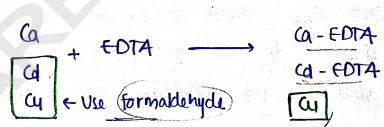
If we want Cu complex, then also use demasking agents again.
Estimation of Magnesium sulphate
It can be determined by complexometric titrations, EDTA is used as titrant.
- Magnesium Sulphate
- Molecular weight 246.4g/mol
Principle
EDTA reacts with Magnesium sulphate and forms complex and for end point use mordant black II as indicator. $$Mg^{2+} + EDTA \longrightarrow Mg-EDTA$$
Procedure
- About 0.3 gm of magnesium sulphate heptahydrate is dissolved in 50ml of distilled water.
- Add 10ml of strong ammonia-ammonium chloride solution.
- Now, this mixture is titrated with 0.05M disodium EDTA, by using 0.1gm of mordant black II mixture as Indicator.
- Titration is continued till the blue color is obtained.
Estimation of Calcium Gluconate:
It is also determined/estimated by complexometric titration by using disodium EDTA as titrant and Mordant black II as Indicator.
- Calcium gluconate
- Molecular weight 430.373 g/mol
Principle
EDTA reacts with calcium gluconate and forms complex and for end point use mordant black II as an Indicator. $$Ca^{2+} + EDTA \longrightarrow Ca-EDTA$$
Procedure
- About 0.4gm of calcium gluconate taken in conical flask and dissolve in 50ml of warm water.
- Add 5ml of 0.05 M disodium EDTA.
- Now, add 10 ml of strong ammonium - ammonium chloride solution.
- Add 2-3 drops of mordant black II as Indicator.
- Titration is continued till color changes from wine red to pure blue (indicates the end point).
GRAVIMETRY ANALYSIS
CHAPTER-3
UNIT-3
SYLLABUS
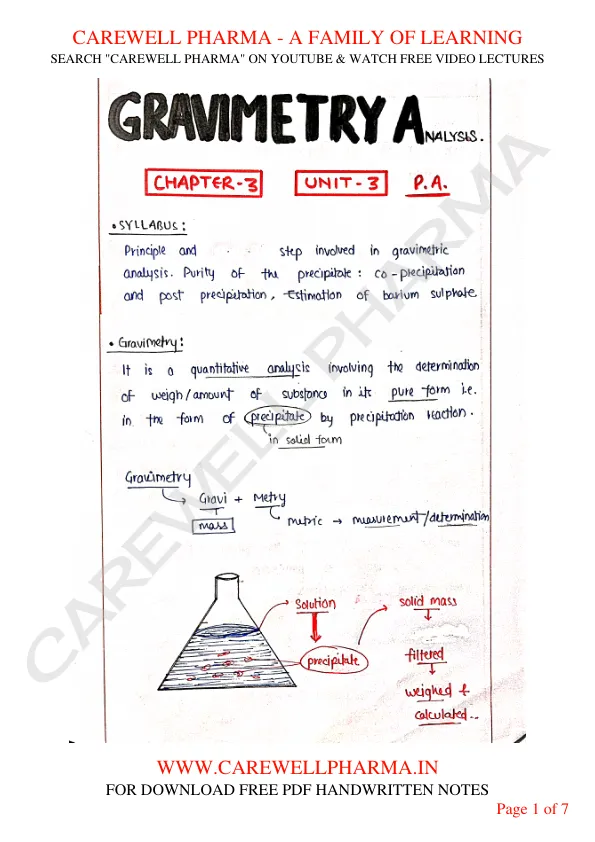
Principle and step involved in gravimetric analysis. Purity of the precipitate: co-precipitation and post precipitation, Estimation of barium sulphate.
Gravimetry
It is quantitative analysis involving the determination of weight/amount of substance in its pure form i.e. in the form of precipitate by precipitation reaction.

PRINCIPLE
It is based on the principle that it involve the conversion of ions/element to its pure form by precipitation reaction, which can be easily weigh and quantify.
STEPS INVOLVED IN GRAVIMETRY
It involves the several steps
- Sampling - preparation of solution.
- Precipitation
- Digestion / Ostwald ripening
- Filteration
- Washing
- Drying / Ignition
- Weighing
- Calculation
1. Sampling
- firstly we have to prepare solution by dissolving of substance in a solvent in which it dissolved and reaction take place.
- the suitable substance/sample is withdrawn from the bulk material.
- eq
- Barium chloride + Conc. H2SO4 Barium sulphate ppt + 2HCl
2. Precipitation
- Precipitation is a process of formation of a solid in a solution, when a chemical reaction take place.
- Precipitation is necessary to convert substance into its pure form.
- Now, for preparation of precipitate, we have to add precipitating reagent for make a precipitate of substance in a solution.
eq. dil
3. Digestion / Ostwald ripening
- It is a process, in which the particles of smaller precipitate is converted into larger one by allowing a precipitate to stand in the presence of mother liquor.
- Mother liquor is a solution that contain precipitate.
- In this, precipitate is allowed to stand for 12-24 hours at room temp.
- to increase the rate of digestion, temperature is raised.
4. Filteration
- In this process, precipitate is separated out from the mother liquor by using filter paper i.e. Whatman's filter paper.
- the filter paper used retains the solid which is termed as residue and allows the liquid to pass through it which is collected below is called filtrate.
5. Washing
- Now, during this process, precipitate are contaminated with some impurities.
- So, we have to wash that precipitate by using warm water or with suitable solvent for remove the impurities from the precipitate.
6. Drying
- Drying or Ignition is used to remove the water from the precipitate which occurs during washing.
- The drying can be done by heating at to for 1 to 2 hours.
- Ignition can be done at much higher temperature, which is usually required if precipitate must be converted to a more suitable form for weighing.
7. Weighing
- After drying, take residue (precipitate) in room temperature and weigh accurately on analytical balance.
8. Calculation
where,
- Gravimetric factor
- weight of residue (precipitate)
- weight of sample.
PURITY OF PRECIPITATE
When the precipitate is separate out from the solution, it is not always pure i.e. the precipitate is contaminated with some amount of impurities.
These amount of impurities depends upon the nature and condition of precipitate.
It is mainly of two types
- Co-precipitation
- Post-precipitation
1. Co-precipitation
It is a condition/process in which the precipitate is contaminated during formation of precipitate (during gravimetry) by those substance which are soluble in mother liquor.
- It is mainly of two types
a) surface adsorption: In this, impurities are adsorbed on the surface of precipitate.
b) Occlusion: In this, Impurities get trapped inside precipitate during growth of precipitate crystals.
eq. adsorbs on precipitate in alkali nitrates.
2. Post-precipitation
It is a condition/process in which the impurities get adsorbed on the surface of precipitate after its formation (After formation of precipitate).
- It mainly occurs when the precipitate is allow to stand in presence of mother liquor.
ESTIMATION OF BARIUM SULPHATE
In gravimetry analysis, the amount of sulphate is estimated quantitatively as barium sulphate.
- Barium sulphate -
- Molecular weight - 233.4g/mol
Principle
In this, dil. Sulphuric acid ($H_2SO_4$) is added to the dil. solution of barium chloride ($BaCl_2$) which forms the white precipitate of Barium sulphate. $$BaCl_2 + H_2SO_4 \rightarrow BaSO_4 \downarrow + 2HCl$$
Procedure
- firstly, we have to prepare solution of
- Sample take 20.08 gm of and dissolved in 1000 ml of distilled water.
- take 3ml of conc. and dissolved in 100 ml of distilled water.
- Pipette out 25ml of solution into 500ml beaker.
- Add 0.5 ml of conc. in a solution and make volume upto 100ml with distilled water.
- Now heat the solution and make solution hot.
- Add dil. dropwise in solution until the precipitate is not separated out.
- Now, filtered, washed and dried it.
Calculation
APPLICATIONS OF GRAVIMETRY
- used in analysis of standard solutions.
- used in analysis requiring accuracy i.e it is time consuming but show better accuracy (accurate result).
- used in determination of chloride as silver chloride, lead as chromate etc.
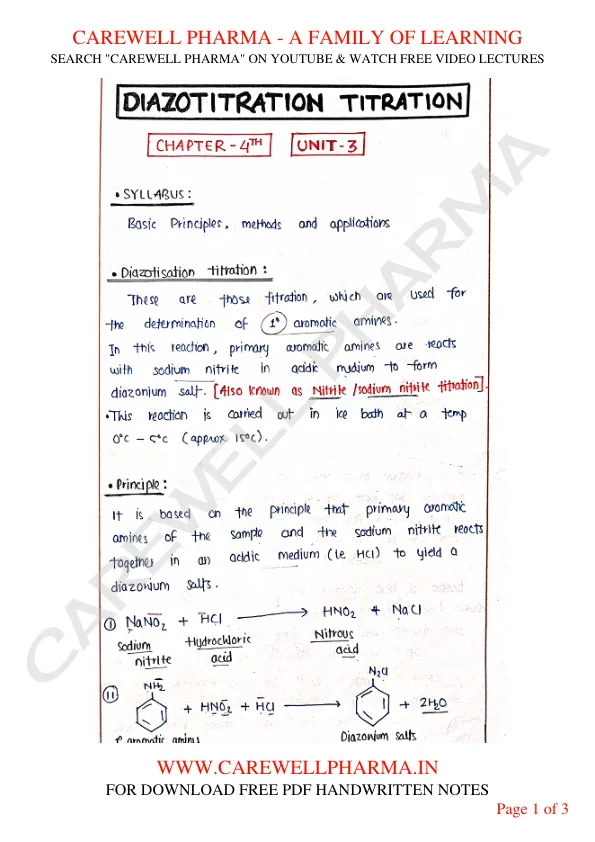
DIAZOTITRATION TITRATION
CHAPTER-4TH
UNIT-3
SYLLABUS
Basic Principles, methods and applications.
Diazotisation titration
These are those titration, which involve the determination of primary aromatic amines.
In this reaction, primary aromatic amines are reacts with sodium nitrite in acidic medium to form diazonium salt.
- This reaction is carried out in ice bath at a temp. ($0-5^\circ C$).
Principle
It is based on the principle that primary aromatic amines of the sample and the sodium nitrite reacts together in acidic medium (i.e. $HCl$) to yield a diazonium salts.

- Firstly sodium nitrite and hydrochloric acid reacts, and sodium chloride and nitrous acid ($HNO_2$) are formed.
- Then this nitrous acid forms a diazonium salt by reacting with aromatic amines.
End Point
- 1. External Indicator - This is starch iodide paper.
- The end point is marked by the formation of a blue color with starch iodide paper, which is prepared by dipping the filter paper in the starch mucilage and potassium iodide solution.
- 2. Potentiometrically indicator - It is used as electrometric method. In this, end point is determined with the help of instrument potentiometer.
Methods
1. Direct method: In this, the amino group containing drug solution, then the resulting sol is immersed in ice water bath ($0-5^\circ C$), which then titrated with sodium nitrite sol$^n$ and the end point is determined by external indicator.
2. Indirect method: In this, the nitrous acid is added to the titration in excess amount, which is back titrated with other appropriate titrant. This method is used for insoluble diazonium salts.
3. Other method: Used for those compound in which oxide group are present, which is not give sharp end point with other two methods.
PROCEDURE/METHODOLOGY
Preparation of 0.1 M sodium Nitrite solution
- 7.5 gm of sodium nitrite is weighed and dissolved in distilled water. After dissolution, volume is made up to 1 litre using distilled water.
Standardisation
- Take 0.5 gm of sulphanilamide (or aromatic amines) is weighed and transfer to beaker.

- 20 ml of and 50 ml of distilled water is added to it, stirred it & cooled to .
- 25 gm of crushed ice is further added and titrated with Sodium nitrite ($NaNO_2$) solution.
- End point is determined with the help of starch iodide paper (glass rod is dipped into solution and touched to starch-iodide paper, deep blue color indicates end point).
Applications
in determination of aromatic amines and also used for determination of sulpha groups (sulphanilamide), procaine hydrochloride etc.
Chapter 1
Chapter 2
Chapter 3
Chapter 4