Pharmaceutical Analysis - Unit 2
Syllabus
Acid base titration: Theories of acid base indicators, classification of acid base titrations and theory involved in titrations of strong, weak, and very weak acids and bases, neutralization curves
Non aqueous titration: Solvents, acidimetry and alkalimetry titration and estimation of Sodium benzoate and Ephedrine HCl
Scroll to Download
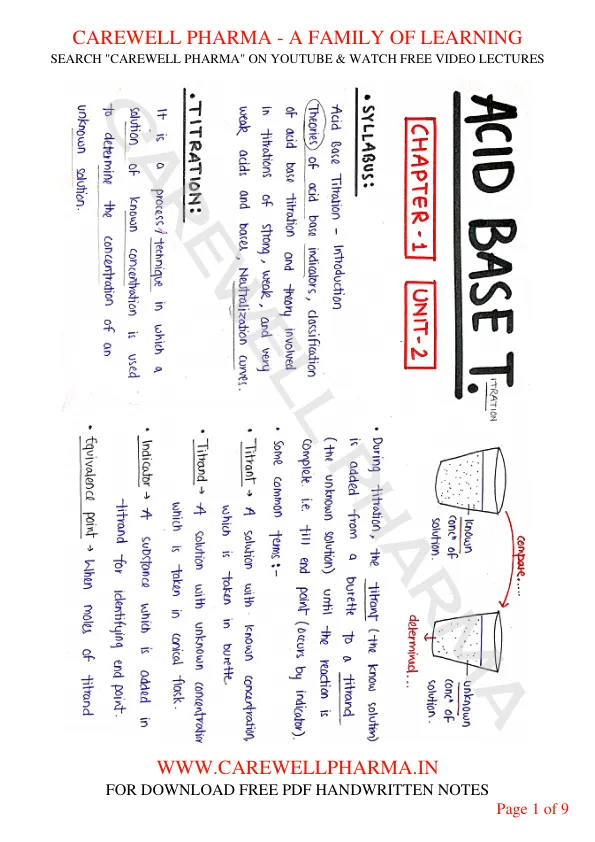
ACID BASE TITRATION
UNIT-2
CHAPTER-1
SYLLABUS
Acid Base Titration Introduction Theories of acid base indicators, classification of acid base titration and theory involved in titrations of strong, weak, and very weak acids and bases, Neutralization curves.
TITRATION
It is a process technique in which a solution of known concentration is used to determine the concentration of an unknown solution.

- During titration, the titrant (the known solution) is added from burette to a titrand (the unknown solution) until the reaction is complete. i.e. till end point (occurs by indicator).
Some common terms
- Titrant: A solution with known concentration, which is taken in burette.
- Titrand: A solution with unknown concentration which is taken in conical flask.
- Indicator: A substance which is added in titrand for identifying end point.
- Equivalence point: When moles of titrand or analyte is equal to the moles of titrant (i.e. known concentration).

- End point The point which indicates that reaction is completed by changing the color of solution.
ACID-BASE TITRATION
It is a quantitative analysis which is used for determination of unknown concentration of acid/base with the help of known concentration of base/acid.
- The principle of acid-base titration is based on the neutralisation reaction, in which acid is react with base and formed salts.

- It is also known as Neutralisation titration.
- Phenolphthalein is the most commonly used indicator for acid-base titration.
Theories:
| THEORY | ACID | BASE |
|---|---|---|
| Arrhenius | producer | producer |
| Bronsted-Lowry | donor | acceptor |
| Lewis | Electron pair acceptor | Electron pair donor |
Acidimetry : It is determination of unknown concentration of acidic solution by std. basic (Standard basic solution).
Alkalimetry : It is determination of unknown concentration of basic/alkaline solution by std. acid (Standard acidic solution).
THEORIES OF INDICATORS
- Indicators: These are those substances which are used in titration for determine end point by changing color of solution.
- Phenolphthalein, Methyl Red etc..
- Theories: These are those theories which explain the working/mechanism of indicators i.e. how they change their color.
Acid-Base Indicators
These are those indicators which are used in acid-base titration.
- They are mainly weak organic acids / bases.
- The principle of acid-base indicator is depends on that they show/produce different color in different solutions based upon the conc$^nof $H^+ ions.
- They change the color of solution when the nature of solution changes (i.e. Acidic to basic or vice-versa). End Point.
- They also known as Visual Indicators.
eg. p-nitrophenol, Phenolphthalein, Methyl orange.
They have mainly two types of theories:
- Ostwald's theory
- Quinonoid theory
1. Ostwald's theory:
Acc. to this theory, Indicators are generally weak acids or weak bases and they change their color on the basis of their ionization state.
- Indicator produce different-2 colors in their ionized and unionized state.

a) When indicator is weak acids
- Now, when indicator is weak acids, it present in unionized form in acidic solution because weak acids does not dissociates (very low) in acidic solution due to common ion effects.
- example - Phenolphthalein ($HPh) $\rightarrow weak acid

- But, these indicator dissociates in basic solution and convert into ionized form and change color.
b) when indicator is weak bases -
- Now, when indicator is weak bases, it present in unionized form in basic solution and ionized form in acidic solution.
- example - Methyl Orange (MeOH$) $\rightarrow weak base

2. Quinonoid theory:
According to this theory, Indicators are present in different tautomeric forms (diff. structure).
- Indicator produce different color in different forms, i.e. Benzenoid form and Quinonoid form.

- Now, in this one form is exist in acidic solution and other one in alkaline/basic and produces color.
- example - Phenolphthalein
- In acidic medium, phenolphthalein is in benzenoid form and colorless.
- While in alkaline medium, it is pink and in quinonoid.

CLASSIFICATION OF ACID-BASE TITRATION
Acid Base titration is based on the neutralization reaction in which acid is react with base and formed salts.
Scale:
Acids: 0 - 7
Bases: 7 - 14
Neutral: 7 ($H_2O$)
Strong acid - Those acids which dissociates completely. pH 0-3
Strong base - Those bases which dissociates completely. pH 11-14
- eg. (Strong acid)
- (Strong base)
Weak acid - Those acids which dissociates partially. pH 3-7
Weak base - Those bases which dissociates partially. pH 7-10

- Based on the nature of an acid and base, these reaction can be classified into :
1. Strong Acid and Strong Base :- In this, strong acid is react with strong base which forms neutral salt.
- Strong Acid (HCl) + Strong Base (NaOH) Neutral Salt (NaCl) + Water ($H_2O$)
- (Sodium chloride)
2. Strong Acid and weak base :- In this, strong acid is react with weak base which forms acidic salt. (due to strong acid).
- Strong Acid (HCl) + Weak Base (NH_4OH$) $\rightarrow Acidic Salt ($NH_4Cl$) + Water ($H_2O$)
- (Ammonium chloride)
3. Weak Acid and Strong Base:- In this, weak acid is react with strong base, which form alkali/basic salts.
- Weak Acid ($CH_3COOH) + Strong Base ($NaOH$) $\rightarrow Basic Salt ($CH_3COONa$) + Water ($H_2O$)
- (Sodium acetate)
4. Weak Acid and Weak Base :- In this, weak acid is react with weak base forms neutral salt.
- Weak Acid ($CH_3COOH) + Weak Base ($NH_4OH$) $\rightarrow Neutral Salt ($CH_3COONH_4$) + Water ($H_2O$)
- (Ammonium acetate)
NEUTRALIZATION CURVE
During Acid Base titration, acid is neutralized by base.
Now, that time during titration the pH of acid is changes when base is added in it.
So, Neutralization curves are those graph/curve in which pH is plotted against the volume of alkali/base added during titration.
- In case, when base is neutralized, pOH is plotted against the volume of acid added.
- It is also known as titration curve.

It is of four types
I. Strong Acid Vs Strong Base
II. Strong Acid Vs Weak Base
III. Weak Acid Vs Strong Base
IV. Weak Acid Vs Weak Base
1. Strong Acid Vs Strong Base
- In this, strong acid is neutralized by strong base.

- In this, the curve begins acidic then rises gradually.
- Near equivalence point, pH increases at greater speed and then turns into basic.
- Equivalence point at pH=7.
- Phenolphthalein, bromo thymol blue and methyl red are used as Indicators.
- For neutralization of strong base, the curve is obtained identical.
2. Strong Acid Vs Weak Base
- In this, strong acid is neutralize by weak base and formed acidic salt whoose equivalence point is slightly less than 7

- In this, the curve begins acidic and turns basic.
- Due to strong acid, its equivalence point is pH<7.
3. Weak Acid vs Strong Base
- In this, weak acid is neutralized by strong base which formed basic salt, whoose equivalence point is slightly more than 7 i.e. (pH>7) due to presence of strong base.

4. Weak Acid Vs Weak Base
- In this, weak acid is neutralized by weak base which formed neutral salts, whoose equivalence point is about 7 (pH=7).

- In this, the curve begins acidic (above 3) and turns basic.
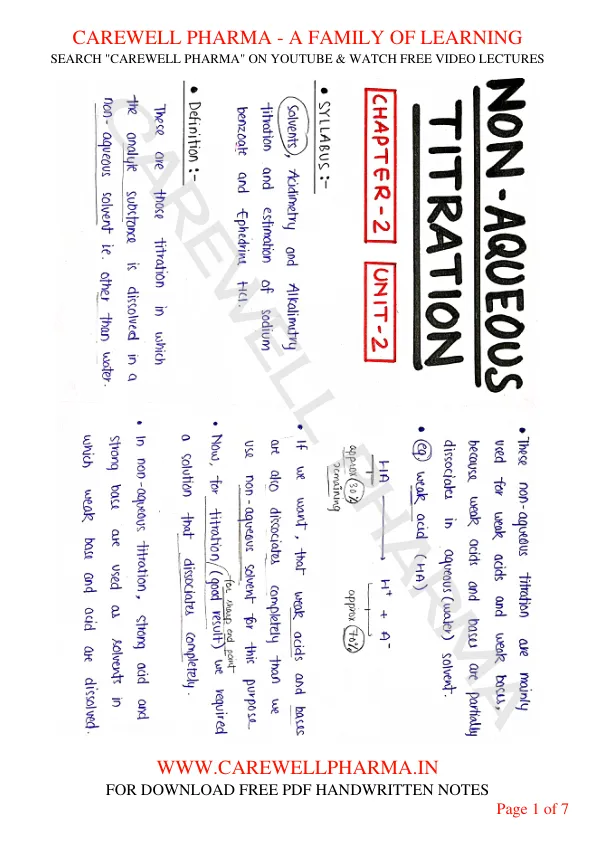
NON-AQUEOUS TITRATION
UNIT-2
CHAPTER-2
SYLLABUS
Solvents, Acidimetry and Alkalimetry titration and estimation of sodium benzoate and Ephedrine HCl.
Definition - These are those titration in which the analyte substance is dissolved in a non-aqueous solvent i.e. other than water.
- These non-aqueous titration are mainly used for weak acids and weak bases, because weak acids and bases are partially dissociates in aqueous (water) solvent.
- eq weak acid (HA)

- If we want, that weak acids and bases are also dissociates completely than we use non-aqueous solvent for this purpose.
- for sharp end point
- Now, for titration (good result) we required a solution that dissociates completely.
- In non-aqueous titration, strong acid and strong base are used as solvents in which weak base and acid are dissolved.

Mechanism
for weak acid (HA)
- acid/base
- HA
- Used non-aqueous solvents
- 30%
- weak acid/base
Acc. to Bronsted-lowry concept, those substances which donate/release ions are acids, and those who accepts ions are bases.
- eq. (Acid) ($H^+$) (Base)
Now, for weak acid use strong base and for weak base use strong acid. 70% not dissociates use strong base, accept ions help in dissociate completely.
for weak base (B) accept ions use strong acid, donate ions helps in dissociate completely.
SOLVENTS
These are those substances which are non-aqueous (other than water) in which a solute particles is dissolved.
- These are of four types
- Protogenic
- Protophilic
- Aprotic
- Amphiprotic
1. Protogenic Solvents : (proto + genic proton generator donor)
- These are those solvents which are acidic in nature. these solvents are used for weak base.
- Sulphuric acid ($H_2SO_4$), Hydrogen fluoride, (Nitric acid) etc..
2. Protophilic solvents : (Proto + philic proton lover acceptor)
- These are those solvents which are basic in nature and these solvents are used for weak acid.
- Dimethylformamide ($(CH_3)_2NCOH$), Pyridine ($C_5H_5N$).
3. Aprotic solvents : (A + protic absent proton)
- These are those solvents which are neither acidic and nor basic, they considered as neutral and used for neutral substances.
- Hexane ($C_6H_{14}$), Carbon tetrachloride ($CCl_4$).
4. Amphiprotic Solvents : (Amphi Both)
- These are those solvents which are acidic as well as basic in nature.
- They contain both protogenic and protophilic properties.
- Water ($H_2O$), Ethanol ($C_2H_5OH$) etc..
Advantages of Non-aqueous solvents -
- Water insoluble drugs are easily soluble.
- helps in titration of weak acids and bases.
- to provide sharp end point.
Frequently used solvents -
- Glacial Acetic Acid
- Acetonitrile
- Alcohols
- Dimethyl formamide
- Dioxane
LEVELLING EFFECTS
These are those effects which level the acidity or basicity of any acid or base.
It also refers to the effects of solvents and properties of both acid and base.
eg: (aqueous water)
- These strong acid gives complete dissociation in aqueous medium, but a weak acid i.e Oxalic acid show acidic character and does not completely dissociate. $$COOH$$ $$|$$ $$COOH$$ (approx. 70%)
- So, when we use non-aqueous solvent instead of water, then it gives complete dissociation. $$COOH \quad \quad COO^-$$ $$| \quad + \quad NH_3 \quad \rightarrow \quad | \quad + 2H^+$$ $$COOH \quad \text{(ammonia)} \quad COO^-$$ (Complete dissociation)
- So, we levelled the acid by using non-aqueous solvent and that is called levelling effects.
TYPES OF NON-AQUEOUS TITRATION
It is classify into two types :-
- Acidimetry
- Alkalimetry
Indicators :
those which are used in non-aqueous titration. i) Crystal violet (violet to greenish yellow) light green
ii) Methyl Red (Yellow to Red)
iii) Naphthol Benzoin (Yellow to Green)
iv) Thymol Blue (Pink to Blue)
1. ACIDIMETRY
It is determination of unknown concentration of basic/alkaline solution by using standard acidic solution.
- In non-aqueous, concentration of weak base is determined by using strong acidic solution.

- In this, samples are Ephedrine, Morphine, Adrenaline, Caffeine etc...
- Protogenic solvents (acids) are used eq Nitric acid, glacial acetic acids.
- Titrant used are strong acid ($HClO_4$). Perchloric acid.
- Indicator used in this titration is crystal violet which changes from violet to light green.
2. ALKALIMETRY
It is determination of unknown concentration of acidic solution by using standard basic solution.
- In non-aqueous, concentration of weak acid is determined by using strong basic solution.

- In this, samples are Acetazolamide, Nalidixic acid etc.
- Protophilic solvents (base) are used. Dimethylformamide (DMF), Pyridine ($C_5H_5N$).
- Titrant used are strong base. Sodium Methoxide ($CH_3ONa$).
- Indicator used in this titration is thymol blue which changes from pink to blue color.
Estimation of Sodium Benzoate
It is used in the determination of unknown concentration of sodium benzoate.
- The assay of sodium benzoate is based on non-aqueous titration.


- In this, we take Sodium benzoate in a conical flask (as unknown conc$^n$) as analyte (titrand).
- Take 0.1N as titrant.
- Use crystal violet as indicator.
Preparation of 0.1N
Gradually mix 8.5ml of perchloric acid into 900ml of glacial acetic acid with vigrous and continuous stirring.
- Now, 30ml of acetic anhydride and make up the volume upto 1000 ml and stand for 24 hours before use.
Procedure
- Take 0.25 gm of Sodium Benzoate and dissolve in 20ml of glacial acetic acid (act as solvent).
- Warm the solution if required.
- Cool and add 2-3 drops of crystal violet indicator.
- Titrate against 0.1N perchloric acid ($HClO_4$) till the appearance of light green (end point).
- Blank titration is also carried out to reduce the errors.
Calculation
Molecular weight of Sodium Benzoate = 144.19 So, 1ml of 0.1N Sodium Benzoate = 0.01441g
Estimation of Ephedrine HCl
- It is used in determination of unknown conc$^n$ of Ephedrine HCl.

- Titrant 0.1 N perchloric acid ($HClO_4$)
- Crystal Violet as Indicator.
Procedure
- About 0.5gm of accurately weighed Ephedrine HCl is dissolved in 25ml of glacial acetic acid and 10ml of mercuric acetate solution and shaken well.
- Now titration is performed with 0.1N (perchloric acid) using crystal violet as indicator light green color act as endpoint.
Calculation
Each ml of perchloric acid = 0.02017 gm of Ephedrine HCl
Precautions
- Dry and clean glass apparatus should be used.
- Non-aqueous solvents should be handled carefully.
Chapter 1
Chapter 2