Pharmaceutical Analysis - Unit 1
Syllabus
1. Pharmaceutical analysis
- Definition and scope
- Different techniques of analysis
- Methods of expressing concentration
- Primary and secondary standards.
- Preparation and standardization of various molar and normal solutions- Oxalic acid, sodium hydroxide, hydrochloric acid, sodium thiosulphate, sulphuric acid, potassium permanganate and ceric ammonium sulphate
2. Errors: Sources of errors, types of errors, methods of minimizing errors, accuracy, precision and significant figures
3. Pharmacopoeia, Sources of impurities in medicinal agents,limit tests.
Scroll to Download
PHARMACEUTICAL ANALYSIS
UNIT-1
CHAPTER-1
Syllabus
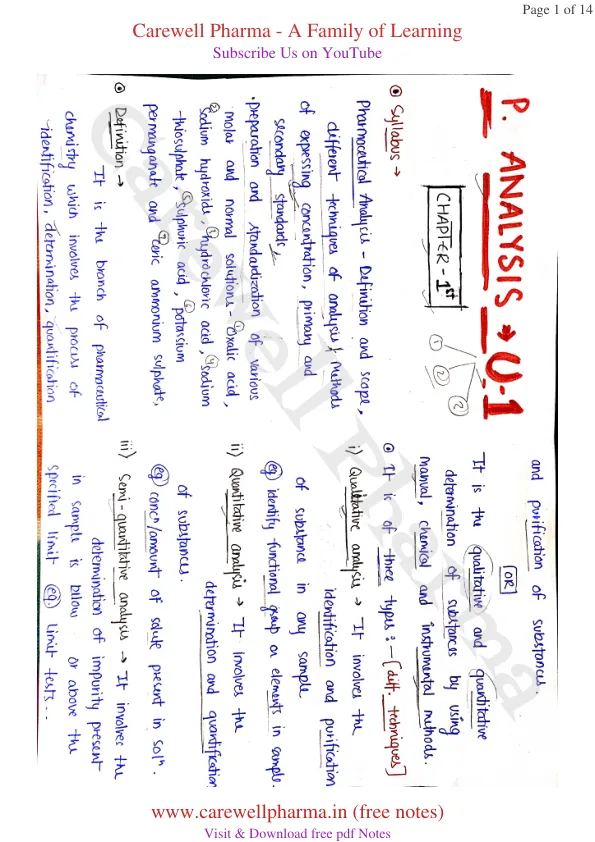
Pharmaceutical Analysis - Definition and scope, different techniques of analysis & Methods of expressing concentration, primary and secondary standards.
Preparation and standardization of various molar and normal solutions - Oxalic acid, Sodium hydroxide, Hydrochloric acid, Sodium thiosulphate, sulphuric acid, potassium permanganate and Ceric ammonium sulphate.
Definition
It is the branch of pharmaceutical chemistry which involves the process of identification, determination, quantification and purification of substances.
OR
It is the qualitative and quantitative determination of substances by using manual, chemical and instrumental methods.
It is of three types
i) Qualitative analysis : It involves the identification and purification of substance in any sample.
- eg. identify functional group or elements in sample.
ii) Quantitative analysis: It involves the determination and quantification of substances.
- eg. conc$^n$/amount of solute present in sol$^n$.
iii) Semi-quantitative analysis: It involves the determination of impurity present in sample is below or above the specified limit.
- eg. Limit tests.
Scope of Analysis
Pharmaceutical analysis play an major role in production of an effective, safe and pure drug.
It is used in following fields -
Quality Control - to ensure the quality of raw materials, intermediate, and finished products.
Identification of compounds - to detect the presence or absence of one or more components in the drug.
Determination of impurity - to determine the amount of impurities and the amount of pure components.
Farming - to know the amount of essential nutrients for the plant growth.
Diagnosis - to diagnose the cause of any illness.
Others -
- food determination
- Biological sample determination
- Dairy product
- Forensic
- soil study
- research etc...
Different techniques of analysis
It is of two types :-
i) Instrumental: In this instruments are used for analysis. It further divided into several types.
ii) Non-Instrumental: In this instruments are not used for the analysis of sample.
It involves titrations and chemicals.
- eg Titration & Gravimetry.

Methods of expressing concentration
- These are those methods which are used to find out the concentration/amount of drug present in any solution.
- Concentration: is basically the amount of solute mixed with solvent.

They are expressed by following terms
i) Molarity or Molar concentration.
ii) Molality or Molal concentration.
iii) Normality or Normal concentration.
iv) Formality or Formal concentration.
v) Mole fraction and mole percentage.
vi) Percentage calculation.
vii) Parts per million (PPM).
i) Molarity
- Also known as molar concentration and denoted by Capital 'M'.
- It is defined as, no. of moles of solute dissolved in one Litre (1L) of solution.
- Mole: It is the fundamental unit which is used to measure the amount of substances (solute).
ii) Molality
- Also known as molal concentration and denoted by small 'm'.
- It is defined as, no. of moles of solute dissolved in one kg of solvent.
iii) Normality
- Also known as Normal Concentration, and denoted by Capital 'N'.
- It is defined as, no. of gram equivalent of solute dissolve per litre of solution.
(ions given or $OH^-$)
eg. find out normality of , 49g of present in 500 ml of sol$^n$. mol. wt. 98.
- Gr. Eq. weight = (2 is acidity)
- No. of Gr. eq. =
iv) Formality
- It is defined as, the no. of gram formula weight of solute dissolved in One Litre of solution. (ionic compounds)
- It is denoted as 'f'.
v) Mole fraction
- It is define as, the ratio of no. of moles of solute to the total no. of moles of solute and solvent.
(total mol)
vi) Percentage Calculation
Also known 'percentage concentration'.
% by weight of solute i.e.
% by volume of solute i.e.
% of weight of solute by vol. of solution.
vii) Parts per million (ppm)
- It is the parts of solute in one million parts of solution.
- It is used for very less quantity conc$^n$ substances.
STANDARD SOLUTIONS
These are those solutions which have accurately known concentration and which is highly pure and which further use for standardization.
Standardization - to make solution standards.
It is of two types:-
- Primary standards
- Secondary standards
i) Primary Standards
- These are those solution which are prepared through highly pure reagents or chemicals and they have accurately known concentration.
- We do not required further standardization.
eg: Sodium Carbonate, oxalic acid, silver nitrate etc..
Properties
- Highly pure, less reactive and stable.
- Highly soluble, non-toxic and eco-friendly.
ii) Secondary Standards
- These are those solution which are less stable and standardized by using primary standard solutions.
- They are mainly used for quantitative analysis.
- They are used for standardization of other substances.
Properties
- Less pure and more reactive than 1$^\circ$ standard.
- Less stable.
eg: Sulphuric acid ($H_2SO_4$), Potassium Permanganate ($KMnO_4$), HCl (Hydrochloric acid) etc..
PREPARATION AND STANDARDISATION OF VARIOUS MOLAR AND NORMAL SOLUTIONS
Preparation - It is the process in which pre-weighed standard solutes (drugs) dissolved in solvent.
Standardization - preparation of standard sol$^n$.
Molar solution - Molarity ($Moles/V. of sol^n$)
Normal solution - Normality ($No. of Gr. eq./V. of sol^n$)
Molecular weight - total mass of all element of any compound.
eg
Following compounds
- Oxalic acid
- Sodium Hydroxide
- Hydrochloric acid
- Sodium thiosulphate
- Sulphuric acid
- Potassium permanganate
- Ceric ammonium sulphate.
1) Oxalic acid
Mol. weight 126 g/mol.
Preparation of 0.1 M oxalic acid
- dissolved in 1000 ml. So,
- for 0.1M dissolved 12.6 g oxalic acid into 1000 ml.
Preparation of 0.1 N Oxalic acid
- for dissolved Oxalic acid into 1000 ml. So,
- for 0.1 N = dissolve 6.3 g oxalic acid into 1000 ml solvent.
No need of standardization (1$^\circ$ standards).
2) Sodium Hydroxide
Mol. wt , Acidity
Preparation of 0.1 M NaOH
- dissolved NaOH in 1000 ml. So,
- for 0.1M dissolved 4g (approx.) NaOH in 1000ml.
Standardization through (titration)

- titration with potassium biphthalate and phenolphthalein used as indicator.
- pink color indicates end point.
- Repeat till two concordant results.
Preparation of 0.1 N NaOH
for = 4g NaOH dissolved in 1000 ml.
Standardization
- Titration with 0.1 N oxalic acid [5ml].
- Pherophthalein indicator - faint pink color end point.
3) Hydrochloric acid
- Acid add in water
- Not water in acid , Mol. wt (mass) 36.46 g/mol Basicity
Preparation of 0.1M HCl sol
- for 37% of HCl sol$^n$, add 8.5 ml of conc$^n$ HCl sol$^n$ in 1000 ml of distilled water.
Standardization 0.1M
- By using THAM, Bromocresol indicator, pale yellow endpoint.
Standardization for 0.1N HCl
- By using 0.1 N of sodium carbonate, methyl orange indicator - faint red end point.
4) Sodium thiosulphate
, Mol. wt 248.18
for 0.1 M = dissolve 25gm of sodium thiosulphate in 1000 ml of distilled water.
Standardization - By using potessium iodate.
(for 0.1N dissolve 25 g sodium thiosulphate and 0.2g of sodium carbonate in 1000 ml water.)
5) Sulphuric Acid
Mol. wt 98g, Basicity
Preparation of 0.1M
- Add 6ml of into 1000 ml of water.
Standardization
- By using Sodium carbonate sol$^n$ (0.2gm in 100ml), methyl red indicator, faint pink color end point.
Preparation of 0.1 N
- Add approx. 3ml of in 1000 ml of distilled water.
Standardization
- By using 0.1 N NaOH sol$^n$ phenolphthalein indicator, end point - pink color.
6) Potassium permanganate - - 158g
For 0.02M
- for 1M 158g in 1000 ml
- for 0.02M approx
- in 1000ml water.
For 0.1 N
- add 3.2 gm of potassium permanganate in 1000 ml.
7) Ceric ammonium sulphate
0.1M
- By applying gentle heat, about 65 gm of ceric ammonium sulphate is dissolve in mixture of (30ml) and 500 ml of water.
- then volume upto 1000 ml.
0.1N
- Same.
ERRORS
CHAPTER-2ND
Syllabus
Introduction, Sources, Types, Methods of minimizing errors, Accuracy and Precision, Significant figures, Identifying significant digits, Rounding-off digits, Rules for retaining significant figures.
Errors : It is defined as, it is the difference between the standard/true value to the observed value.
eg: Paracetamol 500mg (standard) during observation 450 mg find.
- Error ? (Correction from source: 500-450 = 50)
Sources of errors :
- Error can be occured due to improper sampling or sample preparation.
- It can be occured by analyst, due to lack of knowledge and focus.
- Due to improper calibration in equipments.
- Due to incorrect observation and data.
- Due to wrong calculation.
- Due to any type of impurities present in sample.
- Due to wrong method selection.
- During transport and storage - Due to improper handling.
Types of Errors :-
It is mainly of three types :- i) Systemic error (Determinate) ii) Random error (Indeterminate) iii) Gross (total) errors
i) Systemic Errors / Determinate errors
- These are those error, which occurs during analysis by analyst, due to wrong procedure or instruments.
- These errors can be prevented or minimised.
- eg. Incorrect formula used by analyst for calculation.
- These errors can be further divided into following types:-
- Personal error: Those errors which occurs due to personal mistakes or carelessness of analyst. It may be due to lack of knowledge. eg improper sampling, color blindness.
- Instrumental error: It occurs due to defect in instrument.
- Methodic error: Sometimes, analyst choose wrong method which cause errors.
- Reagents error: It occurs due to any impurities in reagents.
ii) Random Errors / Indeterminate errors
- These are those errors, which occurs randomly, and which are unpredictable and difficult to identify.
- Analyst has no control over these types of error, so elimination and prevention of these types of error may not possible.
- eg. Error occurs due to temp and humidity.
METHODS OF MINIMIZING ERRORS
Errors can be minimized by following methods :-
1) Calibration of Instruments/apparatus
- Calibration is the process by which we check the correctness of instruments and apparatus by using Standard reading and value.
- By using Calibration, we minimised those determinants errors which occurs due to instruments or apparatus (glasswares etc.). (eg measuring cylinder).
2) Blank determination
- In this, analysis is performed with or without sample to identify impurities in reagents and solvents and minimize them.
3) Control determination
- In this, standard solution are used for analysis and compared with the normal determination.
4) Independent methods
- In this, we perform the analysis of any substances by two or more different-2 methods and then compare to find error and minimize them.
5) Parallel determination
- In this, we perform the analysis of any substances more than two times (three times) and then compare to find errors and minimize them.
- [Diagram: A-substance 1, 2, 3 (same method)]
ACCURACY AND PRECISION
These are those processes which tell us about the correctness of observation of any analysis.
1) Accuracy :- It is defined as, it is the closeness or correctness of the measured value to the standard or true value. (Near to true value)
2) Precision:- It is defined as, it is the closeness of multiple observation to each other. (Repeated Value of measurement).
- They can decreases the chances of error.
Example :- One tablet have to measure the conc$^n$ of drug present in it. Seven students perform this experiments. Standard Value / True value is 500 mg i.e. Paracetamol 500 mg.
Their observations are -
- 490 mg
- 495 mg
- 490 mg
- 505 mg
- 502 mg
- 490 mg
- 499 mg Accuracy (closeness)
Precision i.e. sepratness (repeated value) 490 mg
SIGNIFICANT FIGURES
- These are those numbers or digits which are used to express the observation and results.
- It is mainly based on decimal system and used to define the degree of accuracy.
- (eg. 2.0 2 significant figures).
Rules for Identifying significant digits
- All Non-Zero digits are considered as significants. 123, 1.23, 345 etc (3)
- Zeroes between two non-zero digits are significants. 1001, 1.001, 2.04
- All leading zeroes are non-significants (insignificants). (initial) eg 005, 0.00252
- Trailing zeroes / Ending zeroes are significant, if occurs, after decimal.
- eg 2.70, 2.700 (3, 4)
- others - 2, 270, 2700, 27000
- or are non-significants.
- (2)
- (3)
Rounding-off digits
- It required when we required answer in fixed digits.
Rules for Retaining significant figures
- for addition or substraction, match the decimal.
- 3.57
- 2.65
- +4.60
- = 8.85? (Sum shown as 10.57 in text? 3.57+2.65+4.60 = 10.82. Source text shows calculation: 2.4 + 3.57 + 4.60 -> 10.57)
- Text example: