Human Anatomy And Physiology 1 - Unit 2
Syllabus
Integumentary system
Structure and functions of skin
Skeletal system
Divisions of skeletal system, types of bone, salient features and functions of bones of axial and appendicular skeletal system Organization of skeletal muscle, physiology of muscle contraction, neuromuscular junction
Joints
Structural and functional classification, types of joints movements and its articulation
Scroll to Download
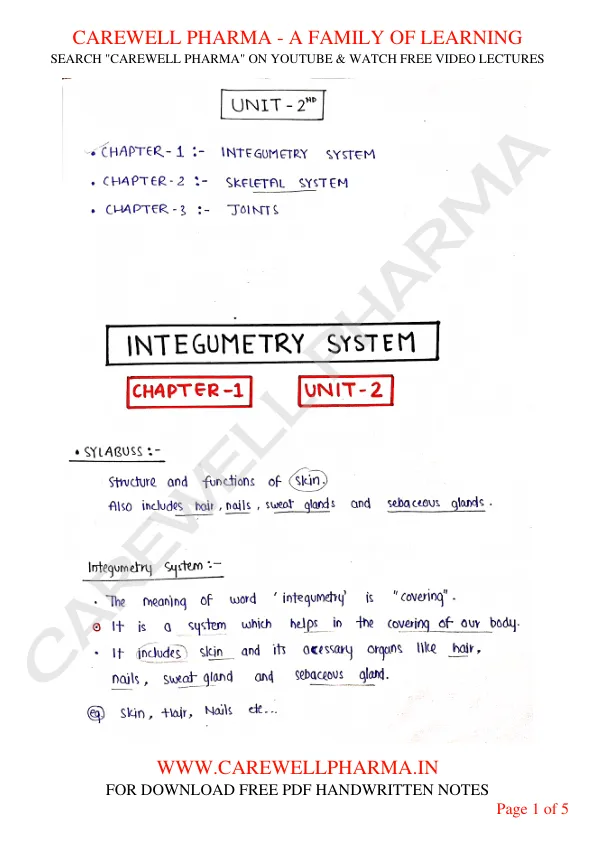
INTEGUMENTARY SYSTEM
CHAPTER-1
UNIT-2nd
SYLLABUS
Structure and functions of skin. Also includes hair, nails, sweat glands and sebaceous glands.
Introduction
- The meaning of word 'integumentary' is "covering".
- It is a system which helps in the covering of our body.
- It includes skin and its accessory organs like hair, nails, sweat gland and sebaceous gland.
eg. Skin, Hair, Nails etc...
SKIN
- It is the largest organ in the human body.
- Also known as Integument.
- It has surface area of and comprises of 16% of the total body weight.
- The thickness of skin varies from eyelids 0.5 mm to 4.0 mm (sole of feet).
- It performs various functions - Most important that it provides protection from the external environments.

TYPES OF SKIN :
It is composed of three layers
- Epidermis
- Dermis
- Hypodermis
1. Epidermis
It is the outermost layer of the skin. It is made up of stratified squamous epithelial tissue.
The major portion of epidermis is made up of keratinocytes (cells) which synthesize a protein called Keratin.
Thickness of epidermis varies from 0.5mm to 1.5 mm (palm) and they do not contain blood vessels.
It is composed of five layers:- (Superficial to bottom)
Stratum corneum (SC) - It is the uppermost layer of skin which contain several layer of corneocytes cells (keratinocytes last phase). It is mainly helps in transdermal penetration of drugs.
Stratum Lucidum (SL) - It is only found in thick skin such as palm and sole of feet.
Stratum Granulosum (SG) - It is the middle layer of epidermis. In this cytoplasm of cell appears granular.
Stratum Spinosum (SS) - It is present above the layer stratum basale. In this keratinocytes cells moves upward to form this layer. It contain Langerhans cells which helps in immunological responses.
Stratum Basale (SB) - It is the deepest layer of the epidermis. It contain dividing and non-dividing keratinocytes. They contain melanin pigments from melanocytes cells, responsible for skin color. It is also responsible for fingerprints.
Dermoepidermal Junction :- It is the junction between the dermis and epidermis layer. It is also referred as basement membrane.

2. DERMIS
It is the second deepest layer of skin, which is lies below the epidermis and made up of a hard supportive cellular matrix (connective tissue).
It contain blood vessels, glands, hair follicles and nerve ending.
It consists of two layers:-
Papillary layer - It is thin and mainly consist of loose connective tissue. It is responsible for the sensation of touch, pain, hot and cold etc...
Reticular layer - It is thick and mainly consist of dense connective tissue. It contain fat cells, glands, hair follicles and blood vessels. It is responsible for the strength of skin.
3. Hypodermis / Subcutaneous layer
It is the last layer of skin and sometimes it does not considered as a part of skin.
- It attaches the skin to the underlying muscles.
- It is composed of loose connective tissue and adipose tissue i.e. contain fat cells.
FUNCTIONS OF SKIN
- Sensation - It contains numerous nerve endings which helps in the sensation of touch, pressure, hot and cold (temp) and pain.
- Protection - Skin act as physical barrier and protects internal organs from external environment. (UV rays, heat, virus etc)
- Absorption - It helps in absorption of various drugs from transdermal routes. (diffusion, active transport etc..)
- Secretion - Skin helps in the secretion of sweat from sweat gland and sebum from sebaceous glands.
- Regulation - It helps in the regulation of temperature of body by secreting sweat or other mechanism.
- Excretion - It also helps in the excretion of toxic substances, ions, drugs and others through sweat.
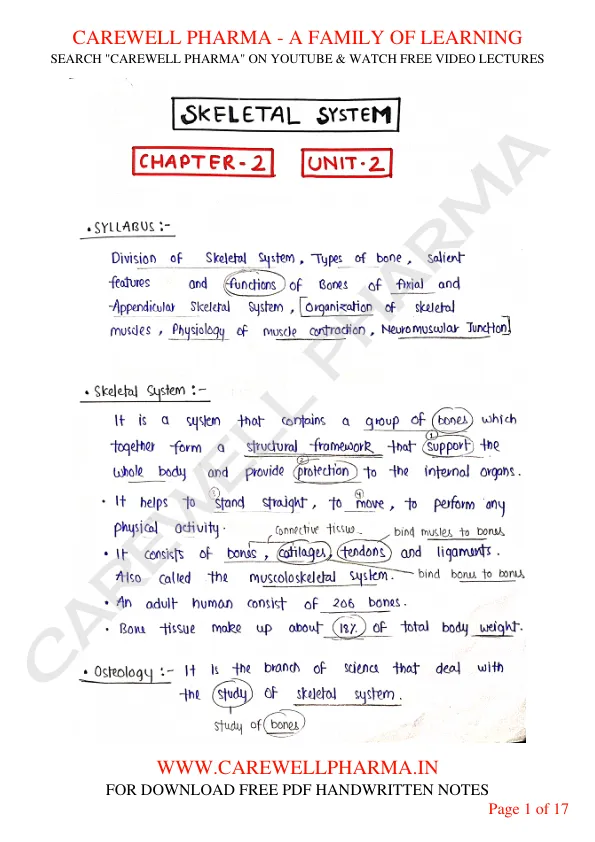
SKELETAL SYSTEM
CHAPTER-2
UNIT-2
SYLLABUS : Division of Skeletal System, Types of bone, salient features and functions of Bones of Axial and Appendicular Skeletal system, Organization of skeletal muscles, Physiology of muscle contraction, Neuromuscular Junction!
Skeletal System :
It is a system that contains a group of bones which together form a whole body structural framework that support the body and provide protection to the internal organs.
- It helps to stand straight, to move, to perform any physical activity.
- It consists of bones, Cartilages, tendons and ligaments Also called the musculoskeletal system.
- An adult human consist of 206 bones.
- Bone tissue make up about 18% of total body weight.
Osteology : It is the branch of science that deal with the study of skeletal system. (study of bones)
BONES
Bone is the hardest connective tissue which makes up the body's skeletal system and performs various functions, such as movement, protection & structural framework.

It basically consist of two parts :-
Diaphysis
Epiphysis
Diaphysis :- It is long, cylindrical and main portion of bone. It contain red and yellow bone marrow which help in the production of blood.
Epiphysis :- It is the end part of bone, they are spongy in nature. Cartilage is present upon these epiphysis, also connected through this end of bone.
TYPES OF BONES
There are mainly six types of bones:
- Long Bones: they have longer lengths as compare to width. they are strong which support the body.
- eq. femur, fibula, tibia, humerus, radius, ulna.
- Short bones :- they have almost equal length and width. helps in movement, bones of ankle and wrist.
- eq. Carpals and Tarsals.
- Flat bones: they have thin and flat structures.
- eq. skull bones, sternum (protection to internal organs)
- Irregular bones: - they have complicated shapes which are different but perform a specific function.
- eq. vertebral column and facial bones (protection)
- Sesamoid bones: - small rounded bones develop in some tendons.
- eq. patellae (knee caps).
- Sutural bones: - these are very small bones found within the sutural joints in between the cranial bones.
- eq. present in Cranium.
DIVISIONS OF SKELETAL SYSTEM
The human skeletal system can be broadly divided into two groups:-
- Axial Skeleton
- Appendicular skeleton

APPENDICULAR SKELETON
It is the body framework of upper and lower limbs and their supporting girdles including total 126 bones. they mainly helps in the movement and performing various physical activity. they mainly consist of
- Upper limb (60)
- Lower limb (60)
- Pectoral girdles (4)
- Pelvic girdle (2)
(i) Upper limbs total 60 bones
- Each upper limb consists of 30 bones.

- Humerus (Arm Bone) - It is longest bone of the fore limb. It helps in pull, push, lift, rotation etc..
- Ulna and Radius - is present at thumb side and shorter than ulna.
- Carpals - these are 8 irregular shapes wrist bones helps in rotation.
- Metacarpals - these are 5 hand bone formed palm of hand.
- Phalanges - these are finger bones consist of 14 bones. All finger contain 3 bones except thumb which contain 2 bone.
(ii) Lower limbs total 60 bones
- Each lower limb contain 30 bones.

- Femur is the strongest and longest bone in the body.
- Tibia and Fibula are two bones present lower region, Tibia is larger than fibula and present at thumb side.
- Patella is a sesamoid bone present at the knee joint.
- Tarsals are 7 bones of ankles
- Metatarsals are 5 bones of sole.
- Phalanges are 14 bones that form toes (fingers of foot), all fingers contain 3 bones except thumb which contain 2 bone
(iii) Pectoral Girdle total 4 bones
It is also present in pair (Left & Right), in which two clavicle and Scapula present, which attach the bones of upper limbs.

- Clavicle (Collar Bone) is 'S' shaped long and narrow structure bone, present on both the side of neck. It connects the upper limbs with trunk (Just above ribs).
- Scapula is a flat triangular shape bone that connect clavicle to the humerus. Also known as shoulder blade.
(iv) Pelvic Girdle It is hip bones also present in pair. It is an irregular, arch shaped structure made up of coxal or innominate bones.

* It is made up of three distinct bones which are separate in children, but fuse completely as the child grows.
AXIAL SKELETON
These are those bones which helps in the formation of 'body axis'. It supports and protects the skull, neck and the trunk region (heart, lungs, brain).
- There are (80) bones in adult and 87 bones in childs.
- It consist of :-
- Vertebral column (vertebrae) - 26
- Skull (face 14 + cranium 8) + Ear ossicle 6 + Hyoid bone 1
- Thoracic cage: Ribs - 24 (12+12) + Sternum - 1
1. VERTEBRAL COLUMN
It is the backbone of our body which is made up of vertebrae which contain 26 bones. Also known as spine. It provides protection to the spinal cord and its membrane.

- Cervical: There are 7 cervical vertebrae, externally forming the neck region. first vertebrae name is Atlas.
- Thoracic: There are 12 thoracic vertebrae, on which ribs are connected.
- Lumber: There are 5 lumber vertebrae, they are strongest and present above the pelvic region.
- Sacrum: There are 5 sacral vertebral, fused formed 1.
- Coccyx: It is the last part of vertebral column and formed by the fusion of 4 coccygeal vertebrae. (1)
Functions of Vertebrae
- maintenance of body balance. It forms a supporting framework for the trunk of the body.
- It provide the protection to the spinal cord and its membrane.
- It supports the upper limbs and head to make them freely movable.
2. SKULL
- It is located over the vertebral column (along the vertical axis) which comprises of 28 bones.
- All bones are immovable, except mandible.
- It consist of: The cranium (8), The face (14), Ear ossicle (6).
- It helps in the protection of brain and face.

CRANIUM : It is a spherical box like structure contain flat and irregular shaped bones that provide protection to the brain.
- frontal bone is a thick plate like structure that forms the forehead.
- Parietal bones forms the side and roof of the skull.
- Temporal bones are 2 bones present along the ear and forms immovable Joints.
- Occipital bone present at the back of skull and forms back of head and base of skull.
- Sphenoid bone is a bat like structure present in the centre of the skull.
- Ethmoid bone is present in the anterior part of skull and separates the brain.
FACE :
It is facial skeleton, also called as visceral skull which forms the framework for face. they contain 14 bones which provide protection to eye, mouth nose and attach the teeth.
- All bones are immovable except mandible, which helps in the chewing food.

- Nasal Bones: It provide flexibility and help in the formation of the nasal bridge. It present in pair (2).
- Maxilla: These are the paired bones of the upper jaw. This bone is responsible for holding the upper teeth. (2)
- Zygomatic bones: These are cheek bones present in pair (2).
- Lacrimal bones: present near nasal bone, smallest bone and support lacrimal ducts responsible for lacrimation. (2)
- Mandible: It is the strongest as well as largest bone, It forms lower jaw and keeps the lower teeth. It is the only movable bone of face. (1)
- Palatine: It forms the floor of the nasal cavity. (2)
- Inferior Nasal Concha: It is the part of nasal cavity and present in pair. (2)
- Vomer: It is the part of nasal cavity and helps in the formation of nasal septum. (1)
EAR OSSICLES : total 6 bones.
These are three small bone of the ear which helps in preventing eardrum and transmission of sound waves.

- Malleus
- Incus
- Stapes - smallest bone in the body.
HYOID BONE : It is located at the middle of neck in between the mandible and thyroid cartilage. It is U-shaped and also known as lingual bone.

- This bone is not attached with any other bones.
- It helps in tongue movement, swallowing and production of sound.
3. THORACIC CAGE
It is also known as Thorax or Rib cage.
- It is lies between the head and the abdomen, excluding upper limbs.
- It protects the organs like heart, lungs as well as many blood vessels and nerve passing through the rigion.
- helps in costal breathing

- It has three major parts:-
- Ribs
- Sternum
- Thoracic vertebrae (cover in the part of vertebral column).
- RIBS
There are 12 pairs of Ribs and total 24 bones.
- these are thin flat bone, which from backside attached with thoracic vertebral and from front it attached with sternum.
- True ribs are 7 pair, which connected with sternum
- false ribs are 8th, 9th & 10th pair which are connected with ribs.
- floating ribs are 11th & 12th pair which are only connected with thoracic vertebrae, not ribs or not sternum. All the 12 pairs are connected with thoracic vertebral (12)
Sternum : Also known as Breast bone, which is flat and give attachment to the ribs.
FUNCTIONS OF BONES
- Shape and Support Bones act as structural framework, which support and keeps the body in shape
- Protection They protects the internal organs, like heart, brain etc
- Movement Bones and muscle interaction helps in body movement lower limbs helps in movement.
- Mineral storage Bones also act as a mineral reservoir, especially for calcium and phosphorus.
- Blood production Bones helps in the production of blood through bone marrow.
- Detoxification Heavy metals and foreign elements are also absorbed by bone tissue, i.e. they are removed from the blood, and they are eliminated gradually by the process of excretion.
SKELETAL MUSCLES
- These are those muscles which are attached to the bones and helps in the movement of bones and joints.
- These are cylindrical shaped, striated, multinucleated cells having a group of muscle fibres.
- These are voluntary in nature, which is controlled by Somatic Nervous system.
- It comprises about 40% of body masses.
Now, As per name suggests,
"These are those muscles which attached on the skeletal System (bones) and responsible for the movement of body by using process of contraction and relaxation"
- These muscles are attached with bones, through a bundle of collagen fibres called tendons.

- Muscle fibres are a structural unit of skeletal muscles, which are long cylindrical cells with many hundred of nuclei
- Outer layer of skeletal muscles is epimysium.
- Perimysium covers the outer layer of muscle fascicles.
- Endomysium is a connective tissue layers cover each individual muscle layers/fibre.
- Sarcolemma is a plasma membrane, which covers myofibrils.
- Sarcoplasm is a cytoplasm of myofibrils and muscle fibres.

- Thin filament (Actin) - Responsible for contraction and relaxation / Movement. composed of actin protein, and approx. 5nm in diameter fibres
- Thick filament (Myosin) - composed of myosin protein and approx 15nm in diameter fibers.
- Elastic filaments are comprised of titin protein
- Inelastic filaments are composed of nebulin and titin proteins.
PHYSIOLOGY OF MUSCLE CONTRACTION
- Muscle contraction is the process in which muscles contract and relaxe and helps in the movement of body.
- The contraction of muscles is also called muscle twitch, in which the length of muscle fibre is changes.
Steps involved in Muscle Contraction:
A stimulus for muscle contraction is generate in CNS, and send this to muscles through motor neurons
Now, Acetylcholine neurotransmitter which is packed in vessicle is released into synaptic cleft and attached on receptor of muscles.
It generates action potential (A.P.) which transfer into t-tubule which release ions into Sarcoplasmic reticulum.
Now this ions attached with troponin (present on actin) and Energy (ADP) attached with head of myosin which form cross-bridges between actin & myosin. (myosin's head attached with actin's troponin part).
After formation of cross-bridge, power stroke occurs, in which actin and myosin are sliding over each other. (pulling of actin filament by myosin by using ATP).
After contraction, ion is released back into Sarcoplasmic Reticulum (SR) by using Active transport.
Tropomyosin restored blockage of troponin and relaxation occurs.
Sliding filament theory : It is a mechanism, by which muscle contraction occurs. In this, thin filament (actin) and thick filament (myosin) are sliding over one another.

NEUROMUSCULAR JUNCTION
It is a junction/connection between the neuron and muscles (skeletal muscles).
- It is responsible for the stimulus of muscle contraction.
- In this junction, message is transfer through the neurons (motor neuron)
- Neuron contain dendrites (body) which receive message (signal) from CNS and transfer into muscles through axon terminal.

- The neurotransmitter gets diffuse into synaptic cleft and binds to the receptors present on the motor end plate, which initiates the process of excitation-contraction coupling.
JOINTS
CHAPTER-3
UNIT-2
SYLLABUS :
Structural and functional classification, Types and its articulation.
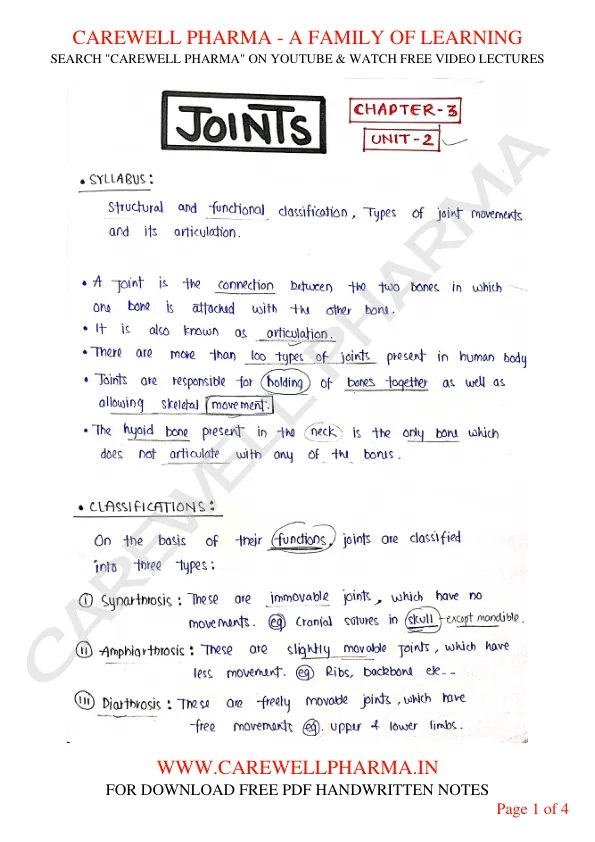
- A Joint is the connection between the two bones in which one bone is attached with the other bone.
- It is also known as articulation.
- There are more than 100 types of joints present in human body.
- Joints are responsible for holding of bones together as well as allowing skeletal movement.
- The hyoid bone present in the neck is the only bone which does not articulate with any of the bones.
CLASSIFICATIONS
On the basis of their functions, joints are classified into three types:
- Synarthrosis: These are immovable joints, which have no movements. Cranial sutures in skull except mandible.
- Amphiarthrosis: These are slightly movable Joints, which have less movement. eq. Ribs, backbone etc..
- Diarthrosis: These are freely movable joints, which have free movements eq. upper & lower limbs.
SYNOVIAL JOINTS
- In this joints, bones are connected with each other with the help of synovial fluids, which is filled inside those bones.
- It also helps in the movement of bones.
TYPES OF SYNOVIAL JOINTS:
- Ball and Socket Joint
- Saddle Joint
- Pivot Joint
- Condyloid Joint
- Hinge Joint
- Plane or Gliding Joint.

(i) Ball and Socket Joint : It is the freely movable joints in which one bone is fitted in to the socket of other bones.
- eg. Shoulder Joints, Hip Joints etc..

(ii) Saddle Joints : A saddle joint is a type of biaxial and movable joints which are similar as ball and socket joints.
- eg. Thumb bone Joint

(iii) Pivot Joint : It is a synovial joint which are movable, but plane movement in only one direction.
- In this joint, a cylindrical shaped bone rotates inside another ligament that forms a ring around the joint.
- eg. Joint of Neck (Left & Right) (between vertebrae) (Atlas & Axial)

(iv) Condyloid Joint : Also known as Ellipsoid Joint. In this the oval shaped surface of one bone fits into the oval shaped depression of another bone.
- Carpals joints (Joints b/w the metacarpals and phalanges).

(v) Hinge Joint : A hinge joint is the joint b/w the two bones that allow movement only in one plane.
- eg. Elbow, knee, Ankle, Interphalangeal joint of hand and foot.

(vi) Gliding Joints : These joints occurs between the surfaces of two flat bones that are held together by ligaments.
- eg wrists and ankles Joints (some bones in wrists and ankles glide against each others, but limited range of motion).

TYPES OF JOINT MOVEMENT
motion existing between two adjacent surfaces, one bone move on the surface of another bone.
- Gliding
- Angular which make angle during movement.
- flexion: bending of knee, lifting of arms
- Extension:- opposite of flexion.
- Abduction:- movement along the frontal plane. Spreading fingers.
- Adduction:- opposite of abduction.
- Rotation Bone turns along its own axis. eq. Joint of Shoulder & hip.
- Circumduction It is the movement in a Circular direction (i.e. $360^\circ$)
- eg. limbs & eyes
Chapter 1
Chapter 2
Chapter 3